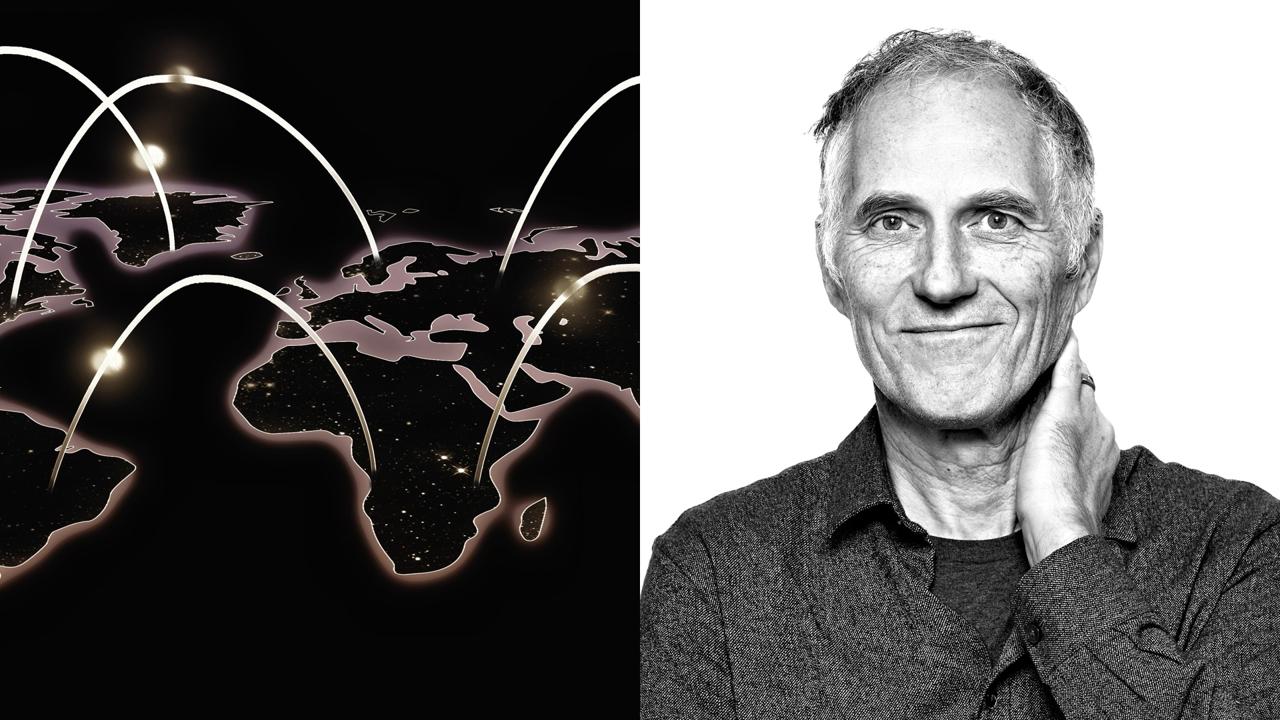
Tim O'Reilly
Birth of the Global Mind
Recorded live on Sep 5, 02012
at Cowell Theater in Fort Mason Center
The global mind is us, augmented
As a student of the classics at Harvard in the 1970s, O’Reilly was impressed by a book titled The Discovery of the Mind: In Greek Philosophy and Literature , by Bruno Snell. In the four centuries between Homer and classical Athens, wrote Snell, the Greeks invented the modern human mind, with its sense of free will and agency. (In Homer, for example, no one makes a decision.) O’Reilly sees a parallel with the emerging of a global mind in this century.
Global consciousness was a recurrent idea in the 1970s---from Teilhard de Chardin’s noosphere and Omega point (“the Singularity of its day”) to “New Age mumbo-jumbo” such as the Harmonic Convergence. O’Reilly noted that the term “singularity” for technology acceleration was first used in 1958 by John von Neumann. In 1960 J.C.R. Licklider wrote an influential paper titled “Human-computer Symbiosis.” O’Reilly predicted that “exploring the possibility space of human-computer symbiosis is one of the fascinating frontiers of the next decades and possibly century.”
Echoing Dale Dougherty, he says the Web has become the leading platform for harnessing collective intelligence. Wikipedia is a virtual city. Connected smart phones have become our “outboard brain.” Through device automation, Apple has imbued retail clerks with superpowers in its stores. Watson, the AI that beat human champions at “Jeopardy,” is now being deployed to advise doctors in real time, having read ALL the scientific papers. YouTube has mastered the attention economy. Humanity has a shared memory in the cloud. Data scientists rule.
The global mind is not an artificial intelligence. It’s us, connected and augmented.
What keeps driving it is the generosity and joy we take in creating and sharing. The global mind is built on the gift culture of every medium of connectedness since the invention of language. You gain status by what you give away, by the value you create, not the value you take.
watch
primer
Tim O’Reilly is a prolific maker of sense. For countless hackers and programmers the world over, his publishing company’s books have helped make sense of programming languages and web technologies. And more broadly, many of the applications and services built by those hackers have, in the last decade, brought about an unprecedented expansion of our very senses. A web user of today can possess awareness of people and events at a distance, to a depth, and with a quickness that was scarcely imaginable when O’Reilly Media was founded in 1978.
Our increasing ambient awareness of the inner and outer states of people all over the globe is the result of an important shift in the way web content is created. Viewing the web as a platform on which users can participate rather than simply consume was called Web 2.0, and O’Reilly was quick to support the skills, ideas and techniques that would enable web developers to embrace this perspective. Steven Levy hinted at why in 02005:
As it turns out, the levers and pulleys of this new Net neatly reflect the operating principles of the man who helped define it: a philosophy of participation and sharing and a sense that collective action will inevitably accrue to the greater good. The crucial technologies that make this happen – the digital infrastructure that makes the online world a perpetual swap meet of goods and ideas – are the culmination of all the stuff he’s been tracking, supporting, and popularizing for the past 20 years.
O’Reilly’s focus on the web as an enabling mechanism for social awareness and empowerment (and perhaps ultimately, a “Global Mind”) looks far into the future, but is also grounded in his interest in writings and thinking done thousands of years in the past. As an undergraduate, he studied Classics and retains an affinity for the lessons he learned from Socrates, Plutarch and others. In an interview about these lessons, O’Reilly credits them with helping him to spot the trends that have led to his success in business. But more than just spotting trends, he has described and refined them, molding glimmers of ideas into causes and campaigns taken up by large swaths of the digital world. This, too, he credits to his classical education:
In telling the same story over and over again in different ways, I’m following in the footsteps of the Greek orator (alas, I forget his name) who said “The difference between a man and a sheep is that a sheep just bleats, but a man keeps saying the same thing in different ways until he gets what he wants.”) Look at a series of essays like Hardware, Software, and Infoware, The Open Source Paradigm Shift, and What is Web 2.0? and you’ll see me pursuing the same ideas, refining, clarifying, and advocating till I get what I want.
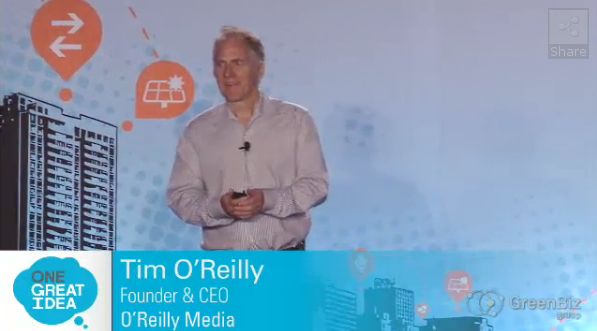
O’Reilly has taken to calling the trend he’s been mulling over most recently – this interweaving collective oneness of our brains and programs – the Global Mind.
Like open source software and “Web 2.0”, the idea has been around since before Tim O’Reilly started discussing and promoting it. But as before, perhaps in his hands – after a few revisions, a few conversations, or a few lectures – the idea of the Global Mind will take the shape of something that can be evaluated, acted upon, and maybe even rallied around.
bio
Tim O’Reilly has a history of convening conversations that reshape the computer industry. He's played a key role in framing and evangelizing terms such as “open source software” “web 2.0” “the Maker movement” and “government as a platform”. He is the founder, CEO, and Chairman of O’Reilly Media, and a partner at early stage venture firm O’Reilly AlphaTech Ventures (OATV). He is also on the boards of Code for America, PeerJ, Civis Analytics, and PopVox. His book, WTF: What’s the Future and Why It’s Up to Us, explores what technology advances teach us about the future economy and government as its “platform.” He is a Visiting Professor of Practice at University College London’s Institute for Innovation and Public Purpose, where he is researching a new approach to regulating big technology platforms by limiting their ability to extract economic rents.
Join our newsletter for the latest in long-term thinking
Subscribe