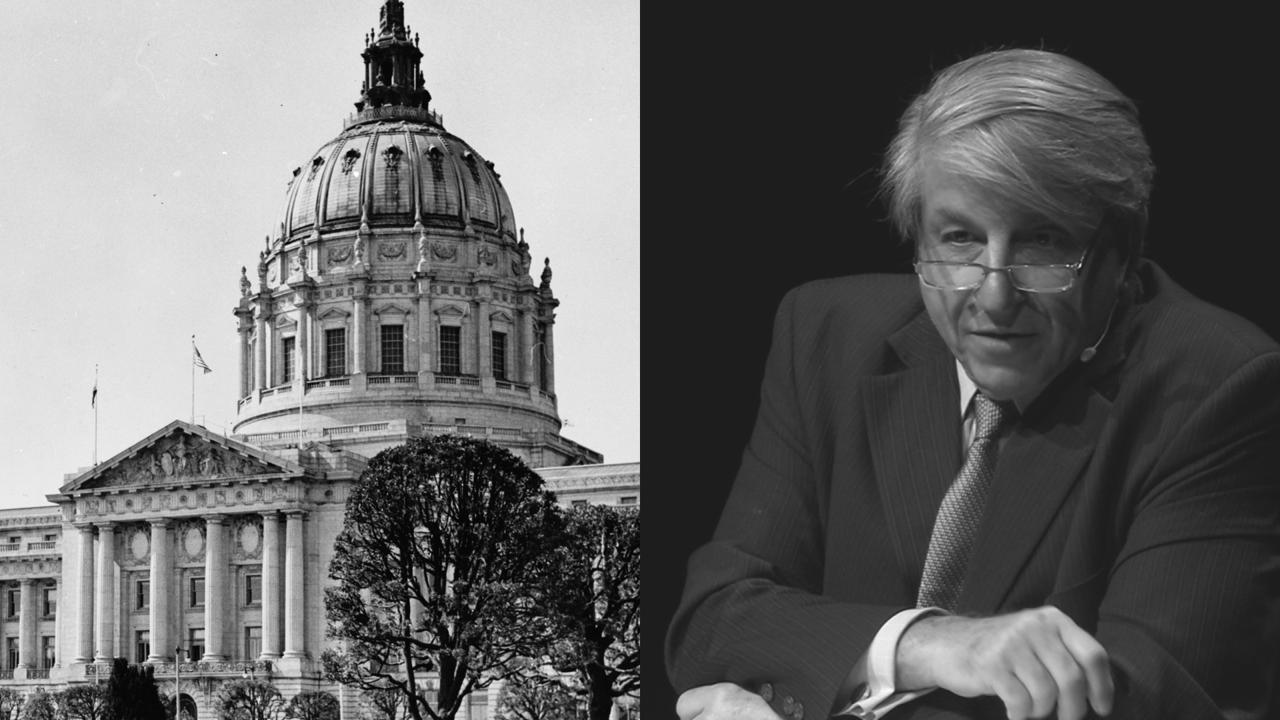
Benjamin Barber
If Mayors Ruled the World
Recorded live on Jun 5, 02012
at Cowell Theater in Fort Mason Center
City-based global governance
Sovereign nation states have conspicuously failed to cooperate well enough to deal with increasingly global problems such as climate change, environmental degradation, and organized crime, Barber said. Nations focus on their borders, which are seen as competitive zero-sum games. “But if we shift our gaze, in thinking about global governance, from nation states to cities, things suddenly become possible that seemed impossible. Cities are apart from one another, separated by wide spaces. Their relationships are based on communication, trade, transportation, and culture. They are relational, not in a zero-sum game with one another.”
Cities are inherently pragmatic rather than ideological. “They collect garbage and collect art rather than collecting votes or collecting allies. They put up buildings and run buses rather than putting up flags and running political parties. They secure the flow of water rather than the flow of arms. They foster education and culture in place of national defense and patriotism. They promote collaboration, not exceptionalism.”
An honoring of all that practicality is shown by polling results of confidence in various levels of government. Only 18 percent of Americans have confidence in the US Congress (“the lowest in a long time”). The Presidency gets 44 percent. Americans have 65 percent confidence in their mayors. They can see clearly that city governments are less distorted by party politics, less responsive to massive lobbying. They see mayors getting things done.
New York City’s “hyperactive” mayor Michael Bloomberg says, “I don’t listen to Washington very much. The difference between my level of government and other levels of government is that action takes place at the city level. While national government at this time is just unable to do anything, the mayors of this country have to deal with the real world.” After 9/11, New York’s police chief sent his best people to Homeland Security to learn about dealing with terrorism threats. After 18 months they reported, “We’re learning nothing in Washington.” They were sent then to twelve other cities---Singapore, Hong Kong, Paris, Frankfurt, Rio---and built their own highly effective intelligence network city to city, not through Washington or Interpol.
Last year following the meeting in Mexico City on climate, where little progress was made by the national delegations, representatives from 207 cities signed a Global Cities Climate Pact pledging to pursue “strategies and actions aimed at reducing greenhouse gas emissions.” The cities did what the nations could not. There are many existing bodies of robust cooperation among cities---the International Union of Local Authorities, the World Association of Major Metropolises, the American League of Cities, the Local Governments for Sustainability, the C40 Cities Climate Leadership Group, the United Cities and Local Governments at the UN, the New Hanseatic League, the Megacities Foundation---200 such networking organizations. “They are dull sounding, but they are fashioning global processes that work.”
Global governance needs no great edifice with unitary rulers. It can be voluntary, informal, bottom-up. Barber recommends forming a global parliament of cities, because nation states will not govern globally. Cities can. They already are.
watch
primer
As the world congeals towards a single, globally interdependent economic and political system, being engaged as an individual can feel less and less meaningful. We’re told to “think globally, act locally,” but it can be very hard to imagine how one’s local actions have a global effect; and though we often say the world seems to be shrinking thanks to improvement in transportation and communications, being more aware of the rest of the world can also make it seem much larger, stranger, and beyond our control.
Benjamin Barber has spent a long career exploring how civil society – the public activities and efforts of citizens outside government – can and must sustain democracy in the face of this growing complexity. Though he’s generally known as a political scientist or a political theorist, Barber is less interested in politics than he is in governance and civics – the actual work of running a society.
In a 1992 article for The Atlantic, he sought to describe the principle forces threatening the spread of democracy (in his eyes, corporate capitalism and religious fundamentalism), later expanding the piece. Jihad vs. McWorld would become his most popular book partly because of its eerie prescience: it was published 6 years before religious fundamentalists attacked and destroyed the World Trade Center.
In his forthcoming book, If Mayors Ruled the World, Barber suggests that cities, one of our oldest forms of governance, offer a path forward into the new and unmapped terrain of a singular global system in need of human-scale feedback. Responsive and local while at the same time cosmopolitan and connected, cities may be even more effective than the relatively young nation-state at governing our world.
While sovereign nations often stress their independence, cities have more readily embraced interdependence. In support of those efforts, Barber helped start the non-profit CivWorld, a group that sponsors an annual Interdependence Day and, along with parent organization Demos, “advances new ideas to cope with a changing world that is faced with accelerating globalization, starker inequities between nations, growing human migration, and profound security and environmental threats.”
bio
Benjamin Barber is a Distinguished Senior Fellow at Demos (a think tank based in New York) and author of Strong Democracy and Jihad vs. McWorld.
Join our newsletter for the latest in long-term thinking
Subscribe