Seminars About Long-term Thinking


A Monthly Seminar Series, Hosted by Stewart Brand.   + About this Series  |  Subscribe to the Podcast


The Long Now Foundation's monthly Seminars were started in 02003 to build a compelling body of ideas about long-term thinking; to help nudge civilization toward our goal of making long-term thinking automatic and common instead of difficult and rare.

Elaine Pagels

“The Truth About the Book of Revelations”

+ Read Introduction

Revelations about the Book of Revelation

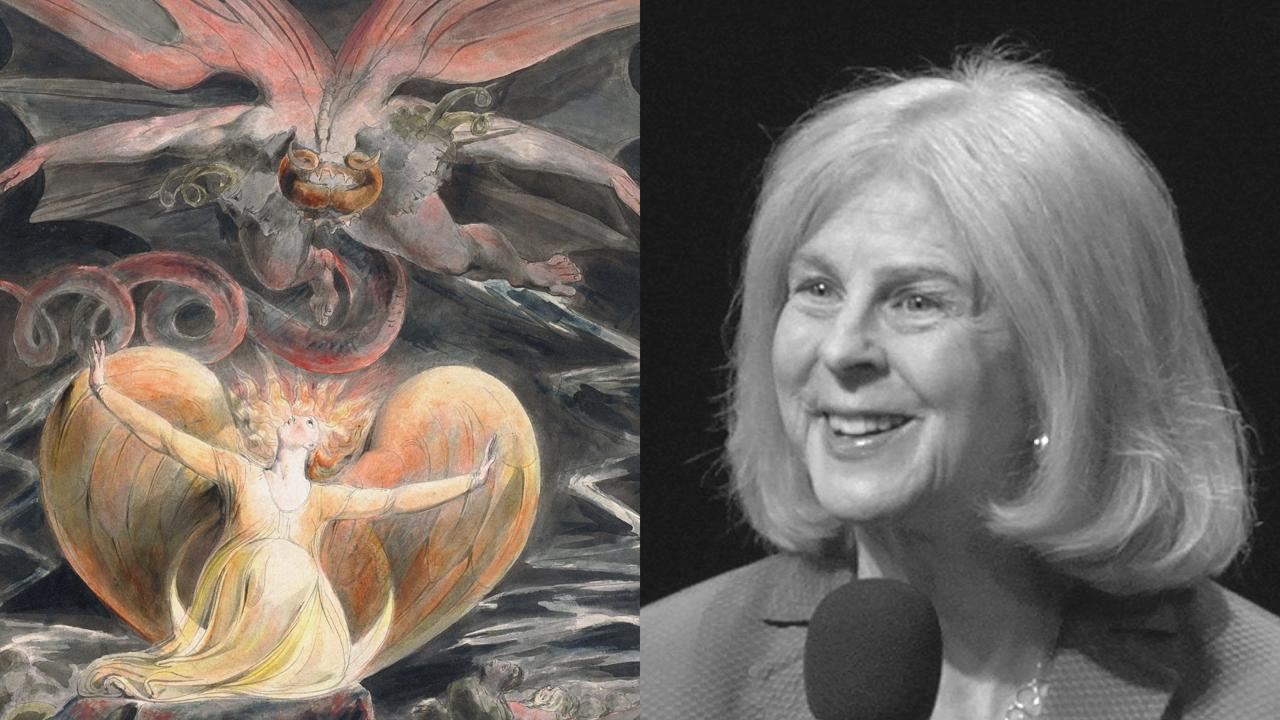
Probably the most consequential vision of the future ever written is the Bible’s Book of Revelation. If God didn’t write it (through the sainted instrument of someone named John), then who did, and why?

Elaine Pagels has a persuasive answer, spectacularly illustrated. The author of The Gnostic Gospels; Beyond Belief; and Revelations: Visions, Prophecy, and Politics in the Book of Revelation, Pagels analyzes other revelations of the time (they were common) and examines how John’s particular version of apocalypse made it into the world’s most popular book. John had his own agenda. It wasn’t Christian.

  • Share:

This talk was given at Cowell Theatre in Fort Mason Center in San Francisco, California on Monday August 20, 02012

Video is available to Members. Membership starts at $8/month.

Elaine Pagels

War in heaven

"The Book of Revelation is war literature," Pagels explained. John of Patmos was a war refugee, writing sixty years after the death of Jesus and twenty years after 60,000 Roman troops crushed the Jewish rebellion in Judea and destroyed Jerusalem.

In the nightmarish visions of John’s prophecy, Rome is Babylon, the embodiment of monstrous power and decadence. That power was expressed by Rome as religious. John would have seen in nearby Ephesus massive propaganda sculptures depicting the contemporary emperors as gods slaughtering female slaves identified as Rome’s subject nations. And so in the prophecy the ascending violence reaches a crescendo of war in heaven. Finally, summarized Pagels, "Jesus judges the whole world; and all who have worshipped other gods, committed murder, magic, or illicit sexual acts are thrown down to be tormented forever in a lake of fire, while God’s faithful are invited to enter a new city of Jerusalem that descends from heaven, where Christ and his people reign in triumph for 1000 years."

Just one among the dozens of revelations of the time (Ezra’s, Zostrianos’, Peter’s, a different John’s), the vision of John of Patmos became popular among the oppressed of Rome. Three centuries later, in 367CE, Bishop Athanasius of Alexandria confirmed it as the concluding book in the Christian canon that became the New Testament.

As a tale of conflict where one side is wholly righteous and the other wholly evil, the Book of Revelation keeps being evoked century after century. Martin Luther declared the Pope to be the Whore of Babylon. Both sides of the American Civil War declared the opposing cause to be Bestial, though the North had the better music---"He hath loosed the fateful lightning of His terrible swift sword." African-American slaves echoed John’s lament: "How long before you judge and avenge our blood on the inhabitants of the earth?"

But like many Christians through the years, Pagels wishes that John’s divisive vision had not become part of the Biblical canon. Among the better choices from that time, she quoted from the so-called "Secret Revelation of John": "Jesus says to John, ‘The souls of everyone will live in the pure light, because if you did not have God’s spirit, you could not even stand up.’

"The other revelations are universal, instead of being about the saved versus the damned."

-- by Stewart Brand
MP3 Audio
MP4 Video (for Long Now Members)

Additional downloads are available to Long Now Members.
Sign in  or  Become a Member

This Seminar also appears on our Seminar Audio Podcast.
Subscribe to receive new Seminar downloads as soon as they are available.

Sign in or Become a Member to participate.

• 10 months ago

I'm surprised, not necessarily pleasantly, by the theme of this seminar. While Dr. Pagels' talk will doubtless be of theological interest, it is difficult for me to imagine how this subject fits with the broader missions of the series ("to build a compelling body of ideas about long-term thinking…").

As secular person, I question the value of this subject. From what I know of other members, I suspect I'm not alone. It certainly falls outside the seminar themes that attracted me to Long Now in the first place.

I learned from a web search that Mr. Brand and Dr. Pagels were both members of the spiritually focused Lindisfarne Association, though I do not know whether they were contemporaries; I wonder whether that played a role in her selection. I hope that the choice of Dr. Pagels as a speaker does not reflect a change in emphasis that will influence the subjects of future seminars in a similar direction.

As a skeptic, however, I'm also willing to reserve judgment. Perhaps I'll learn something; perhaps I will be surprised pleasantly. I'll be looking forward to Mr. Brand's introduction of Dr. Pagels, and to hearing his thoughts about the connections between this topic and the broader SALT series.

• 9 months ago

What was the name of the text that was an early Christian version of meditative thinking, or something along those lines?

• 9 months ago

Is there going to be a podcast for this seminar???? I couldn't make it in person!! DEVASTATED!! Almost left my wife and children to fend for themselves so that I could see *this* show (almost, but didn't).. When will I be able to listen to the Podcast??

Also available through

with enhanced features

Upcoming Seminars

  • Tuesday June 18
  • Ed Lu
  • “Anthropocene Astronomy: Thwarting Dangerous Asteroids Begins with Finding the Damn Things”
  • Monday July 29
  • Craig Childs
  • “Apocalyptic Planet: Field Guide to the Everending Earth”

Seminar Podcast

Audio podcasts are free and updated monthly.

Live Audio Streaming

Members from all over the world can join in on live events.

Seminar Email Updates

Subscribe to our Seminar mailing list for updates and summaries.

Event Calendar

Download and open with your iCal-compatible calendar app.


Previous Seminars

02013 Catalog

  • George Dyson
  • “No Time Is There--- The Digital Universe and Why Things Appear To Be Speeding Up”

02012 Catalog

  • Peter Warshall
  • “Enchanted by the Sun: The CoEvolution of Light, Life, and Color on Earth”
  • Cory Doctorow
  • “The Coming Century of War Against Your Computer”
  • Mark Lynas
  • “The Nine Planetary Boundaries: Finessing the Anthropocene”
  • Jim Richardson
  • “Heirlooms: Saving Humanity's 10,000-year Legacy of Food”

02011 Catalog

  • Geoffrey B. West
  • “Why Cities Keep on Growing, Corporations Always Die, and Life Gets Faster”

02010 Catalog

  • Ed Moses
  • “Clean Fusion Power This Decade”
  • David Eagleman
  • “Six Easy Steps to Avert the Collapse of Civilization”
  • Wade Davis
  • “The Wayfinders: Why Ancient Wisdom Matters in the Modern World”

02009 Catalog

  • Paul Romer
  • “A Theory of History, with an Application”
  • Daniel Everett
  • “Endangered languages, lost knowledge and the future”

02008 Catalog

  • Paul Ehrlich
  • “The Dominant Animal: Human Evolution and the Environment”
  • Craig Venter
  • “Joining 3.5 Billion Years of Microbial Invention”
  • Paul Saffo
  • “Embracing Uncertainty: the secret to effective forecasting”

02007 Catalog

  • Alex Wright
  • “Glut: Mastering Information Though the Ages”
  • Brian Fagan
  • “We Are Not the First to Suffer Through Climate Change”
  • Vernor Vinge
  • “What If the Singularity Does NOT Happen?”
  • Philip Tetlock
  • “Why Foxes Are Better Forecasters Than Hedgehogs”

02006 Catalog

  • Philip Rosedale
  • “'Second Life:' What Do We Learn If We Digitize EVERYTHING?”
  • Orville Schell
  • “China Thinks Long-term, But Can It Relearn to Act Long-term?”
  • John Rendon
  • “Long-term Policy to Make the War on Terror Short”
  • Jimmy Wales
  • “Vision: Wikipedia and the Future of Free Culture”
  • Kevin Kelly
  • “The Next 100 Years of Science: Long-term Trends in the Scientific Method.”

02005 Catalog

  • Sam Harris
  • “The View from the End of the World”
  • Clay Shirky
  • “Making Digital Durable: What Time Does to Categories”
  • Robert Fuller
  • “Patient Revolution: Human Rights Past and Future”
  • Roger Kennedy
  • “The Political History of North America from 25,000 BC to 12,000 AD”
  • James Carse
  • “Religious War In Light of the Infinite Game”

02004 Catalog

  • Jill Tarter
  • “The Search for Extra-terrestrial Intelligence: Necessarily a Long-term Strategy”
  • Daniel Janzen
  • “Third World Conservation: It's ALL Gardening”
  • George Dyson
  • “There's Plenty of Room at the Top: Long-term Thinking About Large-scale Computing”

02003 Catalog