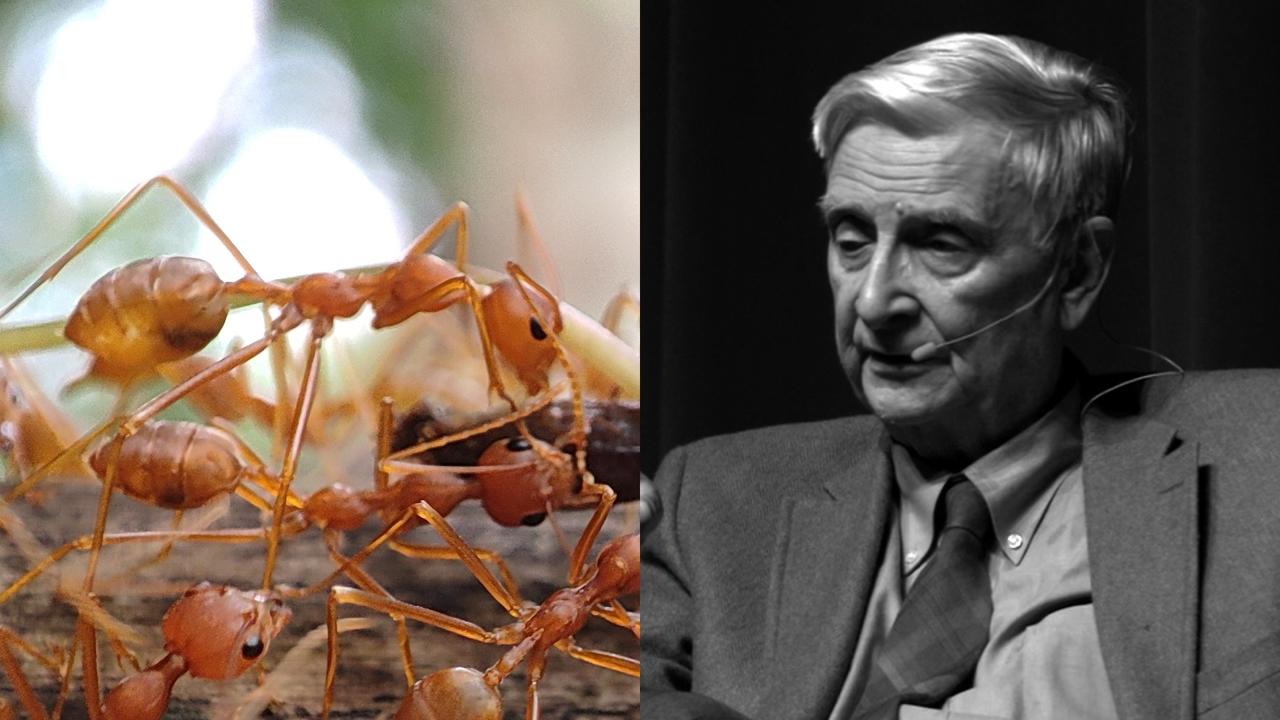
Edward O. Wilson
The Social Conquest of Earth
Recorded live on Apr 20, 02012
at Palace of Fine Arts Theatre
The real creation story
“History makes no sense without prehistory,“ Wilson declared, “and prehistory makes no sense without biology.” He began by noting that every religion has a different creation story, all of them necessarily based on ignorance of what really happened in the past. Religions thus can’t give valid answers on the meaning of life---Gauguin’s questions: “Where do we come from? What are we? Where are we going?” Philosophy gave up on the questions long ago. The task was left to science, and from science a valid, shareable creation story is now emerging.
For the last 65 million years Earth has been dominated by eusocial animals. Ants, termites, and bees in some areas make up half of all biomass. Yet only a few of the million known insect species made the jump to eusociality. One variety of mammal, a tiny set of primates, made a similar jump. Once they began to use their eusocial skills to fan out from Africa 60 thousand years ago, they gradually became far more dominant even than the social insects. “The term ‘eusocial,’“ Wilson said, “means a society based in part on a division of labor, in which individuals act altruistically, that covers two or more generations, and that cares for young cooperatively.”
That eusociality is so rare suggests how difficult it is for altruistic traits to evolve. The powerful evolutionary force to make individuals that successfully reproduce has to be overcome by some form of selective pressure which generates altruistic individuals who yield their interests to the interests of the group. How does that occur? Examining near-eusocial species like African wild dogs and snapping shrimp along with primitively eusocial species like sweat bees shows that a crucial step appears to be made when multiple generations linger to defend a constructed nest with valuable access to food. That step can be made with a simple change to a single behavioral gene, silencing the trait for normal dispersal of young to carry out their own independent reproduction. When the young linger to defend the nest and begin to provide for the next generation of young, eusociality begins.
All eusocial species appear to have arisen from multi-generational nest defense. Two million years ago our ancestors began using fire for campsites and cooking. At the same time hominid brain size began expanding dramatically. Social traits emerged that have characterized humanity ever since. We love joining groups, and we became geniuses at reading the intentions of each other, a skill we fine-tune incessantly with our enjoyment of gossip. In another distinctively human trait, like ants, we became highly adept at collaborative warfare.
Wilson had long been a proponent of William Hamilton’s theory of “kin selection” as an explanation for how altruistic traits could evolve. But as a naturalist he found it did not explain phenomena that he and others were discovering in eusocial species, and he began to favor “group selection” instead---a process where the “target” of evolution was sacrificially collaborative traits, because highly cooperative groups beat poorly cooperative groups, and the “units” of evolution (genes) adjusted accordingly. It is successful groups, more than successful families, that are being selected for. In 2010 Wilson, along with mathematician Martin Nowak and Corina Tarnita formally challenged kin selection with a peer-reviewed paper in Nature. There was, as Wilson put it, “considerable blowback” from kin selection theorists and supporters.
Wilson’s alternative he calls “multi-level selection,” where individual selection and group selection proceed together (with kin selection a continuing bit player). In our eusocial species, that mix of traits makes us “permanently unstable, permanently conflicted” between selfish impulses and cooperative impulses. We negotiate these conflicts endlessly within ourselves and with each other. Wilson sees inherent adaptive value in that constant negotiation. Our vibrant cultural life may be driven in part by it.
In response to a question about what the next stages of human eusociality might be, Wilson said he hoped for a fading of interest in end-state ideologies and end-time religious creation stories because they so fervently deny negotiation.
watch
primer
Edward O. Wilson started small. As a young man interested in biology, the lowly ant was his passion. Ubiquitous, diverse, and socially complex, however, ants provided Wilson with data and inspiration that would eventually grow into sweeping theories of evolution, behavior and culture. Those theories have been both fiercely defended as foundational scientific dogma and vehemently rejected as dangerous heresy – against each other in some cases.
One of the larger questions Wilson’s work with ants would eventually address was how to reconcile altruism with selection of the fittest. Why do we observe animals sacrificing their own procreational success for others? Darwin himself proposed an answer – that there is an adaptive advantage in assisting those, such as siblings, who are closely related to ourselves. But it wasn’t until the 20th century that Kin Selection, due partially to Wilson’s work, become the textbook answer.
Wilson’s belief that aspects of social behavior could be explained with evolutionary logic led to his 1975 book called Sociobiology: The New Synthesis. That the deep past of an organism’s evolution could shape behaviors in the present wasn’t a brand new idea, but seeking to explore it in depth, Wilson included the highly social homo sapiens in the book’s last chapter. Humanity’s cooperation and empathy was understood by many at the time as a cultural invention that worked in spite of the selfish nature implied by the “survival of the fittest.” Dutch primatologist Frans de Waal would later call this Veneer Theory. But as Kin Selection and sociobiology were beginning to illustrate, altruism could be observed in the animal world and could be traced to a much deeper origin: biological evolution. While this might seem like a good thing – that humans won’t automatically revert to savagery in the absence of modern culture – it set off alarm bells to those who heard it to mean that human behavior is determined by biology.
Wilson would later describe the broader goal of Sociobiology’s last chapter in a book called Consilience: The Unity of Knowledge. Rather than ever implying that human behavior is entirely programmed by DNA, Wilson sought to establish a framework for beginning to unite the findings of the humanities and the social sciences with those of evolutionary biology and the natural sciences. In Consilience he explained that human culture isn’t determined by DNA, but that in some ways it is constrained by it. With that in mind, he advocated for interdisciplinary research that would begin to identify what influence DNA has on behavior, and what other influences must be taken into account.
 Spanning the better part of half a century, Wilson’s career has been a long and a fruitful one. But Wilson isn’t interested in taking any of it for granted. He has, in fact, very recently mounted one of the most significant attacks on Kin Selection since he helped put it on the map in the first place. By focusing on eusocial species such as ants, bees and humans, Wilson is proposing that Group Selection, a less popular and long ignored theory, better describes the cooperation we see in ourselves and the animal kingdom.
His most recent book, The Social Conquest of Earth, explains why he’s changed his mind and what this new paradigm means for our understanding of human nature.
bio
E. O. Wilson has received 81 awards in science, conservation, and the humanities. Currently a Harvard professor emeritus and honorary curator of entomology at the Museum of Comparative Zoology, he has authored The Social Conquest of Earth ; Pheidole in the New World ; The Future of Life ; Naturalist ; Consilience ; The Ants (with Ber Hölldobler); Biophilia ; On Human Nature ; Sociobiology ; and The Theory of Island Biogeography (with Robert H. MacArthur).
Join our newsletter for the latest in long-term thinking
Subscribe