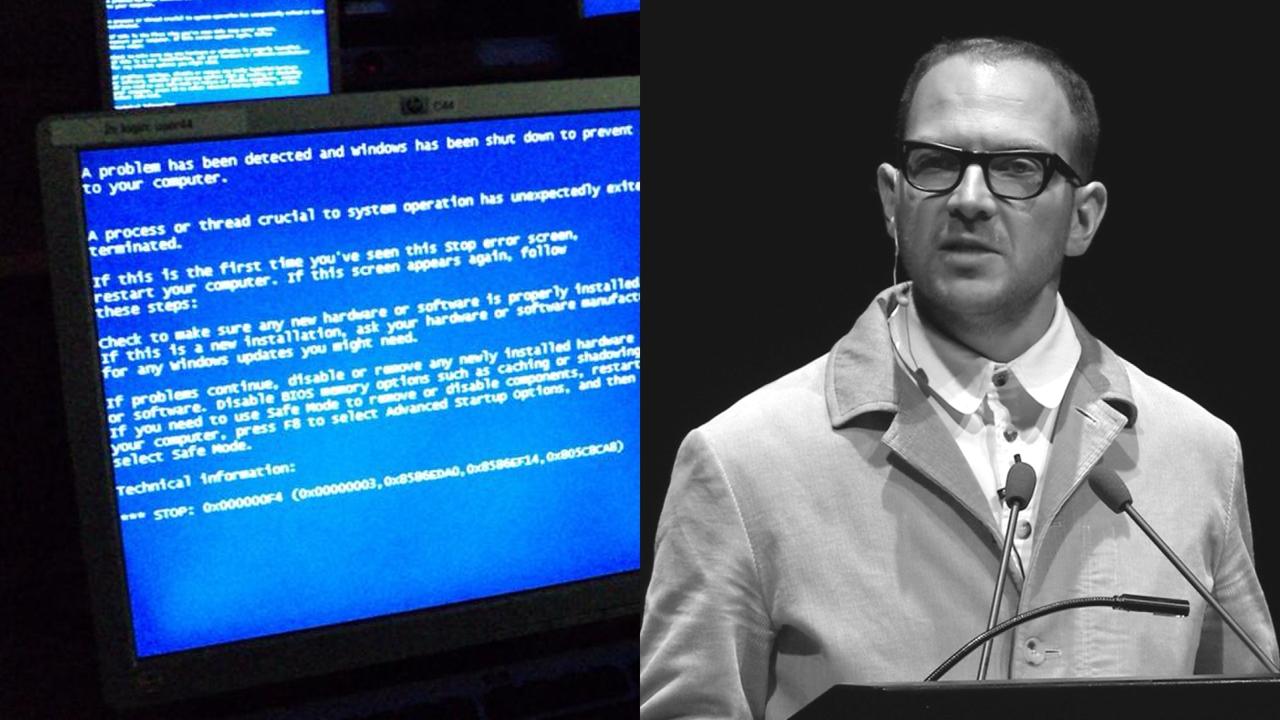
Cory Doctorow
The Coming Century of War Against Your Computer
Recorded live on Jul 31, 02012
at Novellus Theater at Yerba Buena Center
Who governs digital trust?
Doctorow framed the question this way: "Computers are everywhere. They are now something we put our whole bodies into---airplanes, cars---and something we put into our bodies---pacemakers, cochlear implants. They HAVE to be trustworthy."
Sometimes humans are not so trustworthy, and programs may override you: "I can’t let you do that, Dave." (Reference to the self-protective insane computer Hal in Kubrick’s film "2001." That time the human was more trustworthy than the computer.) Who decides who can override whom?
The core issues for Doctorow come down to Human Rights versus Property Rights, Lockdown versus Certainty, and Owners versus mere Users.
Apple computers such as the iPhone are locked down---it lets you run only what Apple trusts. Android phones let you run only what you trust. Doctorow has changed his mind in favor of a foundational computer device called the "Trusted Platform Module" (TPM) which provides secure crypto, remote attestation, and sealed storage. He sees it as a crucial "nub of secure certainty" in your machine---but only to the extent that it is implemented to allow owners to choose what they trust---not vendors or governments.
If it’s your machine, you rule it. It‘s a Human Right: your computer should not be overridable. And a Property Right: "you own what you buy, even if it what you do with it pisses off the vendor." That’s clear when the Owner and the User are the same person. What about when they’re not?
There are systems where there is a credible argument for the authorities to rule---airplanes, nuclear reactors, probably self-driving cars ("as a species we are terrible drivers.")---but at least in the case of cars, and possibly in the other two, it will not make us safer; it will make us less safe. The firmware in those machines should be inviolable by users and outside attackers. But the power of Owners over Users can be deeply troubling, such as in matters of surveillance. There are powers that want full data on what Users are up to---governments, companies, schools, parents. Behind your company computer is the IT department and the people they report to. They want to know all about your email and your web activities, and there is reason for that. But we need to contemplate the "total and terrifying power of Owners over Users."
Recognizing that we are necessarily transitory Users of many systems, such as everything involving Cloud computing or storage, Doctorow favors keeping your own box with its own processors and storage. He strongly favors the democratization and wide distribution of expertise. As a Fellow of the Electronic Frontier Foundation (who co-sponsored the talk) he supports public defense of freedom in every sort of digital rights issue.
"The potential for abuse in the computer world is large," Doctorow concluded. "It will keep getting larger."
watch
primer
If geek culture had a class president, Cory Doctorow would be frontrunner for the position. He writes for BoingBoing, uses Ubuntu, played a hero in XKCD, published several rebellious young-adult sci-fi novels (under CC licenses, no less), and has worked on two continents fighting for the rights of internet users. He’s spent the better part of the last couple decades encouraging content-producers to embrace the new models of distribution made possible by the internet and fought them tooth and nail when they seek to hold it back.
His outspokenness doesn’t come from a single statement like “information wants to be free.” Doctorow argues in a recent essay called Lockdown that enforcing Copyright law in the digital era is about more than protecting the rights of intellectual property holders; it has rather become a kind of trojan horse for the surveillance industrial complex and threatens to severely curtail the individual autonomy of the world’s citizens. Computers are infusing everything, he explains. They increasingly extend our embodiment and cognition and can thus be enabling and liberating. Computing’s inherent flexibility therefore offers a form of freedom; commercial or governmental interests that seek to control computing for their own needs or simply out of a fear of the new way must be resisted in order to protect that freedom.

The hacker resistance is a central theme in Doctorow’s fiction. Little Brother and its upcoming sequel, Homeland, focus on teenagers in a near-future world who, as savvy tech users, confront the increasingly intrusive surveillance of a paranoid government. For the Win explores what the world of online gaming can offer to the understanding of resistance movement recruiting and organization. He also recently collaborated with Charles Stross on a book called The Rapture of the Nerds, comically and satirically exploring the idea of the technological singularity.
Cory Doctorow lucidly and pragmatically voices geek culture’s highest hopes and biggest fears. In a recent column in The Guardian or this interview with Technology and Activism, for instance, he describes both the need to organize against those who would curtail digital rights and the increasing ease with which it can be done through web technology. His work supports the need for a critical and activist approach to technological development, symbolically and creatively through his fiction, but also substantively and measurably through his scholarship, his journalism, and his work with the Electronic Frontier Foundation.
Cory Doctorow describes the threats our technological rights will face – and how we can protect them.
bio
Co-editor of the blog "Boing Boing," Cory Doctorow writes science fiction---Little Brother ; Makers ; For the Win ; and Rapture of the Nerds (coming in September, co-authored with Charles Stross). He is a technology activist.
Join our newsletter for the latest in long-term thinking
Subscribe