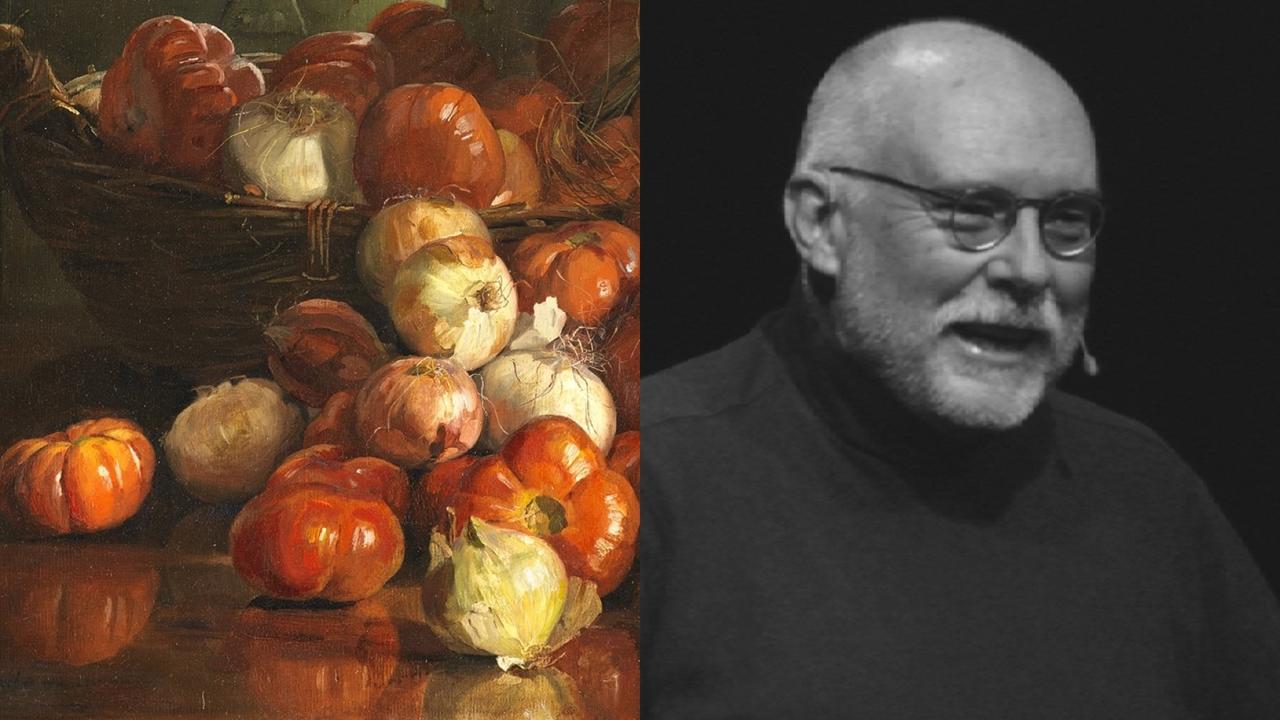
Jim Richardson
Heirlooms
Recorded live on Feb 22, 02012
at Cowell Theater in Fort Mason Center
Save Agricultural Biodiversity
Humanity’s agricultural legacy is on a par with any of our great cultural legacies, Richardson said, but preserving it is not just a matter of honoring the history and richness of our most fundamental civilization-enabling technology. For the health of future crops and livestock we need the deep genetic reservoir of all those millennia of sophisticated breeding. A million people died in the Irish Potato Famine because the whole nation depended on just two varieties of potato. In Peru, where potatoes originally came from, Richardson visited a field at 14,000 feet where 400 varieties of potato (with names like “Ashes of the Soul” and “Puma Paw”) are grown in just two acres. The local 1,300 varieties of potato are managed by a “Guardian of the Potatoes,” whose job it is in the community to know the story and uses of all the potatoes.
The accumulated wisdom in the crops and livestock is profound. We’ve been breeding cattle for 10,000 years, goats for 9,000 years, dogs for 12,000 years, chickens for 8,000 years, llamas for 6,500 years, horses for 6,000 years, camels for 4,000 years. All those millennia we have been in deep partnership with the animals. All of our staple foods are ancient. Wheat has been bred for 11,000 years, corn for 8,000 years, rice for 8,000 years, potatoes for 7,000 years, soybeans for 5,000 years
“For 9,900 years,” Richardson said, “we’ve been building up variety in domesticated crops and livestock---this whole wealth of specific solutions to specific problems. For the last 100 years we’ve been throwing it away.” 95% is gone. In the US in 1903 there were 497 varieties of lettuce; by 1983 there were only 36 varieties. (Also changed from 1903 to 1983: sweet corn from 307 varieties to 13; peas from 408 to 25; tomatoes from 408 to 79; cabbage from 544 to 28.) Seed banks have been one way to slow the rate of loss. The famous seed vault at Svalbard serves as backup for the some 1,300 seed banks around the world. The great limitation is that seeds don’t remain viable for long. They have to be grown out every 7 to 20 years, and the new seeds returned to storage.
Even with living heirlooms, the rule is Use It Or Lose It. Devotees of exotic cattle say “You have to eat them to save them.” With dramatic photos Richardson compared the livestock shows in Wales with the livestock markets in Ethiopia. You see children adoring the young animals and breeders obsessing on details of excellence and uniqueness. “One guy says, ‘You see that sheep with the heart-shaped spot on his left shoulder? I’ll bet you I can move it to his rump in four generations.’” There’s a sheep called the North Ronaldsay that is bred to live solely on seaweed on the coast. Ethiopia has some specialists, like the Sheko cattle that are resistant to tsetse flies, but unlike in Europe, most of their breeds have to be generalists capable of providing meat, milk, labor (such pulling plows), and warmth in the winter.
Helping preserve agricultural biodiversity is open to anyone. The Seed Savers Exchange in Decorah, Iowa, has 13,000 members. Their catalog is a cornucopia of heirloom garden delights, and members learn how to produce and store their own seeds and then share them. “It’s a wonderful example of citizens participating in the process.” And we can always acquire a new taste for old foods. Teff! Quinoa! Amaranth! Randall Lineback cows! You have to eat them to save them.
PS: Jim Richardson’s beautiful heirloom photos and article may be found here.
watch
bio
Photojournalist Jim Richardson has been covering the agricultural beat for National Geographic since 1984.
Join our newsletter for the latest in long-term thinking
Subscribe