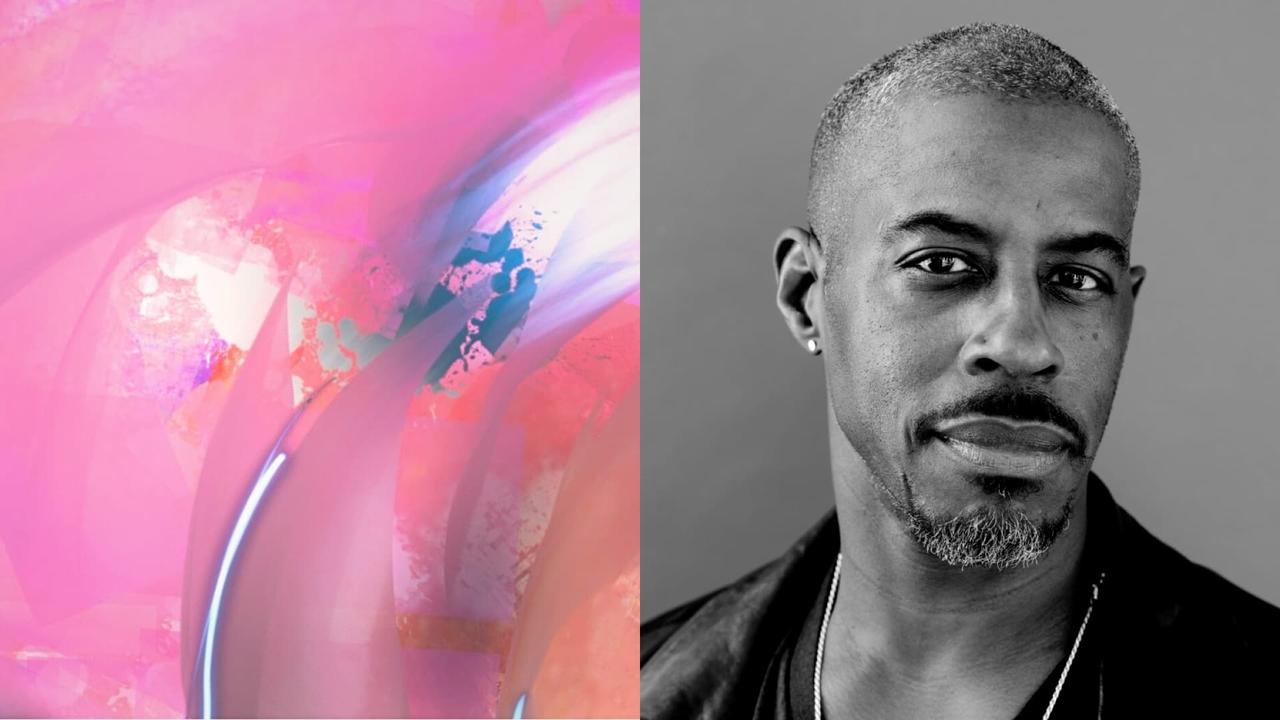
Ahmed Best
Feel The Future
Recorded live on Feb 14, 02025
at Herbst Theatre
When you feel the future, how do you share that feeling in order to build community?
Ahmed Best’s Long Now Talk was the first in the more-than-twenty-year history of Long Now Talks to be held on Valentine’s Day. It was also the first to feature a sing-a-long performance of Al Green’s 01970s soul music classic “Let’s Stay Together,” with the speaker accompanying the audience at San Francisco’s Herbst Theatre on a 7-piece drum kit. Finally, it was the first to feature a live theater performance from audience volunteers, depicting the past, present, and future through glances, gestures, and play.
Yet beyond these firsts, Ahmed Best’s Long Now Talk felt deeply rooted in the spirit of Long Now Talks. Over the course of Feel the Future, Ahmed’s Valentine’s Evening Long Now Talk, he lead the audience on a journey through creativity and imagination, drawing on his experiences as a cast member on the award-winning percussion performance Stomp, as Jar-Jar Binks, the ground-breaking first major CGI character actor in Star Wars: Episode I – The Phantom Menace, and as a lecturer at the Stanford d.school and one of the leaders of the AfroRithms Futures Group.
The core of Ahmed’s argument? Feeling is a form of communication in itself, beyond words — and only by taking action and sharing our feelings of the future with each other in our communities can we create the futures we want for ourselves. Using a diverse range of creative and imaginative tactics, Best incorporated play and motion in order to help us Feel The Future.
watch
primer
When we spoke to Ahmed Best in the lead up to his Long Now Talk, he asked us a question: “When you feel the future, how do you share that feeling in order to build community?”
Over the past quarter-century, Best — first as an actor, musician, and performer, and later as an Afrofuturist scholar and lecturer — has worked to answer that question. By bringing people together through electrifying performance and thought-provoking conversation, Best’s work has been able to make the future not just an abstract, intellectual consideration but something that can be felt in collective experience.
About Ahmed Best
While he first made his mark as a member of the cast of the award-winning percussion performance Stomp and as the first major CGI character actor in 01999 with his role as Jar Jar Binks in Star Wars: Episode I – The Phantom Menace, Best’s impact has stretched beyond just the world of film and theater. As a lecturer at the Stanford d.school and as one of the leaders of the AfroRithms Futures Group, Best has explored how to bring the ideas of Afrofuturism to life, using tools and methods as far-ranging as forecasting, collaborative design, and games. Drawing on his background as a dancer and musician, Best incorporates play and motion in order to help audiences grasp what Black futures may look like from a global perspective.
Why This Talk Matters Now
Our work as long-term thinkers cannot succeed without considering the kaleidoscopic diversity of potential futures that Afrofuturism showcases. Best’s work exemplifies that potential, rousing us out of our routines and finding new creative pathways to understand and imagine the future. In his own thinking, Best draws on a diverse range of authors, citing the work of James Baldwin alongside that of legal scholar Andrea Freeman and historical novelist Amitav Ghosh to sketch out the connections between our past, our planet, and our futures.
The Long View
Best hosts the Afrofuturist Podcast alongside Long Now Research Fellow Lonny J Avi Brooks. Brooks’ 02021 Long Now Talk When is Wakanda: Imagining Afrofutures explored the history of Afrofuturism, following its roots and different cultural manifestations and challenging dominant the narratives of futures and forecasting that have often excluded Black futurists and their insights. Best joined Brooks for the Q&A portion of his talk, contextualizing his role as Jar Jar Binks in the lineage of Afrofuturism and speaking on the need to change the “operating system” of society.
For his own Long Now Talk, Best will be joined on stage in conversation with Long Now Board Member Lisa Kay Solomon. As a Futurist in Residence at the Stanford d.school, Solomon teaches classes like “Inventing the future” and “View from the future” to help leaders and learners learn skills to anticipate and adapt to increasingly complex futures.
Where to Go Next
- Ahmed Best recently sat down with Long Now to discuss interstellar travel, creativity, and the connection between sand divination and smartphones.
- In 02024, Ahmed Best was profiled in the New York Times about his legacy as the first major CGI character actor and the impact Star Wars has had on his life.
- Watch Lonny J Avi Brooks’ Long Now Talk on Imagining Afrofutures, featuring Ahmed Best in the Q&A.
transcript
Rebecca Lendl:
Welcome to The Long Now Podcast — thank you for being with us. I’m Rebecca Lendl, Executive Director here at The Long Now Foundation.
We’re here with award-winning artist, educator, director, and afrofuturist scholar Ahmed Best. Our host is Long Now Board Member Lisa Kay Solomon, best selling author and Futurist in Residence at the Stanford d.school, a teacher and builder of more resilient futures.
Today’s talk is not only a practice in long term thinking, but also in long-term feeling. Ahmed’s work is a heart-centered, somatic experience — he cultivates our sense of agency, unlocks our imaginations, and lifts us up toward more hopeful possibilities. A true gift, especially in our present times.
If you’re interested in learning more about Ahmed, you’ll find a ton of great resources in our show notes.
Lisa Kay Solomon:
A long time ago in a galaxy far, far away... Well, actually, just a few decades ago in the South Bronx, a young boy sat in a movie theater watching his first film, Star Wars, never imagining he would one day make cinema history in that very galaxy far, far away. That young boy was Ahmed Best, and today I'm honored to introduce you to the revolutionary artist, educator and futurist that he is today. Born in New York and inspired by the cosmic horizons of Star Wars and Star Trek, Ahmed has transformed his childhood dreams of intergalactic adventures into a career dedicated to expanding our visions of the future. At just 23, Ahmed broke new ground as cinema's first CGI character, working closely with George Lucas to play the groundbreaking Jar Jar Binks in the Phantom Menace. Yes.
Pioneering the future of that historic performance was just the beginning of Ahmed's award-winning work that sits at the intersection of art, science and possibility. Ahmed is as comfortable mesmerizing audiences with his physicality in Broadway performances like Stomp as he is presenting at a SimBio conference on the future of bioengineering or playing Jedi Master Kelleran Beq in the more recent Mandalorian series. And let's not forget his epic performance voicing Darth Jar Jar in the latest edition of the Star Wars movie, Rebuild the Galaxy Lego Edition.
Ahmed doesn't just help you imagine and experience possible futures. He helps you see what's around you today differently and encourages you to jump in fully. I promise you you're going to see what I mean in just a few minutes. As Ahmed often says, just because no one has done it before doesn't mean it can't be done. Don't let others future all over you. One of my favorite memories is taking Ahmed to the Papua New Guinea garden on Stanford's campus. As we got close to one of the intricate carvings nestled in the woods, barely noticeable to the students walking by, Ahmed quickly exclaimed, "This is not just a sculpture, this is a drum. This is an amazing drum."
Well, you can imagine what happened next. He started playing and everyone started gathering around. That's just what he does. Ahmed's extraordinary talent is only outpaced by his generous, infectious, hopeful spirit and even bigger heart. It feels particularly fitting to be having him join us tonight on Valentine's Day at this special Long Now performance. In short, Ahmed doesn't just use the force. He is a force. Please join me in welcoming a true pioneer, a visionary, and my very dear friend, Ahmed Best.
Ahmed Best:
I'm so in love with you. Whatever you want to do is all right with me. Because you make me feel so brand new. And I want to spend my life with you. They said since. You all know this one. Come on, let me hear you. Since we've been-
Audience:
Together.
Ahmed Best:
Yeah. There you go. Come on. Loving you-
Audience:
Forever.
Ahmed Best:
Sing, you all. Is what I need. Yeah. Be the one you come running. I'll never be untrue. Come on, sing it louder. I can't hear you all, louder.
Audience:
Together.
Ahmed Best:
Together. I'll sing backgrounds for you. Loving you wherever, wherever. Sing, come on.
Audience:
(Singing).
Ahmed Best:
Come on. Let's sing together. Can't hear you all. Time's are good-
Audience:
(Singing).
Ahmed Best:
Sing, come on. Loving you wherever, wherever. Time's are-
Audience:
Good or bad or happy or sad.
Ahmed Best:
Yeah, happy or sad.
Audience:
(Singing).
Ahmed Best:
Good or bad, happy or sad.
Man, you all sound good. You all sound real good. You all feel that? You all feel that? You feel it? You feel it? You all feel that? When I was starting out as a young performer, a young musician, feel was always something that I was trying to achieve. I was always looking to make the drums feel good, make the music feel good, make the play feel good, make the movie feel good. And I recognized that feeling was a form of communication. Like I can talk to you about how I feel. I can talk to you about how I felt. I can give you a feeling even if I don't even have the words. And as I continued feeling as an artist and as an educator, and as a writer, and as a producer, and as an actor and as a director, I recognized that when we start talking about the future and we start imagining the future, we all have an idea of what the future feels like. And we generally keep that feeling to ourselves, right?
Feel the future is a call to action. It is what we do with those feelings and how we convey those feelings to our community to one another so we can feel the future together and we can do something about it. You see, we all have agency over the future. We all have agency over the future. We get to tell and we get to feel what the future gets to feel like, and no one gets to do that to us or for us. But how do we communicate those feelings in a way that is impactful? How do we get those feelings to each and every single person that we know, that we love, that we care about or maybe that we see to move them to feel the way we feel? There's a formula that you can follow to do that. And the formula goes like this.
You need the emotional engine plus Albert Einstein plus the king of monsters, Godzilla, and that's how you feel the future. The emotional engine plus Albert Einstein plus Godzilla. That's the formula.
Okay, so let's start with the emotional engine, right? So my first gig, I was in the show called Stomp in New York City. And Stomp was a found object percussion, body percussion show, but it was really about communication. We taught you how to speak Stomp, right? So if I went like this, you would go... Right. Exactly. And no matter what country I was in, I would do that and they would go... So even if I did something like this. Right? Now, we're speaking a language. Even if I went like this. I got you all. But what made that interesting was even when I did that, you laughed. You felt the humor in it, right? Why? How did you feel that humor?
And when I started writing and I started directing, I recognized something. I recognized that in every narrative, in every story I told, be it on stage or on screen, there was something deep and personal in every one of them that resonated within us. Deep and personal. And I started calling that the emotional engine. And I defined emotional engine as this, the driving emotional force that moves the person that we are following forward towards change. Now, there are a couple of words that I'm not going to say. I do not like the word protagonist. I don't like it. As an actor, I am an emotional athlete. I embody the story and the word protagonist takes me away from my body. It puts me in my head. And then I start thinking of ways to tell the story.
If I say following, following is an action. Following is something that I can do. Following is embodied. So the person that I want to follow is the person who's emotional engine I am connecting to. Right? The driving emotional force that moves the person we are following forward towards change. How do we find it? You pick your top five narratives. They can be books, they can be movies, they can be songs. But you pick your top five and your top five aren't the five that are the best that you've ever seen. No. It's like the five that every time it comes on, you're going to watch it. Like if Ghostbusters comes on, I'm watching Ghostbusters, right? I know every single word of that, every frame, I know who I'm going to call. I'm watching it, right? That's your top five. Anytime it comes on, you're watching it.
So what are my top five? We're going to find my emotional engine right now. My top five are Othello, Enter the Dragon, Blue, Lord of the Rings, and The Empire Strikes Back. Those are my top five. So what are those movies about? What are those plays about? What are those shows about? Othello. When a jealous officer convinces his general that his wife has slept with his trusted friend, the shame of being deceived and betrayed causes the general to kill his wife and himself. That is Othello. Enter The Dragon. When a martial arts expert is recruited by the Secret Service to infiltrate the private island of a criminal mastermind, he avenges the killer of his sister and reclaims the island for the Shaolin monks for whom it was stolen. You all didn't think enter the Dragon was that deep, right? Enter the Dragon is deep. You think it's just Bruce Lee saying wadda and kicking people in the neck. It's a lot. It's deep.
Blue. When a woman loses her husband and daughter in a car crash, she ends up discovering the affair her husband was having and ultimately finds her voice. Christoph Kieslowski, see all three colors. Blue is the best one. The Lord of the Rings. When an unlikely group comes together to destroy the ring of destiny, the journey ends up tearing them apart only to realize the quest was not only to save the world but each other. Lord of the Rings. The Empire Strikes Back. When a talented young warrior sets out to rid the galaxy of an evil empire, he discovers the villain he has vowed to kill is his own flesh and blood. You all can't tell me when Darth Vader was chilling in cloud city and he just chopped off Luke's hand and he's like, "Obi-Wan never told you who your father was." He's like, "He told me enough. He told me you killed him." "No, I am your father." And then Luke goes, "That's not true. That's impossible."
And then this is how you know Darth Vader was black. He goes, "Search your feelings, Luke. You know it be true." I swear to God he says it. Go back, watch it again. I was like, that is a black Darth Vader. True. What do those movies have in common? What is the driving emotional force that moves the person that we are following forward towards change? Loyalty. Every single one of those films and plays that moves the character forward towards change, the person that we're following towards change, they're moved forward through loyalty. There's always an obstacle to your emotional engine. There's always an obstacle. There's always the thing that makes that loyalty harder to stay true to that blocks that loyalty that they have to move through. Betrayal.
There will always be an obstacle to your emotional engine. Always. There is always a hurdle you have to climb over for your emotional engine. For mine, it's loyalty and betrayal. That's what's important to me. That's what I want you to feel when I start talking about the future. Emotionally, I want you to feel the loyalty and betrayal.
Albert Einstein. Albert Einstein came up with the best inch of equation I think ever, which was...
Audience:
E equals MC squared.
Ahmed Best:
Right. E equals MC squared. Now, E equals MC squared did a bunch of things. If there are any physicists in the house or any physicists watching on cyberspace, it's a metaphor. All right? Don't get mad at me because the physics is oversimplified. That's the point. E equals MC squared did a couple of great things. Number one, it proved that time is relative, relative to positioning, relative to where you are in space. It also proved that gravity exists, especially now that we're talking about gravitational waves. And then it did this other thing called quantum mechanics that we're not going to talk about right now, but we're going to just leave that right there. Right?
For this, the thing that we want to talk about is space-time. Space-time. E equals MC squared said you cannot have a time without space. You cannot have a space without time. They are together. Now, when I was studying the Meisner technique of acting, there was one thing that I really, really enjoyed from Meisner, which is when leads you to who and what. The when leads you to the who and the what. But because of Albert Einstein and because of space-time, it really is the when where that leads you to the who and what. It's the when where, it's the space-time. When where, what does that mean? When where in life of the person we are following through their driving emotional force that moves them forward towards change. When are you all in this room? You are when you wanted to know what feel the future was about. Where are you? You're in this beautiful theater in San Francisco listening to a skinny kid from the South Bronx. That's the when where.
When where in life. When where do we meet Luke Skywalker in The Empire Strikes Back? When he wants to really become a Jedi. That's when. Where? In the Rebellion where he joins the Rebellion and he's right in the middle of the fight. He's in the ice planet Hoth, he finds the big giant snow monster, cuts his arm off, revenge for getting his hand cut off. There's a lot of limbs cut off in Star Wars. I don't know what that's about. That's when where in Luke Skywalker's life.
Now, I believe I have some actors that are going to come up on stage. Can I have my actors please come up on stage.
Thank you. Thank you, actors. Wonderful. That's wonderful. Okay. In general, when we are talking about space-time, and this is what I learned in film school, in general, the foreground right there is the past. The mid-ground is the present. The background is the future in space-time. Now that I've given you the rules, we all have a feeling about these people in space-time right now. Okay. Again, for the physicists in the room, it's a metaphor. Quantum entanglement. I love this idea that you can connect bodies, ideas, stars, objects over great distances, light years of distances, and the movement of that one object affects the other. So once we entangle our space-time, we have a feeling about it. If I said that the person in our present is married to the person in the past, but the person in the future, but that's the love of your life.
Yeah. That's the person who you've been connected to that has done everything right, but that's your stronger entanglement. Now, walk up stage. Now look the person in your past. Now we have a feeling about that person. Now we feel a way. Right? That changes the story without even any words. Just knowing that. Right? Now, walk to the past and face the audience. And now all you have to do is hold your hand out to her. Just look at him. Just take a look at him. Just look. You don't even have to move, just look. She automatically wants to go to the future. Now, how do you feel. Right. Now, we have a feeling about the person who's left in the past. We can convey these message in space-time about how we feel emotionally without any words, just by moving them through space-time and entangling them through quantum entanglement, right? Thank you to all my actors. Thank you. Well done. You will get a call from your union rep.
Finally, Godzilla. Wait for it. Yeah, cool. All right. So there have been many Godzillas. There have been a lot of Godzillas. There's Godzilla versus King Kong. There's Godzilla, King of the Monsters. There's Godzilla 2000. But this is the Godzilla that I grew up with. This is the Godzilla that I love. This is the Godzilla that has my heart. I love Godzilla. Every Saturday after karate class, I would come home, I'd rush home and I'd watch the Shaw Brothers Kung Fu movies. And then after the Shaw brothers Kung Fu movies, there would be a Godzilla movie. And every Godzilla movie was the same.
You would meet these wonderful Japanese people, you would see them making friends and loving each other. They all had struggles that they had to overcome and go through, but then they would start going through and overcoming them and they would find love and they would create families, and then they would have children. And then Godzilla shows up and completely decimates everything, turns Tokyo into a rubble. Everybody's distraught. But I realized something. Every time I watch Godzilla, I'm not talking about Godzilla, I'm talking about who he affected. I'm talking about what he destroyed. And I'm feeling for the families that have to rebuild, put their lives back together and put Tokyo back together and be families, even with the threat of Godzilla.
So what is Godzilla? I would love it if everyone stops saying this. I would love it. Raise the stakes doesn't really mean anything anymore. It's something that executives say to screenwriters when they want to sound screenwriter-y, right? But raising the stakes is relative to everyone we talk to. Everyone who has an idea of stakes has a different idea of what that is. It puts you in your head. And like I said, I'm an emotional athlete. I'm an embodied storyteller. I want to be in my body. So we can stop saying raise the stakes, right? At least for tonight.
What is Godzilla? Every time Godzilla shows up, what does Godzilla do? Godzilla is pressure. Godzilla is pressure on your emotional engine. Godzilla is pressure on your space-time. Pressure you can feel. We all know what is pressure to us. It doesn't have to be a hundred-foot lizard, but to us, that's what it feels like. That's pressure. Why is pressure so valuable when we are trying to tell people how we want them to feel about the future? Because it makes us vulnerable.
Vulnerable is the magic. Vulnerable is scary. Vulnerable is what we have to be. Vulnerable is the good stuff. It's the really, really good stuff. This is always hard.
So a few years ago when my son was nine years old, he's 16 now, but when he was nine years old, he asked me to take him on a father-and-son trip to New York City. See, I gave him all my stories about Stomp and growing up in New York and living in Brooklyn and biking over the bridge to the city. So I said, "Yeah, okay." And he and I went to New York. We stayed in Bed-Stuy. And one day he said, "Daddy, I want to walk over the Brooklyn Bridge." And I said, "Okay. Okay, let's walk over the bridge." So we get on a train, we get to the Brooklyn Bridge, and if you've never walked over the Brooklyn Bridge before, there's a path that's concrete and then it leads you up to these wooden slats, and then it leads you to the spiderweb and the arches that frame the city, right? It's the city I love, the city I grew up in.
So we get to the concrete path and my son starts running as fast as he can to the concrete to get to the wooden slats. And I follow him. I'm following him and I'm running and I'm following him. And then I get to the wooden part and I freeze. And my son turns around and he says, "Come on, dad." And I couldn't move. In that moment, I realized that I hadn't walked across that bridge in 20 years. When I was was where my son made me face my biggest shame, my biggest fear. See, 20 years earlier, this bridge I thought was going to be the last thing I would ever see. At a time where I thought my life was going to change for the better, it actually changed for the worse.
Star Wars came out and I faced an intense amount of pressure from the world. And at 26 years old, I didn't want to live anymore. I couldn't take it. It was too much. It was the only time in my life where I couldn't see the future. And here I was 20 years later looking at my little boy saying, "Come on, dad." I remember thinking, it's just a step. Come on man, just take a step. You've been stepping your whole life. You were in Stomp. You can step. Just take a step. Just step onto the wood. Just go, just do it. I was so scared. I was standing right in front of Godzilla and I couldn't even move. So then I did. I took a step. And I took another step and I kept walking. And as I was walking, I knew I was going to come up to the place where I wanted to end my life. And I got there.
And on the night that it happened, I don't even remember seeing anything. I don't remember seeing the Statue of Liberty. I don't remember seeing Brooklyn. I don't remember seeing Manhattan. I just don't remember seeing anything. But this day I saw everything and I grabbed my little boy and I held him, and I took that picture. And all I could think of was 20 years ago, I almost didn't have you. The love of my life, the person that I'm entangled to the most. See, relative to the rest of the world I didn't think my story mattered. I held onto it for 20 years. I kept it inside. I wasn't vulnerable. But then I tweeted this picture and I told the world, I was like, "I just can't hold onto this anymore. I have to just let it go." And it went everywhere. Millions and millions of people retweeted it, and I cannot tell you the amount of love I got back. And then my little boy, he looked up at me, he touched my face, and he said, "Daddy?" And I said, "Yeah, baby." "Can I get something to eat? I'm hungry." "Okay."
And we walked across the rest of the bridge.
And to this day, I am still entangled to all of those people who have the exact same story as I did, and who told me those stories just because I shared my vulnerability and I realized that telling an emotional story is just the tip of the iceberg. It's just the beginning. You need to add intense pressure to your emotional engine that it increases your vulnerability until you have no choice, no choice but to be who you really are.
Every life on this planet has a right to its dignity. Every life. And it's not the dignity that we give it. It's the dignity from its point of view. The point of view of every life is how we have to feel for the future. We use these tools and we use these skills and we use this formula not just for us, but for every life on this planet, to give every life its dignity. That's Earthling culture. That is my prime directive. That is how I build the future that I want to have agency over. That's how I share my feelings for the future. So I want everyone who is willing to do this.
When this is over and you're out in the lobby or wherever or at dinner, put your hand over your heart and find someone else with their hand over their heart and exchange emails. Exchange emails. And in one week's time, share your vulnerable feel the future with them. It is a call to action. Feeling the future cannot be passive. We will not get through this thing alone. We have to get through this together. We have to. There is no way forward through change that happens by yourself. I'll give you my feeling for the future. For today, Valentine's Day, when I thought about being on this stage, see, every stage that I've ever been on is home to me. This is home. And I wanted today to feel like people who I care about, who I love, who care and love about the future are in my home listening to me play some drums and singing an Al Green song. So I want to thank you all for making my feel the future come true today on Valentine's Day. Thank you all.
Audience:
(Singing).
Lisa Kay Solomon:
We promised to you you would feel the future tonight. How many feelings did we feel? Ahmed, thank you. That was beautiful.
Ahmed Best:
Thank you my dear.
Lisa Kay Solomon:
You took us through a huge spectrum of emotion in a short amount of time.
You asked us to start by getting deep and personal.
Ahmed Best:
Yes.
Lisa Kay Solomon:
So we're going to go there right away. I loved how much you brought up your background in New York, a fellow East Coaster. Love that. Can you take us a little bit through some of what it was like to grow up in New York, and particularly the kind of experiences you had, things you saw at an early age that helped lay the foundation for who you've become?
Ahmed Best:
Yeah. The Bronx, shout out to everybody in the BX. New Yorkers, we do that. We shout out the borough, and then we talk about our zip codes for some reason, I have no idea why. We're just like, yeah, South Bronx baby, 10473, that's what's up. I really loved growing up in the South Bronx, even though we didn't have very much. It was this hotbed of culture and growing up when I did, I'm as old as hip-hop and hip-hop started on my block in New York. So I watched as this brand new musical art form was being created, right?
I watched B-Boy culture, I watched DJ culture, I watched rap culture, just figuring it out. I watched everybody figure it out. And it was really impressionable to me because I knew that if you had an idea, if you wanted to create something, you can actually go figure it out. And New York at that time was that kind of a place. Even if you weren't very good at something, you could go do it somewhere and people would go, okay, look, that wasn't good, but there's something, you have a little bit of something. Keep going on that path. Right? And so that was very formative for me, especially having parents that were artists. So there was really this beautiful place to see and experience new things and signals before they became what they became globally.
Lisa Kay Solomon:
One of my favorite stories I've heard you talk about is literally watching the birth of hip-hop and how some of the folks that started really a generation of music were not musicians. They were other things that then spent their evenings experimenting.
Ahmed Best:
Yeah. Yeah. I mean, one of the things that I talk about, especially in our class, is this idea of being the signal. Right? So in future parlance, signals are these messages that usually come from underserved communities that all of a sudden become trends, and those trends then tip and become ways of the future. And most of the time, the neighborhoods where I grew up, that's where those signals start. And hip hop was one of those signals, especially DJ culture was one of those signals. And I remember Grandmaster Flash, a famous DJ hip-hop pioneer, who used to DJ on my block. And Grandmaster Flash was an electrician by day, and he was the person who figured out all you need is a switch to go from one turntable to the next and the party could keep going on, and that switch became the DJ mixer. So it felt like one week there was like five amps and five turntables, and then Grandmaster Flash showed up and it was two turntables, an amp, and this switch, and boom, hip hop changed, music changed.
Lisa Kay Solomon:
I mean, I think that's so telling, given the kind of pioneer that you are, that you're as comfortable in the arts as you are in science. And I want to talk about how you got into futures and specifically, Afro futures, which is I know something you're very passionate about. And I want to give a huge shout-out to our dear friend Dr. Lonnie Brooks, who's in the audience here
Ahmed Best:
My brother right there. My brother.
Lisa Kay Solomon:
Another longtime collaborator of the Long Now Foundation and Anthony Weeks, who's in the audience today who helped bring it to life?
Ahmed Best:
Yeah. Anthony.
Lisa Kay Solomon:
But you co-founded Afro Rhythms Group.
Ahmed Best:
Yeah, the Afro Rhythm Futures Group. So I had always been a futurist. I never really called myself a futurist, but I realized it was something that you can do through George Lucas through working on Star Wars, because George Lucas was very much a futurist. And every time we would talk, there was times where I would ride to the set with him every morning and we would talk, and he would talk about 20 years from now, it's going to be like this. 40 years from now, it's going to be like this. And I was just like, oh, wow. You can actually take your ideas and visions of the future and make something and move the future to that thing. And that's what he was doing with Star Wars in front of and behind the character. When I played Jar Jar, Jar Jar had never been done before. He was really pushing the envelope and trying to change cinema.
He's always the guy going, but we can do this. Right? And so that was really infectious being part of the team that changed movies, because movies hadn't changed in a hundred years. But every film technique, up until today, every single film technique ever created is in the Phantom Menace, like all of them. That's how future forward George was. So I loved that and I wanted to live in that world. So I wanted to do a podcast about Afrofuturism. And so my brother-in-law, Aram Sinreich, who was at the time the chair of communications at American University in DC, was like, "Oh, you should talk to this guy Dr. Lonnie Brooks."
So I remember this. I was on my way to brunch on Sunday and I was like, oh, let me call this guy Dr. Lonnie and have a real quick conversation and talk to him about this podcast. So I'm in my Prius and I called Lonnie and three and a half hours go by. We did not stop talking. And I knew I had found a kindred spirit. We were quantum entangled. He was one of those people. He was one of those brothers. And I was like, okay, we're going to do this thing. And then he and I started the Afro Futures podcast, which then turned into our game, Afro Rhythms From the Future, which is our card game about futures. And then we started the Afro Rhythm Futures group where not only do we play our game, but we also use it as a consultation tool and we talk to people through Afrofuturism.
And Afrofuturism I love because art is at the center of Afrofuturism. It's not like European Futurism where it's like science is at the center. So because I'm an artist, it really spoke to me that I can move the future through art, and that was centralized through the practice. But I personally believe that Lonnie Brooks is probably the best Afrofuturist scholar in the world and I learn from him every time we talk. I just love him so much.
Lisa Kay Solomon:
Yeah, another shout out. Another enormous hearted human. And I will say that we met actually because of the Long Now presentation that they did. It is a piece of art and history and just cannot recommend going back to see that talk. It's extraordinary. And also, I love the podcast. And like you, it's not surprising. The podcast has artists and scientists and computer scientists, programmers, graphic artists. It was really fun to hear you have a conversation with Natrice Gaskins and then go to the Smithsonian. They had a Museum of the future and her work is everywhere. So again, I think your signal that this is someone who is communicating and embodying a whole new set of possibilities through her accommodation of art and computer science.
Ahmed Best:
Yeah, Natrice, that's the homie. She's an amazing artist, amazing professor, but she's one of those people that I believe everybody should know. And the best thing about what we do in the Afro Rhythm Futures Group and with the Afro Futures podcast is we get to talk to those people and introduce them to an audience that might not know them, and then they find them out. They figure them out, they search them out.
Lisa Kay Solomon:
Yeah. During the Pandemic, I started a future series and you are part of it and I invited some of the guests that I learned about from your podcast series. Again, just a tremendous resource. And I also want to talk a little bit about what you've done with the game, because I have had the great privilege, we hosted you at Stanford to play the game a couple of times. We went to [inaudible 00:57:02]. The joy that I see unleashed When you play the game with people, it's unlike anything I've ever seen.
Ahmed Best:
I really love playing Afro Rhythms From the Future because we get to create a universe and a planet through a community of today. We always say we have a reverence for the past and awareness for the present and creativity for the future. There's so much more to the Albert Einstein than foreground, mid-ground, background. That's part of it. And I love that we can use present emotions and present feelings and present tensions to build a universe and a planet of tomorrow. And then whenever we come back after the game, everybody responds to us in such a positive way because now they look at the future as something that they could create. That's something that they can actually do.
A lot of times when we talk about the future, most people just kind of feel powerless. Everybody is worried about the immediate future and not the long-term future, but you're going to get there and somebody's thinking about it. Right now, somebody's thinking about how they want you to feel 25 years from now. Right? And it's not a practice that we're used to. It's not a practice that is talked about that we do. We talk about the past a lot, and there's a whole industry about the now and being in the present, but we can perceive the future. As far as I know, we are the only creatures on this planet so far, right? Whales could probably do it really good, as soon as they tell us, I'm down, but we can do this. We have this ability. So turning that ability into a practice is one of the reasons why we created the Afro Rhythm From the Future game.
Lisa Kay Solomon:
You were so vulnerable with us, Ahmed, about how difficult it was for you to be at a part in your career that you thought was opening up and then to get a response that you didn't expect, and I'm just so glad that you made yourself vulnerable to feel the love back because the millions of lies you've transformed.
And I know you often go to Comic-Cons and feel the love and people dress up and tell you about what you have meant to them, but you truly are one of the most optimistic people that I know. And even in my darkest days, I'll get a text from you, "It's time for the department of awesome. Let's go. Where are we going? What are we doing? " So I just wonder if you could share a little bit, because I think we could all use a little jolt of optimism and just stronger sense of resilience at this moment. What keeps you going?
Ahmed Best:
This is going to sound really cheesy. I love you and that's why I text you. And the stronger we can hold those bonds of love, the more optimistic we can be. It's very easy to be pessimistic. It's easy. It's very easy to be afraid. I love this term, ancient neurons. I think it was David Eagleman, the neuroscientist, who said these things about ancient neurons. It's really easy to excite our ancient neurons when it comes to fear, when it comes to dystopia. It's easy to do. We were prey animals for a lot of our years as early humans, which is where those ancient neurons come from.
But it is just as easy to excite those ancient neurons towards optimism. And I love the James Baldwin quote when he was asked if he was an optimist, he was like, "Of course I'm an optimist. I'm alive." And we're alive, and as long as we're alive, we can do something. And not doing anything is not being alive. So even if it's just a text, even if it's like Drew Endy, who is another one of our colleagues, he and I talk about the department of awesome and having the department of awesome be in our government, even imagining a department of awesome is an activity.
I like saying action as a director. Usually first ADs call action. I like calling action. But I like action. I like moving. I like setting things in motion because as you move, you get ideas. My father has this saying, he says, "A bullet can't hit a moving target, so keep moving." I have to keep moving. If I feel still or stagnant, I know I've got to get up and do something because doing nothing is not an option, especially now. It's not an option. We have to do something and you don't have to do a big thing. Do a dance. Get up and dance in your room. Dance is a rebellious act. Singing is a rebellious act. Do it. A lot of governments have been changed over music. Bob Marley said, "One good thing about music, when it hits, you feel no pain." That's how you move forward. So it doesn't take a lot. It doesn't take a lot to be an optimist. Just move. Just keep moving.
Lisa Kay Solomon:
Keep moving. We're going to hold that close to us. Keep moving. I want to talk about where you landed around Earthling culture. And I know in recent years you've gotten really excited about the future of bioengineering, synthetic biology, working with Drew and others. Can you share some of what you're working on now related to that?
Ahmed Best:
Yeah. Earthling culture, I'm creating a clothing line called Earthling Culture. I think that when you wear your beliefs, it's easier to promote your message. And I talk about embodied feelings. I think things like clothing, I think things like food, I think things like movement, dance, art, if you embody your feelings, it's really easy for that to be infectious and change the world. So I just want to see people walking around with a shirt that says Earthling Culture on it because the ethos of it, the prime directive of every life is entitled to its dignity. Drew Endy always talks about what does the banana slug want? And it kind of feels like a frivolous exercise. But to the banana slug, it's a lot. It means a lot, right?
And one of those things about being an actor, you do all of these acting exercises where you're like, you're a can of condensed milk. You know what I'm saying? And it seems silly in acting class, but what it does do is it allows you to go to extreme points of view where I can put myself in the banana slug's point of view and go, actually, I don't like any salt. You know what I'm saying? So the idea of dignity and respect is a really big idea, and it's so very important. Because you don't have to agree with me, but you damn better respect me. If we don't respect each other, then we can't live together. We can't have empathy for one another. And respecting you from your point of view and respecting you as the dignified life that you are, even if it's a life that we don't understand, even if it's an intelligence that we don't understand, even if it's an intelligence that we create, we have to start thinking about it as a life with dignity and what that dignity means from its point of view.
So Earthling Culture has become an ethos and a prime directive for me, and I want people to wear it. And I'm also starting a creative studio called Geosman. And Geosman is going to be a place where works of art can turn into actual things like Earthling Culture, like a clothing line, like films, like movies, like spatial web projects. So just putting this out in the world, this idea of dignity. I did a project for the Getty for PST Art with my brother Jesse Gilbert in Oguri Lightning Shadow, my wife Raquel, and another great dancer, Malaya, and Dr. Lonnie and Drew called the Multiplanetary Garden. And the idea for the Multiplanetary Garden is rather than Earth is this dystopia where we have to go out and find another earth so we can plant a garden, we don't leave Earth until we figured out Earth. Earth becomes the garden. Earth becomes the protopia, right?
Once we get Earthling culture, once we understand that as an Earth, then we can go. But until we get that together, we don't get to go out to the stars, because you're just going to bring all of that baggage with you. And when we find the planet, we ask the planet, can we be here? Are we dignifying you with our presence? If not, even if it's a planet that we can live on, if not, we go somewhere else because we have Earthling culture, and that is the dignity and the respect for the life from the life's point of view. And so we created this piece that is dance and visuals, just celebrating that idea of Earthling culture.
Lisa Kay Solomon:
Yeah, that's so beautiful. I often think we can't get better at things we don't practice. And oftentimes we're asked to be experts at things we've never had a chance to practice safely. And the idea that dignity and respect are things we actually need to practice-
Ahmed Best:
Day to day.
Lisa Kay Solomon:
Day to day.
Ahmed Best:
Absolutely.
Lisa Kay Solomon:
Yeah. Well, you certainly bring that to everything that you do. All right, we've got a couple of audience questions here that are really good and I'm excited to share. There's even one that ended up with an exo, which I thought was very Valentine's.
Ahmed Best:
Love it.
Lisa Kay Solomon:
So the question comes from Tina. She asks, how would you identify a spark and how do you think a spark can light a movement to ignite it? And then she also asked, what was your first spark?
Ahmed Best:
What was my first spark? Oh, I've probably had a lot of sparks. How do I identify a spark? I listen. I'm a really, really good listener, and I listen to the person who's not talking. Yeah. I mean, it's easy for all of us to listen to the loud thing. That's why I got off Twitter because it's loud and then you're trying to respond to all the loudness. But it's the person who's not speaking who you know has a wonderful idea, they just might not be good in that room. I listen to that person intensely. As a director, when I talk to actors, especially when I'm teaching, I'm always saying, just listen. Even if you're not saying anything, if you're not saying any words on stage, listen, know what's going on because you can feel listening.
So the spark that I find is the spark that's quiet. I look for the quiet spark. My first spark, that's probably hard. But I remember my mother went to a school in New York called FIT, Fashion Institute of Technology. She studied fashion design and jewelry making. My mother's a brilliant artist. She's almost too brilliant. She can deconstruct everything. So sometimes she's just like, I can do everything, I don't know what to do. But I remember one of my mother's classmates was doing a fashion show and she was doing kids fashion and she needed kids and my mom had three kids. So we went in there and did it. And I remember being on a fashion runway, I must've been like four years old, and I was walking the runway and I was in my model like... I was feeling it and I was like, oh, I like this. Oh, I like this. I really like this. And that's when I was just like, yeah, I've got to be on stage. Yeah. I really loved that.
Lisa Kay Solomon:
We've got to find a picture of that.
Ahmed Best:
Yeah.
Lisa Kay Solomon:
We need a picture of that.
Ahmed Best:
It's somewhere. I know it's somewhere on a contact sheet.
Lisa Kay Solomon:
That is so great. That is so great. And could you quickly share, how did you go... I know martial arts to Stomp. What was the Stomp entry?
Ahmed Best:
Yeah, Stomp. Stomp was kind of one of those things where I felt like I was always doing it. So I'm a martial artist. I grew up a martial artist. My father was my first martial arts teacher, which has cost me a lot of hours in therapy, but I stayed with it. I still do martial arts to this day. But that was really my movement. So I'm a martial artist and I'm a percussionist. So my mother, who was a percussionist, had a class at this African dance school in Manhattan called Feretta, right? And it was underground in the basement of this huge building on Lafayette and Houston. And as soon as you walked down the stairs, you were in Africa. There was people speaking African, they would hang goat skins in there. It smelled like a slaughterhouse. When my mother couldn't teach her class, I would teach my mother's class.
My mother plays a Nigerian percussion instrument called a Shekere. It looks like a gourd, and there's beads around it. She's a master at this thing. And I grew up playing it. So I was teaching my mother's class, and I saw this sign that said, "Percussionists who move." And I was like, I don't even know what that is. So I saw the sign and then I left. And I used to walk down Broadway playing the Shekere, just walking down the street playing it. And I'm walking down Broadway playing my Shekere, and I see these three British people, they stop and they look at me and I'm just like, "Okay, what's up? How you doing? Welcome to New York," whatever. And then I keep playing and then I go, you know what? I should just start auditioning for shows. I mean, I'm not really making a lot of money doing this percussion class and a life of a broke musician, you're piecing it together.
So I'm like, I'm going to go to this audition. And the audition was for Stomp. And then I walk in the room and the three British people who were looking at me were the three creators of Stomp.
Lisa Kay Solomon:
Quantum.
Ahmed Best:
And I was like, oh, snap, it's you all. And they were like, oh yeah. And then I did the audition and it just felt natural. It felt like I was like, oh, I kind of understand this. I feel this. And then two weeks later I'm at the Westbeth in rehearsal. Stomp was the time of my life. I really found myself as a performer on stage doing eight shows a week, breaking myself in half trying to get this show. But it was really about communication. Everywhere in the world that we played, we got the same reaction. Everywhere. And it didn't matter what language you spoke or what you believed in, by the end of the night, you were smiling. Even at a two o'clock matinee in Fort Lauderdale, because the two o'clock matinee in Fort Lauderdale, it's all the seniors from the senior home that they get bussed in.
And I remember one time I was doing this Stomp show in Fort Lauderdale, senior show, and the two o'clock matinee is brutal. The senior citizens are brutal. And we all know, we all know they're brutal. So we called it the Blue Hair Show. So we had a two o'clock blue hair and they brought all the seniors in and I'm the lead of the show. So I come out on stage with a broom, and there's this older woman sitting in the front row. Right? Looks up at me, and I'm like doing my Stomp thing, and then she turns off her hearing aid and puts up a book and starts reading the book as I'm on stage. And I was like, these blue hairs are brutal, man. They're brutal. But then I was like, I'm going to get you. By the end of this show, you're going to be my best friend. And by the end of the show, she was cheering. I was like, oh, I got you. That's one blue hair down.
Lisa Kay Solomon:
We have another wonderful question here from Natalia. We're going long future now. She said, what do you think the future will be like in 2050?
Ahmed Best:
Yeah, that's a good one.
Lisa Kay Solomon:
Yeah.
Ahmed Best:
That's a good one. It really depends on what we do now. That's actually not that far in the future, to be honest. I want the future to feel in 25 years like there's another 25 years. And it's incredibly possible.
When questions like that come up, oftentimes we're not really talking about the future. We're talking about trust and how can we trust that there will be a future in 2050? And the hardest part about the now is we don't know who to trust. We don't know who to believe in the macro sense, right? In the micro sense, we trust the people who are close to us. We trust the people that we love. But in 2050, I would love the future to feel vulnerable. I would love it to feel honest, and I would love all of us to be comfortable with practicing vulnerability with one another. Because if we start doing that, then we will have a 2050, right? We'll have a 2050 that we can all thrive in. Now I'm building towards an optimistic 2050 where your kitchen is your garden. I'm building towards a 2050 where everyone is seen and everyone is respected, and I'm building towards a 2050 where we can really eradicate poverty. Poverty is one of our biggest manmade problems that's very easy to solve. We just don't. We just don't do it.
Lisa Kay Solomon:
We need some Earthling culture.
Ahmed Best:
We need some Earthling culture.
Lisa Kay Solomon:
We do, and we need some practice. Remember your promise? You're going to put your hand over the heart?
Ahmed Best:
Hand over your chest, and an email.
Lisa Kay Solomon:
Ahmed, I just can't thank you enough for spending your Valentine's Day with us, for coming up here, for giving so much to this stage, to this audience, to this community, to the future. We are all very, very lucky.
Ahmed Best:
Thank you for being who you are. If you don't know Lisa, she is a force of nature, and I always call you my future warrior because every time I hit you with an idea or a call to action, you're right on it. And I can't think of a better person to look at this future with. I just love you so much. Thank you so much.
Lisa Kay Solomon:
Well, I love you. Thank you so much. Thank you, thank you. Thank you.
Rebecca Lendl:
If you enjoyed this Long Now Talk, head over to longnow.org to check out more Long Now Talks and programs, and of course to become a member and get connected to a whole world of long-term thinking.
Huge thanks our generous speaker, Ahmed Best, along with our incredible host Lisa Kay Solomon.
And, as always, thanks to you, our dear listeners, and our thousands of Long Now members and supporters around the globe.
Also a big thanks to Anthropic, our lead sponsor for this year’s Long Now Talks.
And appreciation to our podcast and video producers: Justin Oli-font and Shannon Breen and to our entire team at Long Now who bring Long Now Talks and programs to life.
Today’s music comes from Jason Wool, and Brian Eno’s “January 07003: Bell Studies for the Clock of the Long Now”.
Stay tuned and onward!
bio
While he first made his mark as a member of the cast of the award-winning percussion performance Stomp and as the first major CGI character actor in 01999 with his role as Jar Jar Binks in Star Wars: Episode I – The Phantom Menace, Ahmed Best’s impact has stretched beyond just the world of film and theater. As a lecturer at the Stanford d.school and as one of the leaders of the AfroRithms Futures Group, Best has explored how to bring the ideas of Afrofuturism to life, using tools and methods as far-ranging as forecasting, collaborative design, and games. Drawing on his background as a dancer and musician, Best incorporates play and motion in order to help audiences grasp what Black futures may look like from a global perspective.
Join our newsletter for the latest in long-term thinking
Subscribe