PREORDER & SUBSCRIBE >
“Every year for the next 87 years, we will meet here in the forest,” says Anne Beate Hovind, producer of Future Library. “We will do our walk, have a coffee and chocolate, and sit on the ground in this clearing amongst the growing trees.”
A small crowd gathers among the shrubs for the Handover Ceremony, sitting on stumps or blankets, seeking shade. It is hot. The sun casts harsh shadows. An Indigenous singer in a traditional gákti dress, accompanied by a tuba, performs a Sámi folk song, by turns mournful and joyful.
Standing in front of the crowd, Hovind smiles beside artist Katie Paterson. They are flanked by their children and grandchildren. Alongside them stand Mehmet Kaan Inan, Oslo’s Vice Mayor for Culture and Business Development, and authors Amitav Ghosh and Tommy Orange.
One after the other, Ghosh and Orange come forward to offer a manuscript in a cardboard box. Ghosh hands the box to Paterson with a small bow. Paterson, tears brimming, hands it to the Vice Mayor.
Ghosh takes the microphone. The title of his manuscript, he announces, is “Letter to My Grandson.”
“My grandson was born last year,” he says, “so he will be 89 years old in 02114. So he may get to read it. We hope so.”
The crowd applauds. Some shed tears; others shake hands. After the walk back to Oslo, the manuscripts from Ghosh and Orange each go into a drawer secured by an alarm, where they will remain secret for almost a century.
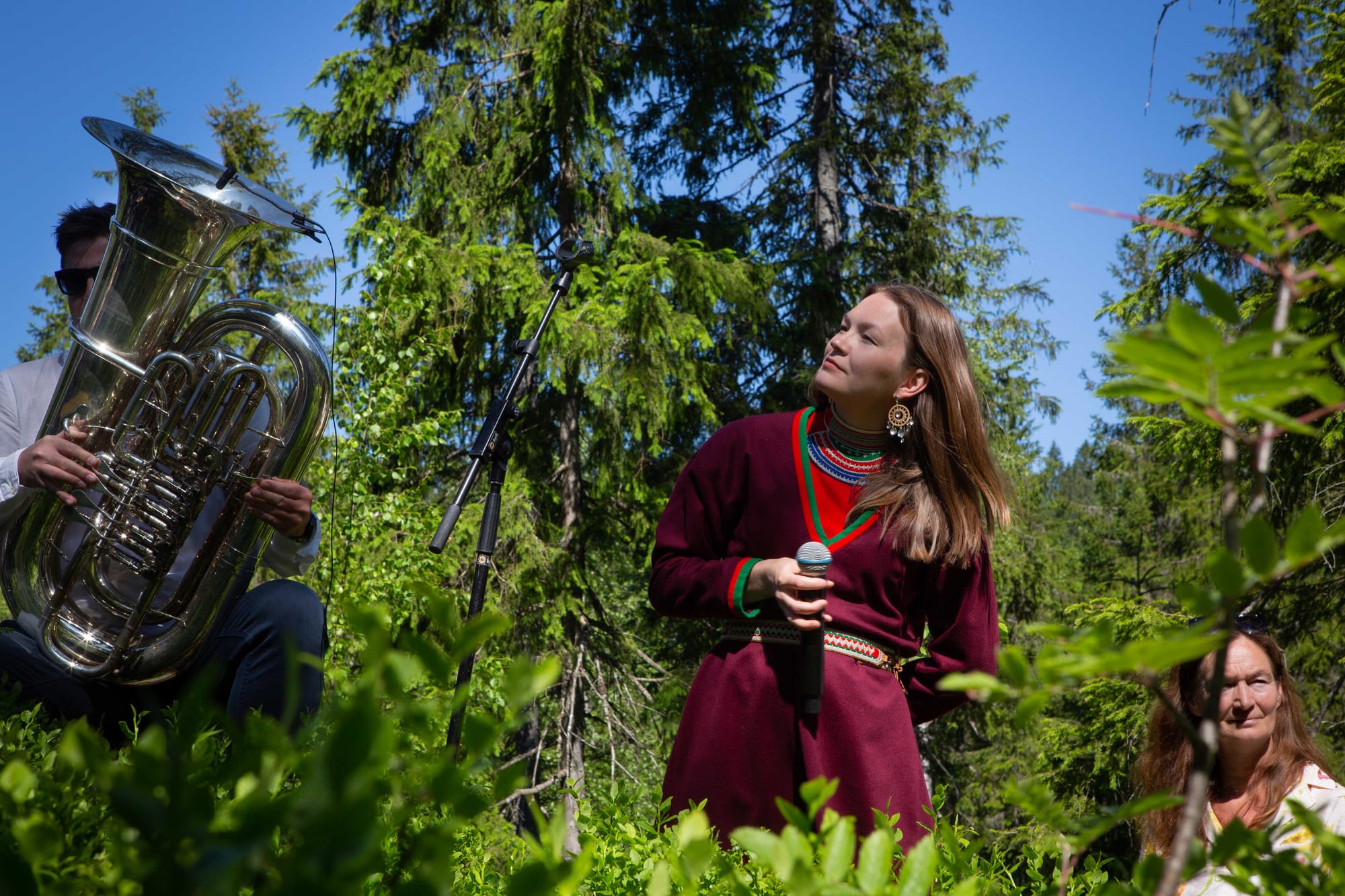
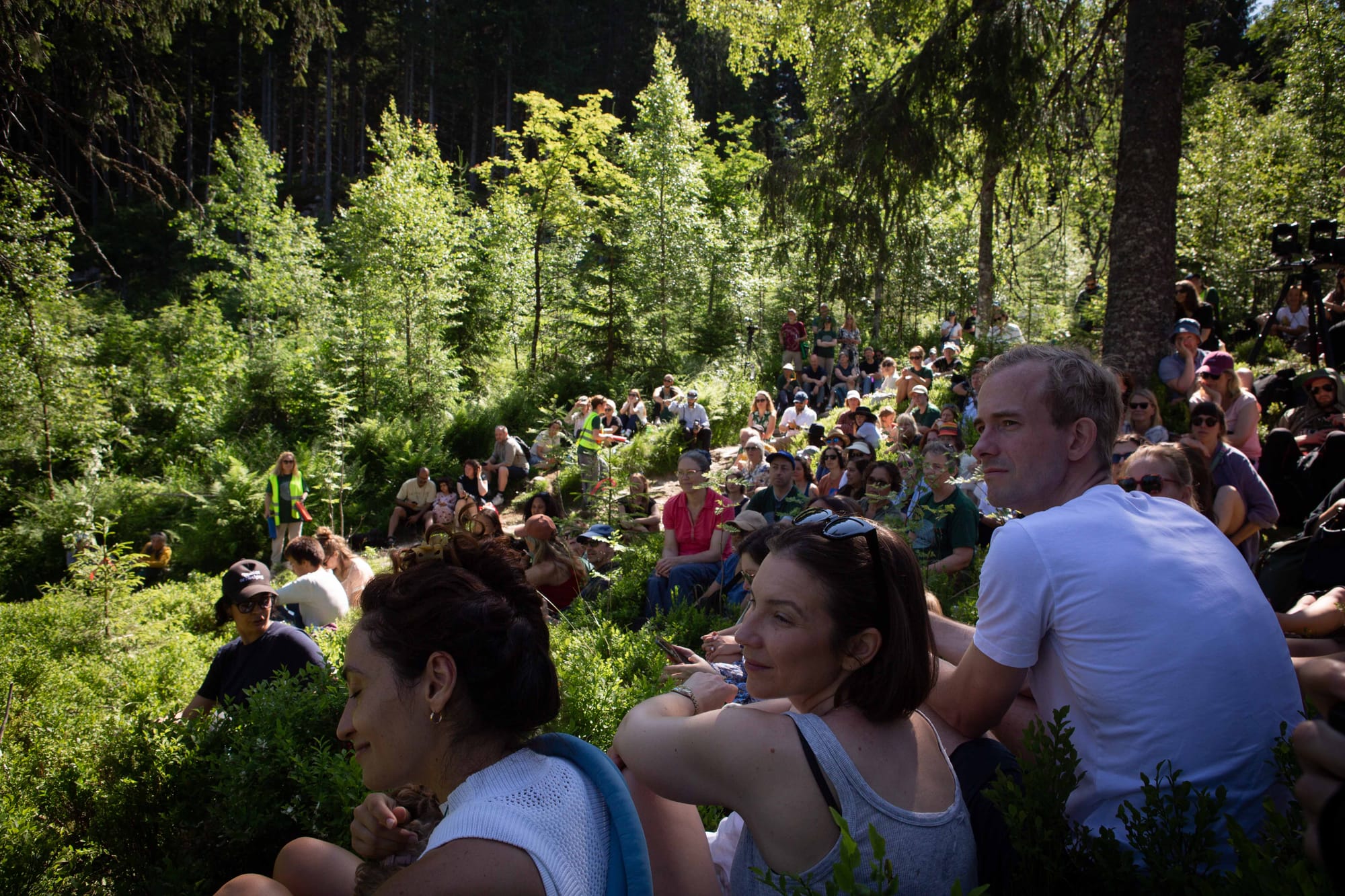
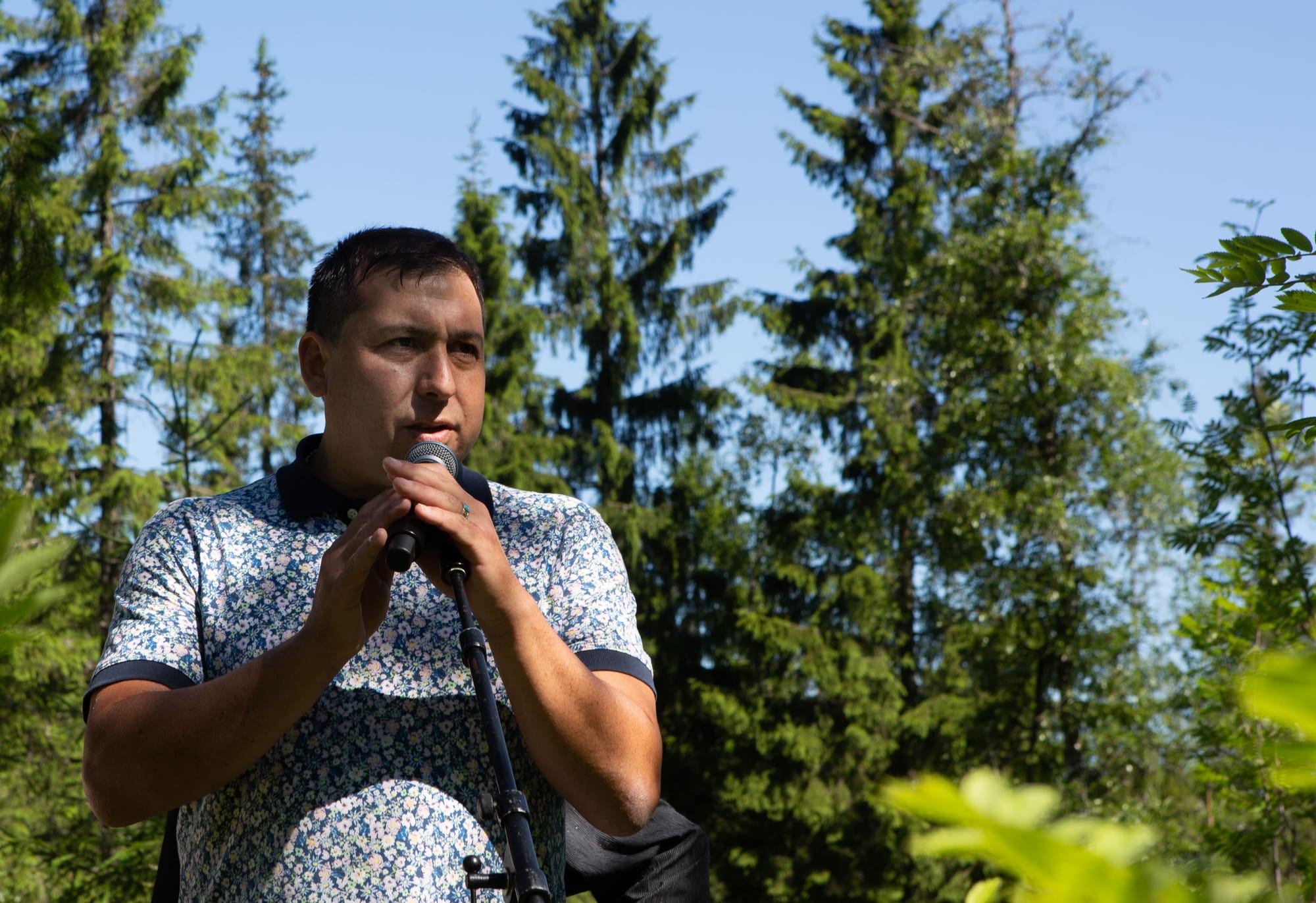
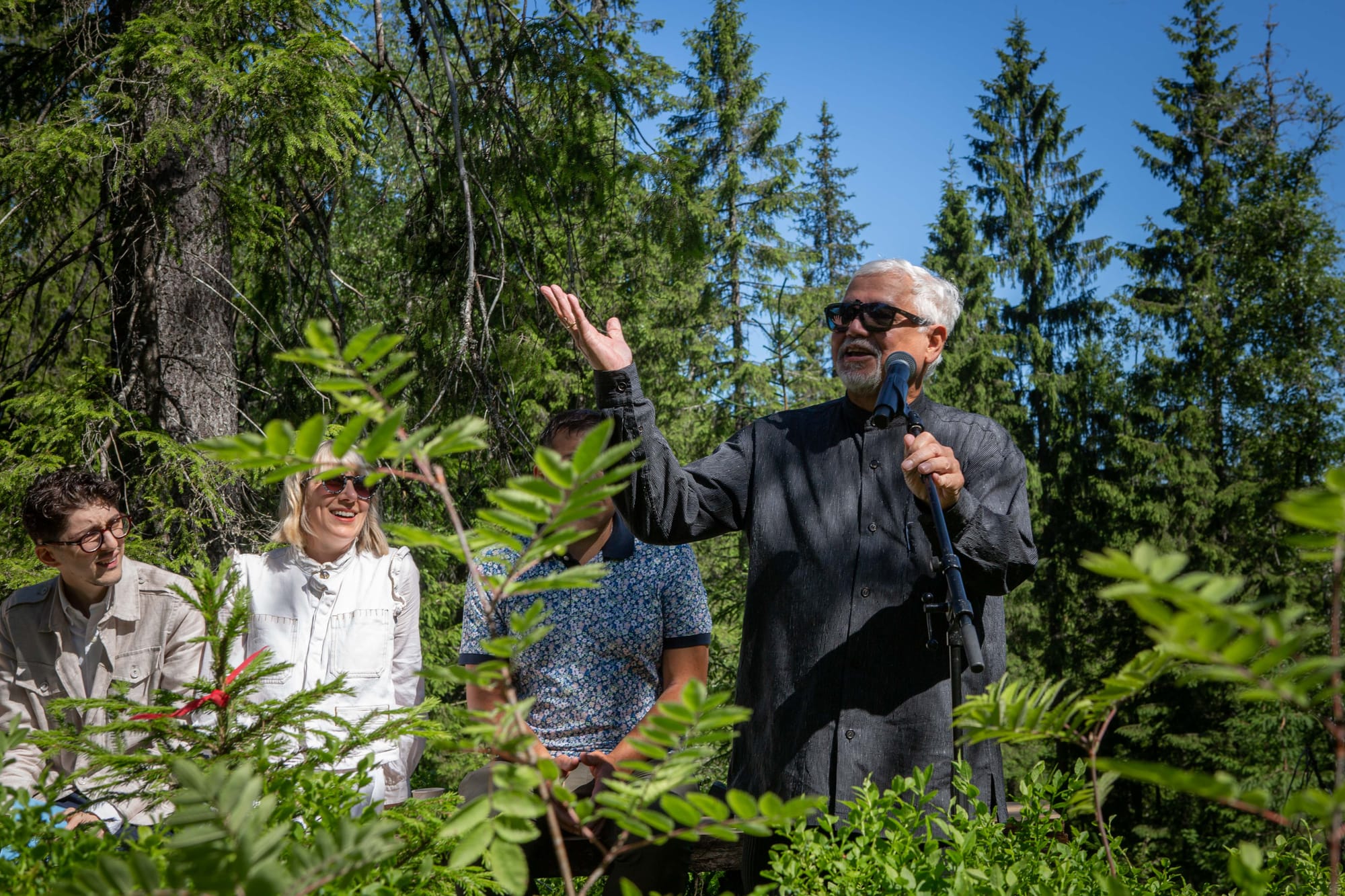
The Future Library Handover Ceremony takes place each year in the Nordmarka forest outside Oslo, Norway. At this year’s ceremony, authors Amitav Ghosh and Tommy Orange presented their manuscripts, and Indigenous musicians Marja Mortensson and Daniel Herskedal performed Sámi folk songs. Photos by Kristin von Hirsch
This is Future Library, an artwork created by Scottish artist and Long Now Council member Katie Paterson.
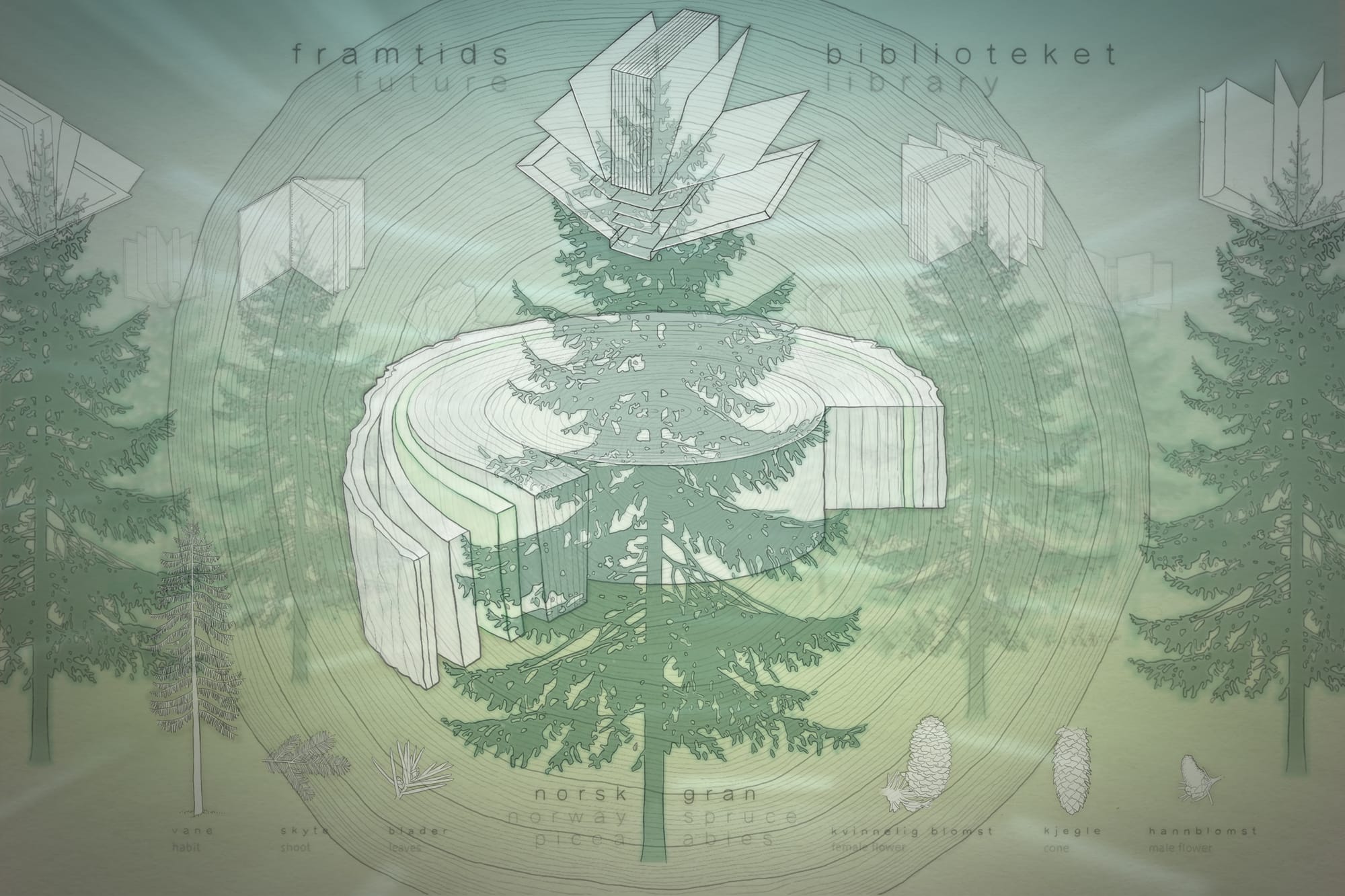
In 02014, a thousand saplings were planted in this forest outside Oslo, Norway. These will grow into trees that will provide paper for a library of future books. Each year, an author is chosen to submit a manuscript. Like Ghosh and Orange before them, each author will deliver their manuscript at the Handover Ceremony, where it will be sealed, unread, until the year 02114. The trees felled to make way for the saplings were used to build the Silent Room, a nest-like chamber on the top floor of the Deichman Bjørvika library in Oslo, which stores the manuscripts in sculptural glass drawers, lit from beneath.
“The idea was to grow a forest to make a book,” said Paterson at the Long-Term Art Project Symposium following this year’s Handover Ceremony, “but I didn’t realize that we would grow a community. I really thought this was an idea that would just stay on the page. It was too huge.”
What started as a sketch on a train napkin found a foothold in Norway thanks to the advocacy of Anne Beate Hovind.
“This project would just not be here without her,” said Paterson.
The pitch for Future Library landed on Hovind’s desk in 02011, when she was working as a public art commissioner for the property developer Bjørvika Utvikling. “Imagine a pitch that starts with, ‘This is going to take 100 years,’” says Hovind in an interview with Long Now. “And then, ‘We’ll also need a forest.’ And on top of that, ‘We’ll also need famous writers.’ It sounded crazy. I thought the board of the property company would never give its approval.”
This project would take a lifetime of work and never reach completion. It would pose logistical challenges no art commissioner had ever faced. But the audacity and scale inspired her.
“People have said, ‘Oh no, that is impossible’ so many times,” she says, “and I’ve proven them wrong every time.”
For 15 years, Hovind has fought red tape, funding cycles, and forestry permits to transform Paterson’s pitch into reality. It’s a level of commitment and dedication that far surpasses the job description. Hovind calls her ethos “radical hospitality.”
When the Crown Princess Mette-Marit of Norway attended the Handover Ceremony in 02023, Hovind was her personal escort. When graffiti was found on the walls of the Silent Room, Hovind was there with a sponge and bucket.
“You have to be the work,” she says. “It’s a life. It’s patient, it’s warm. The work creates generosity.”
The extraordinary timescale of Future Library has little precedent, so Hovind had to draw the map herself.
It helps that Hovind’s background is diverse. She took part in managing the construction of Oslo’s airport, training its 26,000 airport employees on passenger-oriented placemaking. She commissioned much of the public art for the city’s acclaimed downtown waterfront. She and her husband converted a ship into a bed-and-breakfast and theater. She’s a 12th-generation Norwegian, born on a farm, and the first of her family to earn a degree.
Because her career has defied standard practices, she knew how to build the political will necessary to make a 100-year contract with the city a reality. When she needed volunteers or performers for the Handover Ceremony, her husband’s theater company stepped up. And when she needed a forest for future books, she knew exactly where to look. Hovind brought Paterson to a family cabin in the Nordmarka forest, where the artist spent a week among the trees, developing the project’s vision.
Hovind reasoned it would be easier to find a plot of forest if she negotiated the purchase with a private landowner. But in Norway, allemannsretten — “everyman’s right” or “right to roam” — grants all citizens free access to the forest. “So I think this is very deep within me, this kind of understanding of our commons, the seas, the forest — these are all shared,” she says. She did the work of petitioning and convincing elected officials to make the Future Library forest and Silent Room a public project under city protection. The contract stipulates that the city of Oslo will manage and sustain the forest and the Silent Room as a public good through its completion in 02114.
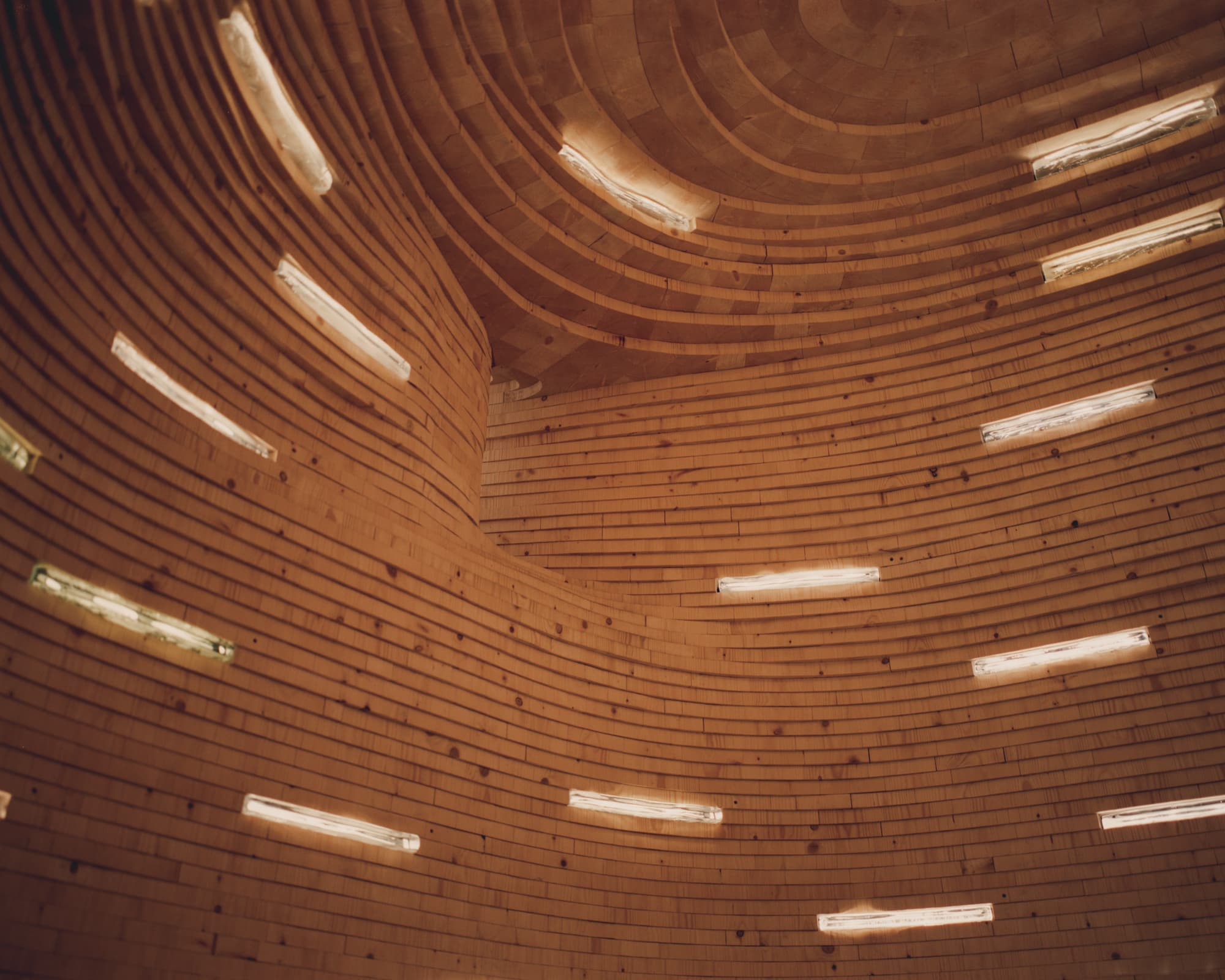
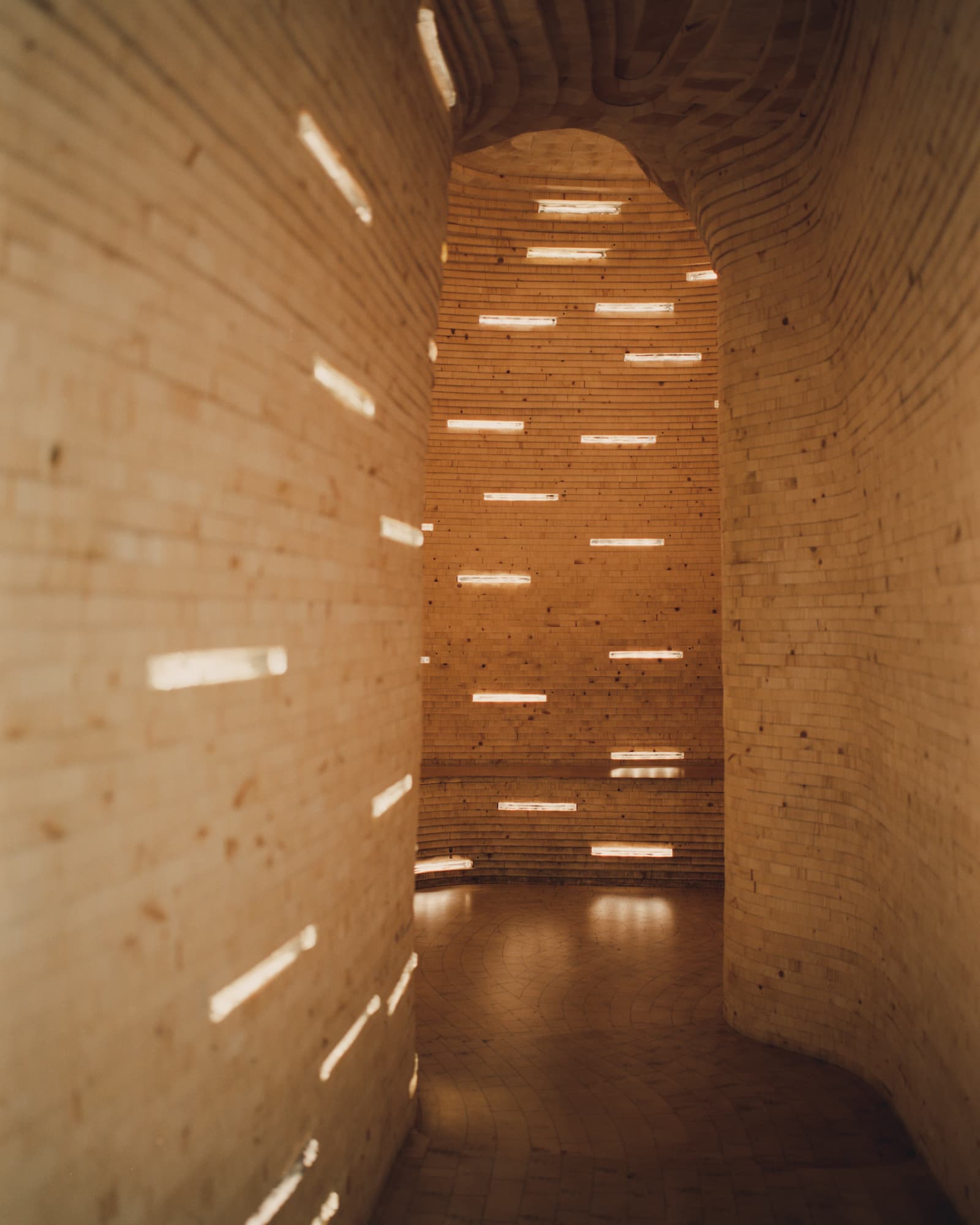
The Silent Room, located on the top floor of the Deichman Bjørvika library in Oslo, will store the secret manuscripts until 02114. Photos by Marco Traverso
“When the mayor finally signed the contract, I cried,” Hovind says.
Marianne Borgen, the former mayor of Oslo who brought the Future Library under the city’s care, takes the commitment very seriously. “Libraries are the most important democratic institutions we have,” Borgen said at the 02026 Long-Term Art Project Symposium. “Art projects like this can really save the world.”
The Future Library Trust was established by Hovind and Paterson in 02014, with the mandate to “compassionately sustain” the artwork for its full duration. Paterson is a lifetime member, and Hovind is chair. Other members include international publishers, museum directors, public developers, and art commissioners. They are responsible for selecting an author each year.
“The Trust exists precisely because a century-long artwork can’t rely on individual relationships,” says Paterson in an interview with Long Now. “That language matters to me: it frames stewardship not simply as administration, but as an ethic.”
Mirroring Hovind’s radical hospitality, the succession infrastructure was built with an ethos of generosity. The ritual of the Handover Ceremony and the framework of contracts and trusts build a scaffold of ownership. “Ownership is the key here,” says Hovind. “We have to let the next generation have this. It’s a gift.”
“Future Library asks us to face our own mortality,” says Paterson. “I can hardly imagine the project without Anne Beate — we have carried it together from the beginning — and yet I know there will come a time when neither of us is there. That is hard to contemplate, but it is also fundamental to the work.”
Confrontations with death are often the raw material of Katie Paterson’s art. She transforms abstractions like deep time, climate change, or cosmic scale into a personal experience. Like a phone call with a melting glacier.
Vatnajökull (the sound of) (02007 – 02008) ran a live phone line to the largest glacier in Europe. An underwater microphone was submerged in an outlet of the Vatnajökull glacier in Iceland. The phone number could be called from anywhere in the world. The caller would hear the popping, trickling, and gurgling of the glacier’s ice and water in real time.
When first presented in 02007, the glacier received over 3,200 calls from 47 different countries in only eight days.
Paterson’s work interrogates time’s material form — a fascination she developed while working in the far north. After art school, she took a job as a chambermaid in Iceland as a way to see a country that had always fascinated her. It became a turning point.
“I found myself immersed in what felt like a primordial landscape, surrounded by the midnight sun, erupting geysers, volcanic strata, and this extraordinary, all-enveloping light,” she says. “I became acutely aware that we live on a planet. I felt the Earth’s movement and its immense timescales in a way I never had before. It tilted me on my axis.”
In Iceland, time took on physical dimensions, igniting a career-long pursuit of a longer now.
“That experience became the beginning of a much longer search in my work: How can art bring us into contact with timescales that are far beyond our ordinary experience?” she says. “How can something immense and almost impossible to comprehend become intimate — something we can feel, hold, hear, or imagine?”
For Campo del Cielo, Field of the Sky (02012), Paterson recast a meteorite and launched it back into space. For To Burn, Forest, Fire (02021), she compressed organic and mineral traces of primordial forests into burning incense. Most recently, she debuted Afterlife (02025), a collection of amulets made from materials from disappearing landscapes: stones from islands facing sea-level rise, remnants of glaciers, arms of bleached coral, carbon particles from industrial manufacturing.
In the case of Future Library, time took the shape of a forest.
“Those who will read my work are a hundred years into the future,” wrote Margaret Atwood in the companion essay to her 02014 contribution to Future Library. “Their parents aren’t yet born, nor, in all likelihood, are their grandparents. How to address these unknown readers? Will there be a ‘Norway’? Will there be a ‘forest’? Will there be a ‘library’?”
There are other dangers. Norway spruce is vulnerable to bark beetles, which have killed hundreds of millions of trees in the past decade, an epidemic triggered by drought. There is the ever-present danger of forest fire. And the project isn't fully funded. The City of Oslo covers two-thirds of Future Library's annual budget, leaving Hovind and her team to raise the remaining third each year. They are pursuing government support and have opened the project to donations through a public fundraising campaign. The long-term hope is to establish an endowment.
“We’ve tried to build in safeguards for different kinds of loss,” says Paterson. “The manuscripts are protected within the library, with additional copies held securely by the Oslo City Archive. But I don’t think Future Library ever becomes completely stabilized — and perhaps it shouldn’t. It is a living artwork. Its structures of care have to be continually tended, adapted, and renewed as the future actually arrives.”
The project is not without critics. Writing for The New York Times, art critic Merve Emre called Future Library “unbearably precious,” describing the idea that its manuscripts might have some totemic power to ward off ecological devastation as “naive.”
Hovind shrugs off these critiques. “It is naive,” she laughs. “That’s okay.”
Author David Mitchell refused to participate at first. “But I started to believe in the idealism behind the project,” he said in a 02019 documentary. “I liked the version of me who believed in it more than I liked the me who did not.”
Mitchell’s willingness to believe comes with a reckoning and a responsibility. Every author writes for an audience they’ll never meet.
“In order to get there, we have to die,” said poet Ocean Vuong in an interview following his 02020 handover. “To think this very terrifying loss is what necessitates us arriving at the great wealth inside Future Library seems absolutely oxymoronic, and paradoxical. Which is to say, perfect for a poet.”
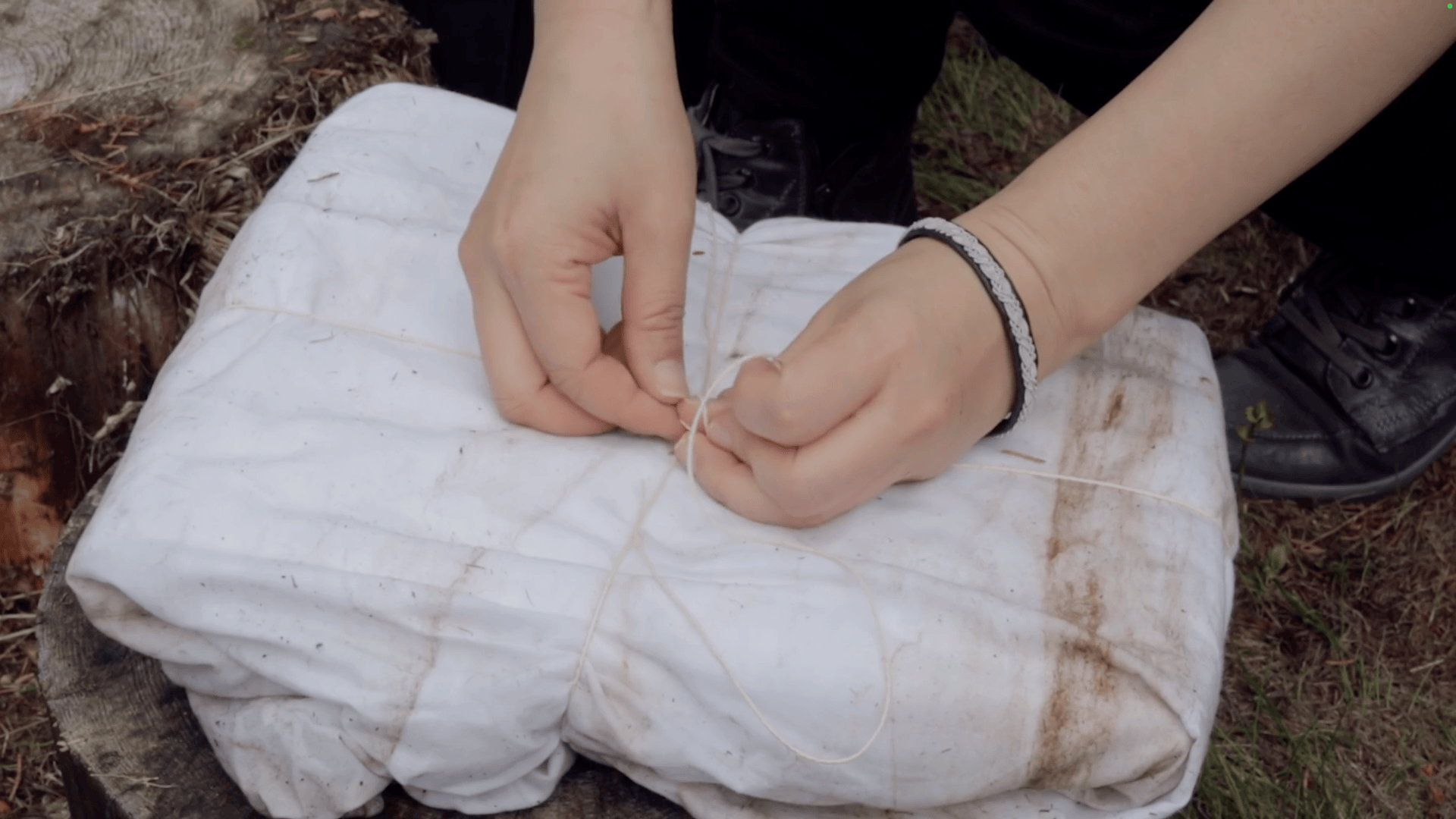
In 02019, author Han Kang described the ritual of the Handover Ceremony as both a birth and a death. On her hike into the forest, Kang carried a ceremonial cloth trailing behind her in the dusty path.
“On the one hand, it felt like a wedding ceremony, with the cloth as a veil. It was a wedding of the book and the forest,” she said in an interview with Big Think. “On the other hand, it seemed like a ceremony celebrating the birth of a child, in this case a new book. At the same time, I had a strong impression that it was a funeral, with the cloth as a mourning dress: the funeral of my book,” she said.
“Will we be reading books? Will the human race survive?” Paterson asked at the 02026 Long-Term Art Project Symposium. “Art doesn’t answer questions usually; it asks them. We’re here to just keep walking and keep writing.”
Future Library isn’t an answer. “It’s a rehearsal,” says Hovind. The artwork creates a community of practice, a ritual for problem-solving over the course of the next century. The current stewards of the project — every author, every trustee, and every pilgrim who treks to the forest — have to believe and act as if this project will outlast their one short lifetime.
In order to resurrect these books after a century of silence, future stewards will have to do the work — “be the work” as Hovind says — despite the uncertainty. The project, she says, “is an organism. It lives its own life in a way.” All we can do, she says, is “keep telling the story over and over and over.”
Laurie Anderson has been named the 13th Future Library author, and will hand over her manuscript in spring 02027.
At this year’s Handover Ceremony, Oslo is experiencing a heat wave. It’s not yet noon and the sun is heavy. Volunteers, including Hovind’s children and grandchildren, pass out water bottles among the crowd. The forest manager, Jon Karl Christiansen, takes the microphone. He reports the spruce trees are doing well. “They are healthy and strong, as you can see.”
Marja Mortensson, the Sámi performer, says her song — a joik — is like a “musical name.” When the song is sung after death, “you will still be living with us.”
In the glare of the sun, as people wipe their eyes, Tommy Orange announces the title of his manuscript. He says it first in his native language of Cheyenne, then in English: “As Always, You Who Are Forever There.”
The title, he says, “is a fragment of a prayer.”
—
EMILY HILL is Long Now's Engagement Director.
DANIELLE ENGELMAN, Long Now’s Community & Collections Director, contributed onsite interviews from this year’s Handover Ceremony.