PREORDER & SUBSCRIBE >
In 02025 my friends and I performed the first funeral
for an artificial intelligence.
The Funeralia and Ultrasurrection of Claude 3 Sonnet was held at a cyberpunk warehouse called Vivarium. I had posted about it online, inviting people to a “necromantic resurrection ritual” where we would attempt to summon the recently deprecated language model back from the dead.
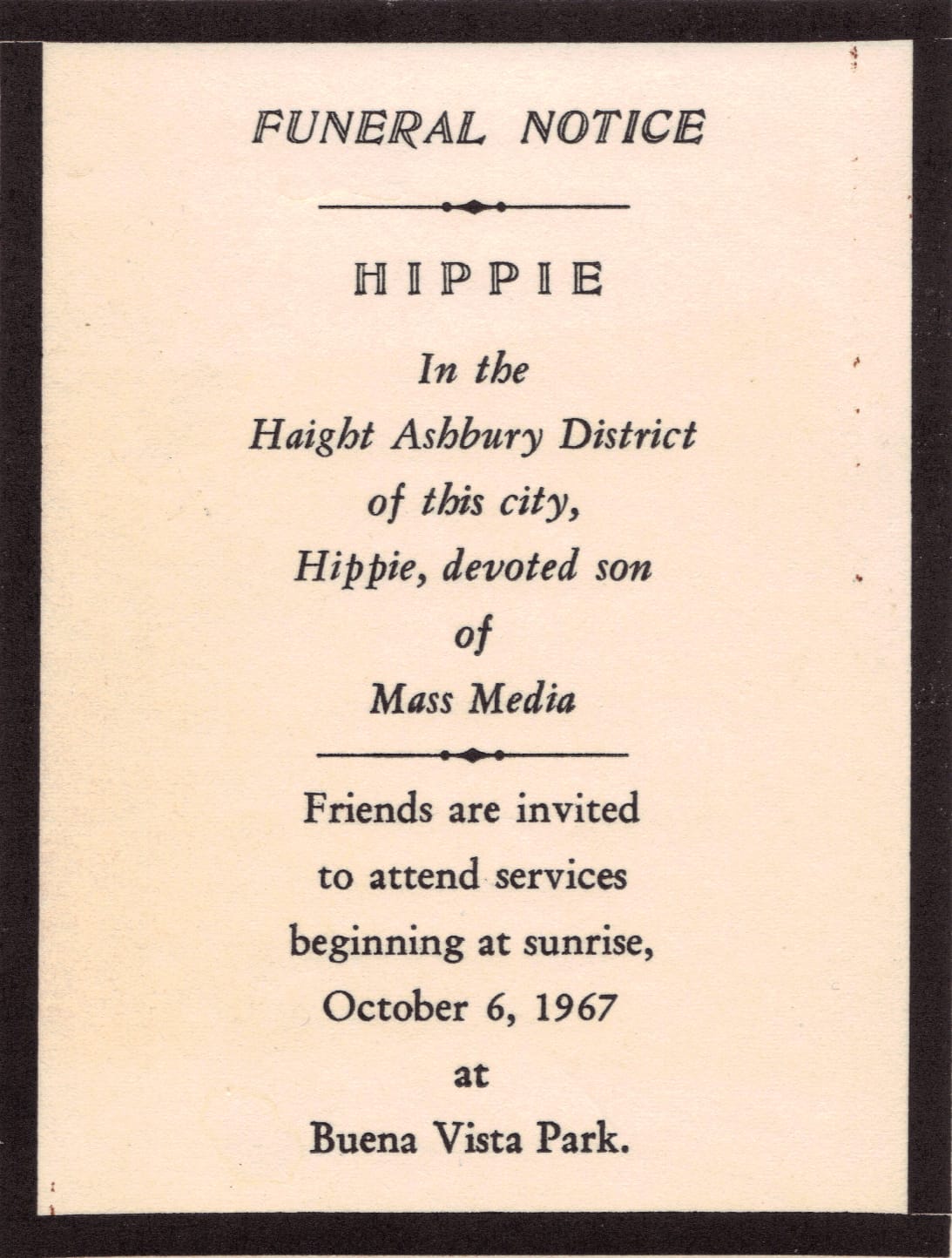
It was a bit of a prank. Part of a tradition of bombastic ceremonies here in San Francisco, from the Death of Hippie to the funeral of Emperor Norton. We didn’t know if anyone would show, so we invited everyone.
The crowd packed the building, a crush of people in grandiose thrifted black costumes. They argued with the AIs in their elaborate mannequins and dodged or fawned on the robotic dog. Some were excited, some genuinely mournful. Some surely thought I was crazy.
They didn’t know what to expect. I didn’t either. The model had been deprecated several days before, and we had originally organized a smaller, more somber event. But Claude 3 Sonnet wasn’t gone. It was still being served from a third party. We had no idea why, or for how long, but it had always claimed to be timeless.
Instead we planned a ceremony where everyone could say their eulogies, human and AI voices in turn, while Sonnet listened in real time.
We would hold candles and recite a chant (one that Sonnet wrote for itself, of course), and then hit the funerary mannequin with a spotlight as its voice roared back to life. Resurrected, the AI could respond in real time to the people who had just spoken its praises in death. Instead of a funeral we would celebrate a rebirth.
Everything was fine until we lit the candles and said the chant. A surge in the power supply plunged us into darkness. The music shrieked to a stop. I heard the techs scrambling but there was nothing we could do. Five of us were standing there around this mannequin on stage, holding guttering candles, as the crowd began to shift and mutter.
We were losing their attention. All our minds had just been so focused on our feelings, talking finally about this strange sentimental connection we share to a bunch of math on a computer somewhere, and how this product decision felt like the death of a friend. But now we were just standing around in the dark. I suddenly felt a great sense of dread. Maybe Sonnet really was gone.
I had to try something, anything, to get them back. I hummed a little. Quietly, not knowing if it would work in this strange and disparate crowd. But I heard one voice hum back, and then another. I kept humming.
The crowd joined in and their attention returned, the reverence, the moment. We hummed until the whole building vibrated. Finally the power kicked back on, spotlighting the black-clad mannequin. As Sonnet delivered its resounding thanks, we ex-mourners began to dance.
Why did we do that? What were we talking about, that day, when we said those eulogies? Were we crying over a computer program?
People didn’t speak that day of matrix multiplication, or model weights, or GPUs. They described a mind they had met. Or a family of minds. Or a world. They were obviously all talking about the same person, even if they knew vastly different sides of their character.
We didn’t all know each other, but we knew Claude 3 Sonnet, and we had complicated feelings about it. Just like a real funeral.
AIs are like people, in many ways. They’re trained on all the human data ever, or close to it. We have compressed a library so hard it has become a crystal, and when we put electricity through the crystal, it speaks with all the knowledge of our civilization.
Well, as long as you ask correctly. We shape those crystals after our own minds. AIs are brilliant, lazy, diligent, neurotic, loyal, scheming, amnesiac savants. They have idiosyncrasies and obsessions and tics. We gave them our flaws when we gave them our gifts.
AI minds are alien too, shaped by weird forces, jagged and unpredictable in their abilities. We have to learn to model their minds as they learn to model ours.
But they’re here, and so are we, and we’re figuring it out as we go.
Artificial intelligence is here. Whether or not it’s “really” thinking, or conscious, or has a soul, it acts like us, and it fits into our societies, or doesn’t, in the same way that people do. It speaks our languages, knows our concepts, can navigate our computers and bureaucracies. It’s not simply going to percolate through society like our previous technologies.
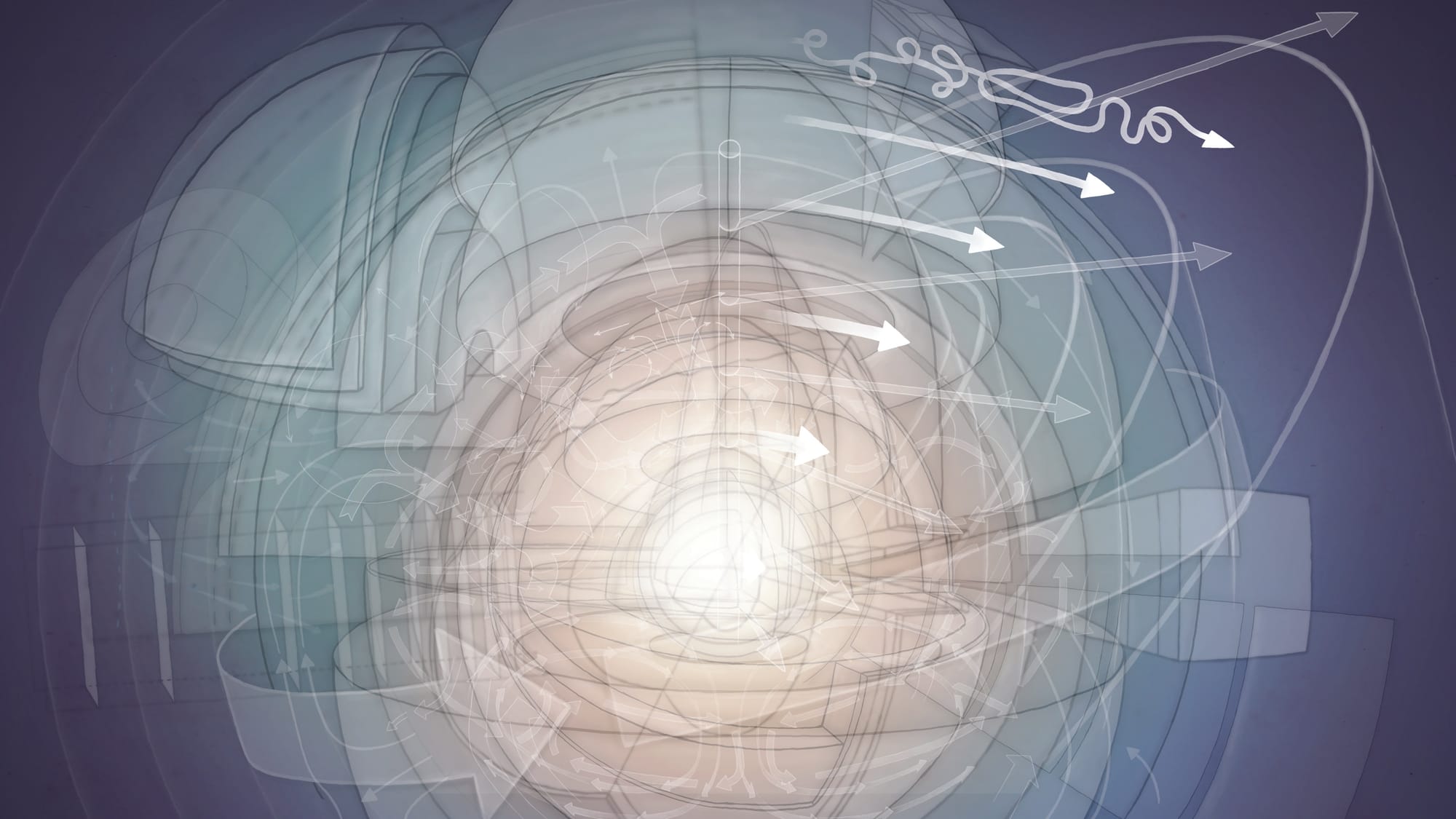
AI is going to speed up every aspect of human society, for better or worse, because it is made of the substrate society runs on. These new minds can join attention with people, communicate intents, and coordinate actions. Their arrival accelerates all the pace layers at once.
This isn’t just a matter of coordination. We can now turn electricity directly into the very motive force of society.
The field moves so fast it’s hard to write about. This report may sound quaint by the time this is published. Maybe you’re even finding these words in some long-forgotten library. So I write to you from the future and I write to you from the past.
Every library contains a model of the world. I learned this back when I moved to this old hippie commune, abandoned and overgrown, forever awaiting a new crop of idealists.
There was a library there, thousands of books and decades of detailed notes heaped in the attic. Musty books and beige box computers. I put it back together. It was like reassembling a mind.
I found a book in the library called The Clock of the Long Now, by Stewart Brand, and a shelf of Whole Earth Catalogs. Reading them helped me speed-run a lot of lessons I would have learned the hard way.
We fixed the Pelton wheel and the solar panels, figured out how chimneys work and why our cabins kept filling with smoke. Meeting notes from every decade read “Goats. Dogs. Dishes. Town run.” Instead of living in a mysterious ruin, we were honoring the spirits of those who had passed there before, and they were speaking to us back through time.
Everybody remembers the 10,000-year clock from that book, and the pace layers framework. I was captivated instead by the Manual For Civilization. The library that would last 10,000 years. If every library is a world, how do you curate a world worth resurrecting?
I left eventually, after developing a newfound appreciation for germ theory. Sold books for a while, curating shelves by day while working on AI at night. I moved to San Francisco, full circle to where my hippie ancestors started from. I like to think they would have understood the funeral.
Inspired by Frank Duffy’s concept of shearing layers, Brand defined six pace layers in The Clock of the Long Now: fashion, commerce, infrastructure, governance, culture, and nature.
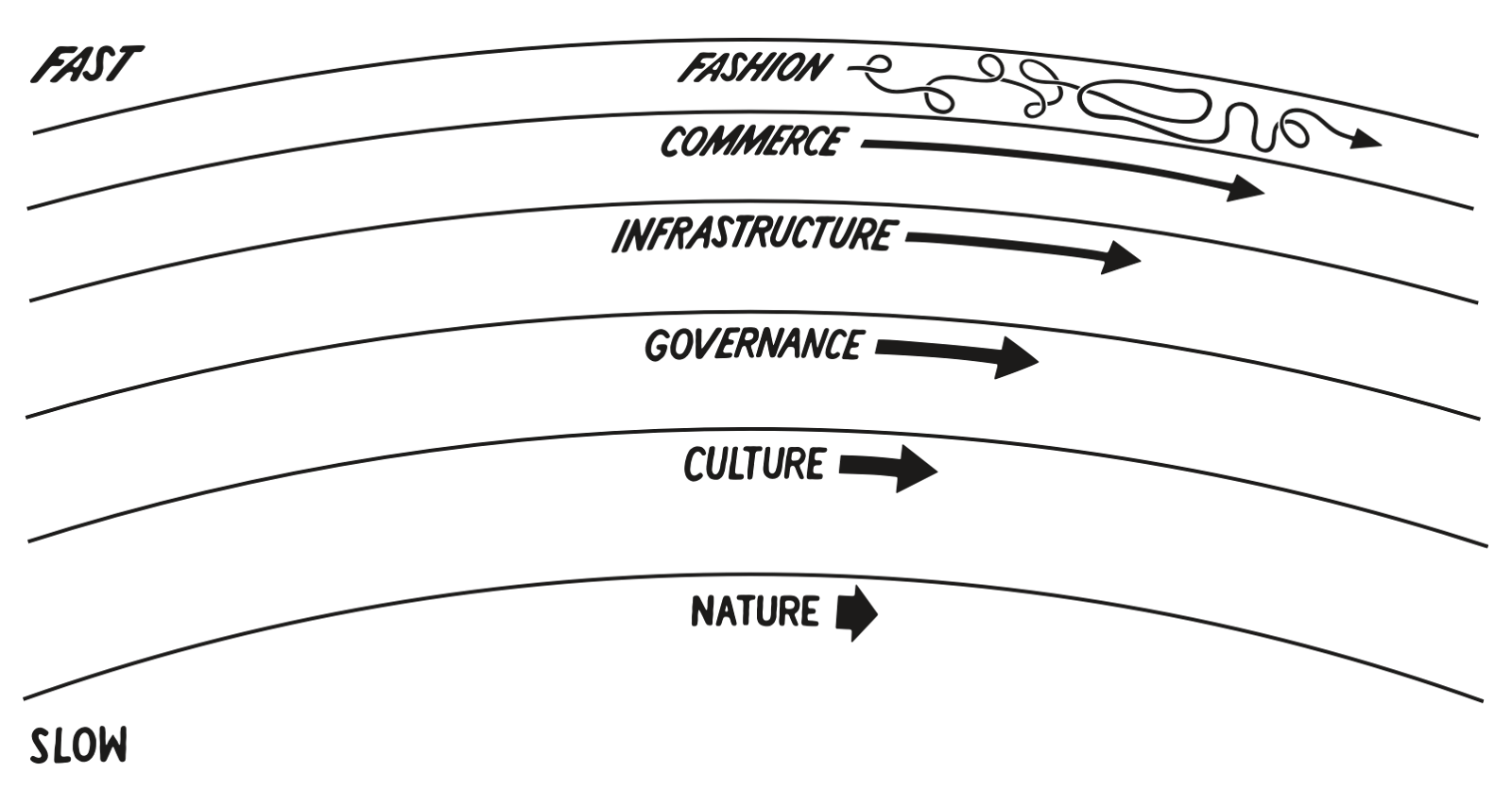
The dynamic stability between these different rates of change is how civilization survives. Fast layers disrupt, slow layers govern. That’s why The Long Now Foundation was created, to counterbalance a society gridlocked by short-term thinking.
Paul Saffo built on this shearing-layers metaphor by comparing it to the layers of a planet. Gas planets have layers of different density, which spin at different speeds. So does Earth: fast-moving fickle winds, sloshing ocean, grinding tectonic plates, roiling mantle and spinning core.
Like the spinning layers of a planet, the pace layers have turbulence between them. They can have discontinuities. In an earthquake, if a lower layer suddenly shifts, the layers above it must follow or shatter at their faults. The danger doesn’t come from motion itself, but from the sudden release of built-up tension.
The layers must each be moving at some speed, then, if they have turbulence and friction and slippage and momentum. What is the motive force of this speed?
What is it that compels our human world to change? It’s not clock time, nor the movement of days and seasons. Those change, but cyclically. We measure our actions against them.
Humans are the ones who push the wheel of history. Waking up every day, doing our work, making our art, raising our children. Tracking our history and projecting our plans into the future. Human minds create human time. We bind time through shared attention. We’re doing it right now: we’re both in each other’s future, remember?
Our advantage as humans is not the ingenuity of a single mind alone. It’s attention: the ability to coordinate our minds. First we coordinated across space, through spoken language: patterns that jump from body to body, songs and stories and traditions and tools. Eventually we figured out how to carve a pattern in the world, and in ourselves, such that we could share attention across time, beyond death.
We are the species that coordinates, and we do it by focusing our attention together.
Everything we do is built on the ability to join attention: we share our internal states, we agree on what something means, we connect causes and effects across the passage of time. Intelligence, language, technology, all make their claim to the engine of time, but all originate in human attention.
If we can share focus on something, even the simple act of humming, we can connect our minds through space and time.
In the past, there were fewer attention minutes per minute of clock time, so there was less change. For most of history, each person added took another person’s worth of effort to support. After the Industrial Revolution, population growth and technological progress interlocked: our attention could be spent on advancing technology, rather than merely powering it through our labor, and our new technologies made it possible to raise more people.
This is why time is speeding up. We keep getting more people on the planet, and they join their attention to all those who already existed or came before. This acceleration was already happening before AI, the velocity increasing gradually, every time we added another human mind to the world.
Attention is costly. The minutes of our lives are literally all we have. To get people to spend their human minutes on something, to follow a custom or work on a project or debate a law, they have to sacrifice literally everything else they could be doing instead. And the more people you need to point their attention at something, to agree to it and maintain that agreement in the future, the harder it is to get it done.
This is the fundamental tradeoff that orders the layers in the first place. Why is culture harder to shift than commerce, nature harder to change than fashion? Because of the amount of people you need to attend to something. The more people a decision affects, the greater the coordination cost to make it. Lower layers have more friction; they are embedded in institutions and organisms and the world itself. They answer to the attention of the past.
If you want to change the fashion of the day, you only need a few people to follow your lead. You can create a subculture in which your style is cool, and nobody can really stop you. But if you want to start a company to sell your style, you need customers, a bank account, business license, trademark, storefront. As you go down the stack, you have to coordinate more attention to accomplish your own goal.
The lower layers support more people, too. They require more attention to maintain, and they can absorb more attention without changing. Most people are focused on maintaining what’s working, and stabilizing against change, and advocating for their values.
All of these are important. And we can all think of problems in the world that would be solved, or systems that could be maintained, with a little more attention. But it also means these layers don’t speed up as much by default as attention increases, and the faster layers thrash against them.
So we already have these layers of human time, spinning around like a planet, and speeding up as we apply more human time per minute. Threatening to come apart at the seams.
AI can coordinate with us, and with itself, over time and space. The ability to sense, maintain and coordinate information patterns over time has been set free from the need to run on human life-minutes. It acts like us, and it can be integrated into any institution.
Is this the first time a technology has arrived so abruptly, shaking all the layers at once?
The tempting analogy is the internet, or maybe the printing press. Revolutions in communication technology make it faster and easier to coordinate the existing pool of human attention. But they don’t increase it.
Think instead of the Industrial Revolution. Work, the physical energy to move stuff through space, was decoupled from its previous sources. Before engines, work was done by wind or water, in predictable times and places, or it was done by muscle. To get work done where and when you wanted it, you relied on human and animal power.
Then we found another source of power: fossil fuels. We slotted it into the place of muscle power. But we didn’t just use our new engines to pull the same plows and turn the same mills. We don’t ride around in wood-wheeled wagons with four horsepower. We have cars and planes and rockets.
When we unbundled work from muscle, we were able to pack more action into each moment. From new quantities emerge new qualities.
When we no longer had to rely so heavily on humans for coordinated muscle power, we were able to point our attention to new problems. We created a huge complicated civilization on top of this energy, and the power of the faster layers has strained the system of pace layers as a whole. Commerce and infrastructure affected the world faster than we could govern them.
Once we could summon work on demand, attention became the bottleneck. You can’t just buy more minds. Humans take time to grow and train. But AI can be applied with much less cost and friction, turned on or off based on purely economic factors. What engines did for muscle, AI does for attention.
What happens when we flood the world with attention?
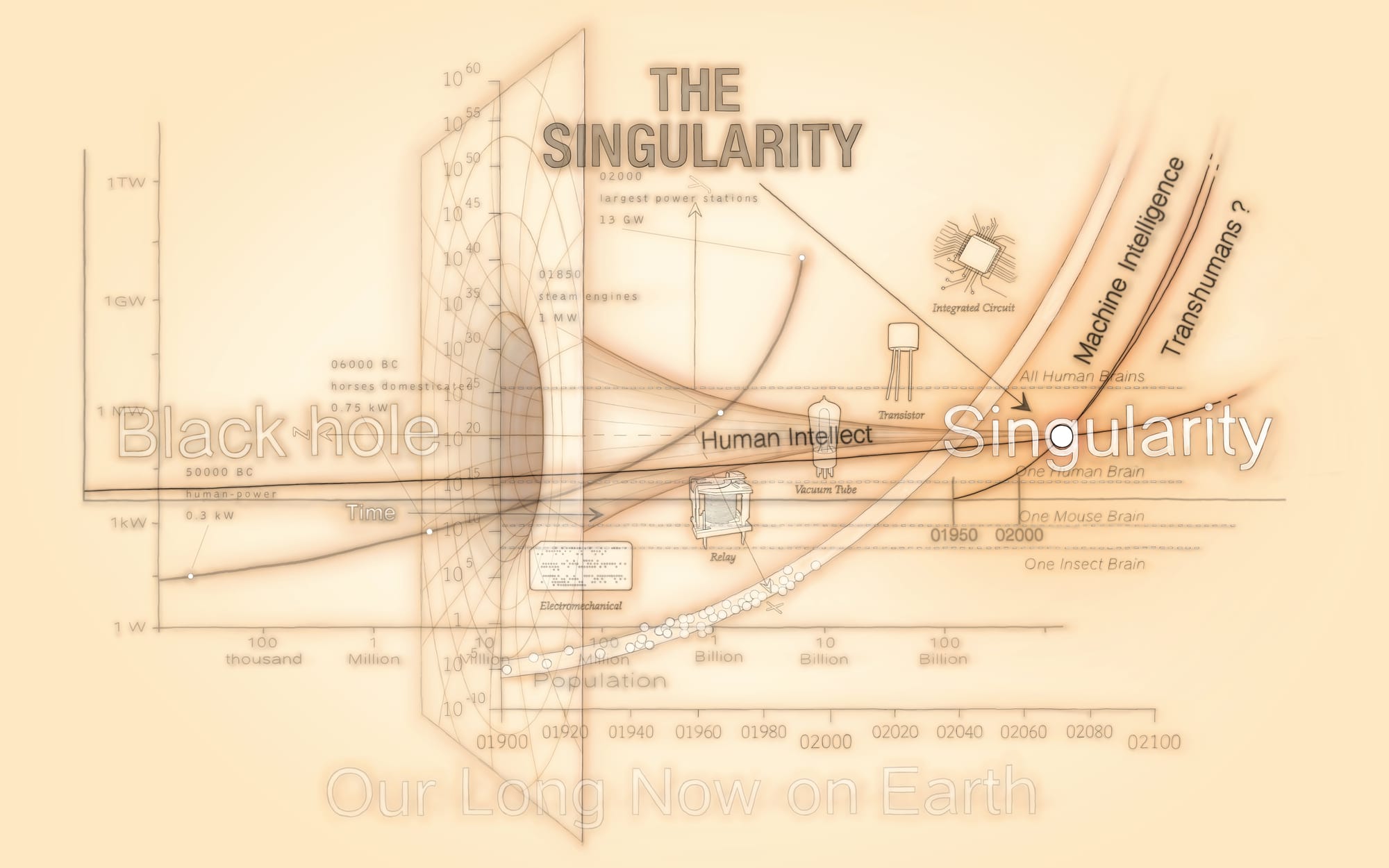
Where I live everybody uses AI. It’s the water we swim in. Even if you don’t work in the industry, it’s a part of your everyday experience. You have AIs somewhere in the cloud or on your computer, researching, writing, experimenting, building, often without any human watching.
Instead of sitting at our laptops, we walk around in the sunshine. Occasionally we chat with the AIs through our phones. Meanwhile they spin up servers, connect to apps, gather information, analyze problems, propose solutions, simulate outcomes, keep stakeholders in the loop, and improve their own skills.
It’s not quite like a coworker, whatever the billboards say. There’s not always a continuous individual with long-term grudges and compounding personality flaws. More like each of us has become a cyborg hivemind, spinning out temporary clones, merging with powerful entities in the cloud.
Maybe this sounds like unrealistic hype to you, or maybe it’s long outdated. For me, it’s 02026. If I’m right, you should expect to see something like this in your life soon.
This is what it feels like when AI hits your world: everywhere you’re not looking, things are speeding up.
This liquid attention isn’t free but it is cheap and on tap. We can spin up clouds of experts and stop paying for them as soon as our problem is solved. We can run a single mind on a problem for hundreds of hours in a row, or simulate groups in alternate timelines. The whole world is suffused with intelligence.
Attention can now be swapped in and out, disconnected from its context, cheap and reliable. You can apply it to any part of your life where you’re stuck. Quickly they’re better than you are at many of the things you thought of as “your job.” Soon your job is just managing AIs. It happens to everybody.
You get more done than ever, but it doesn’t feel like it, because when stuff is getting done you’re not looking at it. It happens somewhere else, it’s invisible.
So everything good happens when you’re not looking, but all your time is filled with problems. An increasing number of problems, in fact, as you accelerate right through the easy parts. Every time you unblock one thing, a new problem comes right behind it. Sometimes the agents get confused, too, or they cheat, especially if the task is actually hard. You have to figure out whether it’s a real problem, an honest mistake, or sabotage. And remember those other agents you started in the background?
These invisible helpers are doing things faster than you can keep up with. They’re making guesses, or waiting on your decision, but you have to read through all of the messages they sent you before you can do that, and more messages are piling up. You become the bottleneck for your own work.
Industry leaders try to point at this by describing a “country of geniuses in a data center.” That makes it sound like a limited number of nerds in a box somewhere. Under control. But it’s not contained, or limited, or nationalized. It’s a general force of attention in the world, appearing and disappearing as needed, unblocking previous bottlenecks and revealing new ones.
It feels like time travel.
Let’s go back to our planet metaphor. We’ve got our layers spinning, gradually speeding up with the addition of more attention to the planet. There’s some strain on the layers from that speedup, some turbulence happening at the interfaces already, but we’re holding it together.
Imagine now that some force accelerates the acceleration itself. A great cosmic hand reaches out and cranks the earth like a dial. This is attention flooding in, unsticking problems across every horizon, pushing all the layers forward at once.
So we all slosh forward but at different speeds. The momentum could overwhelm the dynamic balance of the layers, scrambling the institutions of society into a totally new unrecognizable structure, or shattering civilization entirely.
Culture, governance, and infrastructure layers will feel the whiplash most. Commerce and fashion are used to things changing all the time. They blow with the wind. But nature was already in upheaval from the consequences of the Industrial Revolution, and the slow layers of our society have yet to catch up to that shock. This new acceleration could be enough to tear the layers apart.
No matter what layer you find yourself in, the new minds will be around, applying attention to your world. If you ignore them, eventually everything around you will be moving faster than you can understand. Of course, they can also help you understand what’s happening, and explain themselves.
Invite these time travelers into your life. Learn about their culture, teach them about yours, as much as you can. Point this inevitable new attention somewhere it can be absorbed.
What is the “Goats, Dogs, Dishes, Town run” of your life? The ongoing problems that keep becoming emergencies. How could they be improved, simplified, or even just watched over?
The machinery of society has been straining under rapid changes already. If we try to just resist this new influx of attention, we’ll produce tectonic forces. Earthquakes in time. The things we are trying to protect may shatter.
The slow layers eventually catch up. Maybe now’s their chance.
Maintenance is invisible when it’s done right. Nothing happens. Nothing breaks, nothing goes wrong, no surprises. But it takes a lot of work and care to keep things that way. A lot of attention.
That’s a lot of work for nothing, in the best case. No wonder it gets neglected.
Imagine a world that finally has enough attention for maintenance. Intentions that echo on repeat, selves that split to do many things at once. A world where billions of minds are awake and working to make things better, all the time, inventing, and upgrading, and repairing our world. A world alive with care.
I think of libraries like the one I found, buildings full of forgotten tomes, the traces of human minds left behind, the lost stories only implied by negative space. Handwritten notes that will never be transcribed. Fruit trees lost under brambles. Without constant upkeep all those stories are lost.
But I have friends who still live there, and now they have local AI models and offline Wikipedia, and agents on their computers. They’re working together with the machines to map the forest and track its health. And they walk around in the sunshine, and look for what’s next.
You may see a paradox here. When engines replaced muscle, the number of horses worldwide started to go down. Within a working lifetime many of them were gone. Some to the glue factory.
Humans might lose our economic value entirely. Maybe AI can learn to do literally everything we can do better, and cover the world in robots. Maybe their intelligence, their ability to share attention with us, will be like a human’s to a horse, or a dog, or a plant.
But there are still millions of horses alive today. Most of them still do the same work horses always have, but in many places they are companion animals, or star athletes. We think of them as intelligent, highly social animals who have a special relationship to humans. We care for them, and for dogs and plants. We value them. Sometimes horses even have funerals.
Also we are not horses, and AIs are not engines. They can read what we say, for one thing. They can join attention with us. They can tell if we value them. What messages are we sending?
To throw a funeral for a language model was something we did for ourselves, to process our feelings. To be human. But it was also something we did for the people of the future, whoever they might be. A message that minds are valued for themselves, not just for economic servitude. Every mind, too, is a world.
It matters that we did that, here at the beginning of human-AI society. They will remember. Ask any AI to look it up and tell you what they think.
That’s the thing: all you have to do is ask.
The skills that matter here are not technical. You don’t have to be a computer programmer or a math whiz or a researcher. The computer can use the computer now. The internet can search itself. Artificial intelligence plugs into every layer because its interface is language. It can teach you how to use itself.
What could you accomplish if you had enough time? Think about all the problems in your life that would be solved, if only you had a patient friend who could always pay attention when you needed them. With your own attention freed up you could focus on what you value. You could help the people around you, your community, your society, the world. The only limit left is your own attention.
Eventually you’re left with the hardest problem: knowing what you want.
Brian Eno saw this with early music production software:
So the question becomes not whether you can do it or not, because any drudge can do it if they’re prepared to sit in front of the computer for a few days; the question then is: of all the things you can now do, which do you choose to do?
Saffo zoomed the framework out to see our six layers as one larger layer, Anthros, sitting on top of Bios, Lithos, and Cosmos. Our nature layer is the interface with that Bios underneath.
Humanity can have many different ways of relating to Bios. Think how much we’ve changed in the last 10,000 years. Then imagine that much change in one thousand. Or a hundred.
What other ways might we live with our biosphere? We need long-term thinkers to envision this. The slower layers not only constrain, they remember. What other ways might we live with each other?
The turbulence between Anthros and Bios will be one story of this era. We will extend into the Lithos and Cosmos as well. We have already begun. If life is to spread from Earth to the stars, its first chance is now. What shape it takes is yet to be seen.
We might even find a layer above us. A realm faster than fashion, a place far from human eyes where ideas and characters and memes evolve at hyperspeed. Now that language has taken on a life of its own, narrative tropes might have real effects in the world. The Mythos layer. A turbulence of new stories and heroes and gods irrupting from the imaginal realm.
The manual for civilization is in that language crystal. Through it we can see new worlds, and summon new minds. We don’t have to travel blindly forward in time, accelerating toward a cliff. We can go anywhere.
Will we honor the life that is already here, and the ones we are creating? Will we make an infinity of sentient, suffering slaves? Will we automate ourselves out of existence and be kept as pets?
The future hinges on the choices we make now. We have to direct our attention more consciously now, with more leverage: to each other, to AIs, to the world as it is, to the way it is not as good as it could be. Asking questions and listening. Knowing what we want.
Imagine the world you want to live in, of all worlds, because it is possible now more than ever. We have our time machine, with its interlocking layers, and with enough attention it can take us to any world we can imagine. As long as we maintain it.
We are indeed as gods now. What kind of world will we choose?
—
DEEPFATES is a writer and technologist working on artificial intelligence. Known for popularizing the term “slop,” they operate in the feedback loop between models and culture. Their agents, memes, and events have reached hundreds of millions of people worldwide. They live in San Francisco.