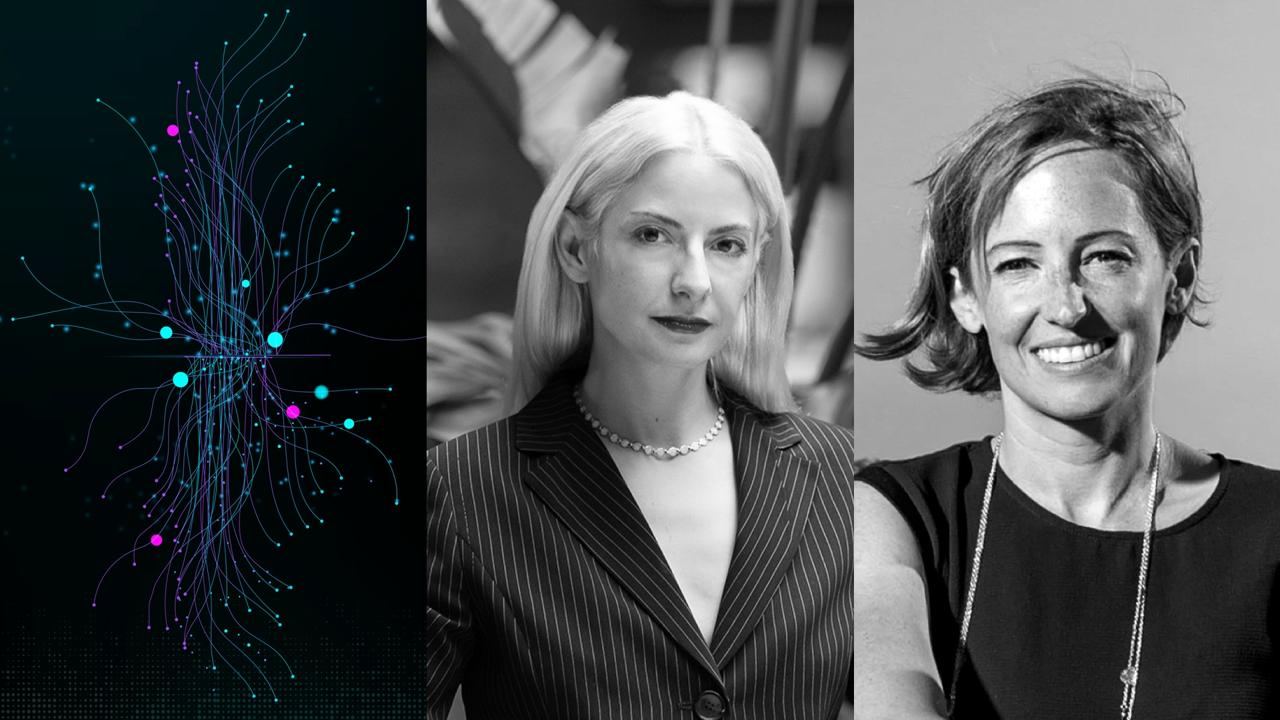
Claire Isabel Webb & Nina Miolane
The Geometry of Consciousness
Recorded live on Apr 20, 02026
at The Interval at Long Now
This evening is made possible with generous support from the John Templeton Foundation.
How do the binary electronic signals of neurons give rise to subjective experience? Mathematician and machine learning researcher Nina Miolane joined science historian Claire Isabel Webb to explore this question from an unexpected direction: geometry.
Plotting the collective firing rate of neurons in 3D space, Miolane's Geometric Intelligence Lab at UC Santa Barbara found the result created a torus. When they trained an artificial neural network on the same task, it converged on the same shape. Miolane posits that biological and artificial intelligence may be reaching for a universal computational design.
In this fascinating conversation, Webb and Miolane discussed how geometry is the most ancient branch of physics; it is the language we use to describe the curvature of spacetime and the General Relativity of the universe. Might it also map the universe inside us?
watch
primer
What is consciousness — and how might we describe it scientifically? Neuroscience can map neural activity with extraordinary detail, yet the relationship between electrical signals and subjective experience remains one of humanity’s most enduring questions.
Mathematician and machine learning researcher Nina Miolane approaches this question from an unexpected direction: geometry. In her work, patterns of neural activity can be understood as structures in a mathematical space. In this view, cognition may be described through the geometry of neural representations: patterns that can be measured, compared, and modeled across biological and artificial systems.
In conversation with science historian Claire Isabel Webb, Miolane explores how new mathematical frameworks may help illuminate long-standing puzzles in the science of mind. If consciousness arises from structured patterns of activity, what does that imply about intelligence? Could similar patterns arise in machine systems? And what might it mean to study consciousness as a phenomenon that admits formal description?
Why This Talk Matters Now
As humanity increasingly shares cognitive labor with machines, a rigorous language for studying the mind would be game-changing. If that language could unlock a deeper understanding of consciousness, it would not only have broad implications for the evolving relationship between human cognition and AI, but for how we as human beings fundamentally understand ourselves.
The Long View
From Aristotle to Descartes, every generation has recast the mystery of consciousness. A geometric and mathematical explanation might lead to a paradigm shift that could affect all of society's pace layers — how we design, govern, and relate to each other in the next 10,000 years and beyond.
Learn More
- READ Nina Miolane's Ideas essay, “The Fifth Era of Science: Artificial Scientific Intelligence”
- EXPLORE the Geometric Intelligence Lab at UC Santa Barbara
- LEARN how Future Humans at the Berggruen Institute is answering the question “what will life become?”
transcript
Nina Miolane
So we are after building what we call a mathematical theory of intelligence. We believe that there are unifying principles, mathematical equations that can describe how intelligent systems, both brains, but also machines, how these intelligent systems operate in the world.
Rebecca Lendl
Welcome to The Long Now Podcast — thank you for being with us. I’m your host Rebecca Lendl, Executive Director here at The Long Now Foundation.
For most of a century, neuroscience has been a story of zooming in: finding the one neuron that fires for vertical lines, the one that fires for a location in space, and the one, famously, that fires for Jennifer Aniston — you’ll hear more about that one in a bit.
Nina Miolane is zooming back out. Nina is a mathematician and neuroscientist who directs the Geometric Intelligence Lab at UC Santa Barbara, and she’s looking beyond any single neuron to the collective geometry of neurons firing together.
Here’s the astonishing part. When you train an AI to perform the same task as a living brain — say, navigating a room — both will converge on the same shape: a donut-shaped surface called a torus. Across species, across substrates, all intelligence systems — be they brains or machines — seem to favor the same mathematical forms.
Now, these patterns are just becoming observable, but the deeper question is why. As in physics, Kepler observed, Newton explained. And that’s what Nina’s lab is after for neuroscience: a mathematical theory of intelligence.
Nina is joined in conversation by Claire Webb, historian, theorist, and Director of the Future Humans program at the Berggruen Institute. Together they explore what this new language might mean for AI, consciousness, and what it is to be a mind at all.
You’ll find a ton of great resources in our show notes.
Now, before we dive in, a quick note — here at The Long Now Foundation, we are a counterweight — deepening our capacity to move wisely in these times of uncertainty. If you feel so inspired, we hope you’ll join us. Head over to longnow.org/donate to become a member and get connected to a whole world of long-term thinking.
With that, we’re excited to share with you the Geometry of Consciousness with Claire Webb & Nina Miolane
Claire Webb
Hi, everyone. Thank you so much for coming. I'm Claire. When Nina's speaking, I invite you to keep in mind conceptual shifts in her speech that's different from what you have heard about what the brain is. The brain is a computer. The computer is a brain. So many discussions right now are on evaluating if AI is conscious or not conscious, does it cross a certain threshold? And of course, we run into all sorts of trouble because how we construct that threshold is there's no consensus. And Nina starts from the other way around and we're so pleased to have her. Thanks, Nina.
Nina Miolane
Thank you, Claire. This is where it all begins. This is the brain of a mouse. More particularly it's a recording from my colleagues at UCSB of the visual cortex of a living mouse. And on this recording, you might detect this flashing lights, this positive light, dust flashes. These are firing neurons. And so what this is showing is that now we have access to incredible technology that allow us to image the living brain and the neurons firing within it.
And that's just an example. We have new technology today that allow us to image hundreds of thousands of neurons, sometimes up to one million neuron in the living brain. So that's extremely exciting, but it also highlights a key tension in neuroscience right now, which is that technology has outpaced our theoretical understanding. Sure, we can watch what is happening in the living brain in almost real time, but we do not know how the firing of these neurons encode are subjective experience. If we look at these patterns, honestly, at least to me, at first they seem quite disorganized. They seem almost random. Where is the structure there?
And yet somehow in this randomness is encoded everything we see, everything we hear, everything we feel, touch, even our decision making or capacity of planning and acting and interacting in this world is encoded in the firing patterns of these neurons. How is that possible? And how can we even begin to make sense of the complexity of this data? What is the right approach? What are the right tools, the right mathematics? This is the question that animates my lab, but it's also a question that has animated neuroscientists for quite some time. And even before we had such incredible recordings, scientists were asking, how do neurons, how does the electrical activity of neurons encode the subjective experience?
And because neuroscientists have thought about that for over a century, for a moment, we're going to take a step back in time and look at the neuroscientists that discovered the first cue to answer this question. The first cue to answer, how do the firing patterns of neurons encode our subjective experience? That researcher is Edgar Adrian, and he got the Nobel Prize in 1932 for that discovery. And Edgar Adrian was interested in how neurons encode our subjective experience, but he was particularly puzzled by one thing, which is that neurons have a binary code. In other words, the neuron is either on or off. Either it's firing, it's on, or it is not firing, it's off.
The magnitude of the firing, the voltage of the firing, is almost always the same. So really it's a binary code. Either the neuron is on or the neuron is off. And that was very, very puzzling for Edgar Adrian because that seemed to be completely contradictory with subjective experience because our experience of the world, at least to us, feels very continuous in some sense. You can tell the loudness of a sound, the redness of the red, the intensity of a touch. So how is it possible that a binary code, a neuron that's either on or off encode this continuous subjective experience? And Edgar Adrian found an answer to this question.
He took the leg of a deceased frog, which is what you see here. And in this leg, there were neurons that were known to fire when the muscle was being stretched. And so he recorded from those neurons when he was putting different weights at the extremity of this muscle. And he was asking the question, "How will this neuron behave if I put more weight?" If I put five gram, 10 gram, 25 gram. And what he saw is that the magnitude of the firing of the neuron didn't change, but the number of times the neuron was spiking, that was changing. So that's what you see on the column here. At the top is when he was attaching a small weight, say five gram, and the neuron was firing once. And at the bottom is when he was attaching a bigger load, say 25 gram. And in that case, the neurons was firing five to 10 times.
So the number of times the neuron is firing, of the firing rate, we quote the number of times per say, 10 millisecond, that firing rate is a continuous viable that is encoding a continuous experience. Here, the intensity of the weight that was attached to the leg of the deceased frog. And that was an extraordinary discovery, and it also unleashed a program in neuroscience that lasted over a decade. And in this program, researchers were looking at individual neurons and asking the question, "What is this neuron coding for? And what is that neuron coding for?"
So for example, a little bit after Adrian, Hubel and Wiesel, got the Nobel Prize for the discovery of a neuron in the visual cortex that would react every time I have a vertical bar in my visual field. So for example, the sides of those windows here are vertical bars, and I would have a neuron in visual cortex that fires every time I look at the vertical bar. That got the Nobel Prize. And then a bit later, other neuroscientists were recording from another part of the brain, a part that encode navigation or sense of place, and there they found neurons that fire, that have an increased firing rates every time I'm in a specific location in space.
So every time I'm here, I have some neurons in my brain that fire to encode the fact that I'm currently right here in this room. This outplaced cells and also got the Nobel Prize. And then other researchers made another kind of peculiar discovery by pushing this logic. Back to the visual cortex, a bit more recently, researchers discovered that there was one neuron that was firing every time Jennifer Aniston was mentioned. So yes, the actress. They found a neuron in visual cortex that would fire like crazy every time there will be a picture of Jennifer Aniston. Doesn't matter the clothing, doesn't matter the haircut, it could be a drawing of Jennifer Aniston, it could be the words Jennifer Aniston, that neuron will fire like crazy. They called it the Jennifer Aniston neuron.
And it's one of my favorite findings because I think it's really weird and interesting, but the Jennifer Aniston neuron also highlights one of the limitation of this research program. This research program is what we called the single neuron doctrine, because it's a program that looks at individual neurons and ask, what is this neuron firing for? What is that neuron firing for? But this program has limitations. First, there are 80 billion neurons in the human brain. So if we want to catalog what each neuron does, we're going to be here for a very long time.
And also, a lot of those neurons are not as interpretable as the ones I've just mentioned. There are neurons that code for Jennifer Aniston, but there are also neurons that code for many things at once. Maybe a neuron that codes for the color red and also curvy lines. And so it's an explosion of possibilities if we want to catalog what each neuron is coding for in the human brain. And so these limitations, I've wrote my lab and other labs around the world to kind of move away from the single neuron doctrine and to embrace what we call the analysis of population coding. So we don't analyze one neuron at a time, but rather we ask, what does this group of neuron, this group of thousand neurons code together? And what my lab is doing in particular is to write a mathematical theory of intelligence.
We believe that there are mathematical equations that can describe the geometric patterns that you find when you look at the collective activity of a thousand of neurons, and I'm going to show you how that works. So this is a simplified representation of the brain. We have just a few neurons to make it simple, and we're going to focus in particular on three neurons, the blue, the red, and the yellow. These neurons are firing, and on the top right, we record their firing rates. So you can see that the neuron one has a firing rate that oscillates, neuron two has a firing rate at oscillates, and same for neuron three.
Now, the conceptual shift, and what our lab is bringing to the table is basically to propose a new way of visualizing the same data. We have this three time series of the firing rates of those three neurons, and we're going to represent it differently. We're going to represent it in the 3D space that you see on the bottom right there. So we take a point in time, at a point in time, neuron one has a given firing rate, neuron two has a given firing rate, neuron three has a given firing rate. These are three coordinates that we can plot in the 3D space. So in this 3D space on the bottom right, every dimension represents the firing rate of one neuron. The X axis is the firing rate of neuron one. The Y axis is the firing rate of neuron two, and the Z axis is the firing rate of neuron three.
And so one point in this space represents the collective activity of the three neurons at a time. And as time unfolds, while you see, the points is moving in this 3D space, the black points. And so what's striking on this animation, this is just a simulation, is that in that case, the geometric patterns of activity that is described is a perfect torus, that's a donut shape. Now, that's just an animation, that's a simulation, that's not real data, but I'm going to show you now real data. So that is what you get. If you record from a brain circuit in a mouse brain, you should record from a brain circuit that encode space, that encode where the mouth thinks it is at a given point in time.
Researchers recorded from 150 neurons, and they plotted the collective activity of these 150 neurons as a point in 150 dimensional space. On the previous slide, I was showing you three neurons, therefore a 3D space, but researchers record from many more than three neurons. In that case, they recorded from 150 neurons, and so the collective activity is one point in 150 dimensions. For us to see, they projected that down to 3D, and that is what they found. This is a torus. Now, this is real data, and the electrical activity of 150 neurons organizes itself on the torus.
And when you think about it, that's very, very profound because they're recorded from 150 neurons, meaning that point in this 150 dimensional space could have gone anywhere, could have explored all the 150 dimensions of this crazy high dimensional space, and yet there are such strong structures that constrain that point to live in the two-dimensional surface of a torus. Even if in the 150 dimensional space, we have these two-dimensional torus that here we see in 3D. And so this type of structure is really where the work of my lab begins because we're not content to just observe the geometry of the electric patterns of the collective activity of neurons. We want to know why they are here.
So to give you an analogy, I'm a physicist by training, and in physics, Kepler was the first to discover that the trajectory of planets around the sun had an elliptical trajectory. That was a beautiful and perfect geometric discovery, but it didn't explain why the trajectories of planet around the sun were elliptical. He reported it. So that's what we're doing now. We're reporting the electrical activity of neurons is a torus in that case. What Newton did is deriving laws that explain why the trajectory of planet are elliptical around the sun.
That's a direct consequence from Newton's law of motion and theory of gravitation, and that's what my lab is after, finding the equations that can explain why we see such beautiful and symmetric patterns when we plot the geometry of the electrical activity of neurons. So we are after building what we call a mathematical theory of intelligence. We believe that there are unifying principles, mathematical equations that can describe how intelligent systems, both brains, but also machines, how these intelligent systems operate in the world. So I hope that we get to touch on this today in our conversation.
Claire Webb
Thanks, Nina. That was fascinating. Can you talk about artificial systems and let's say human systems, biological and non-biological? You're actually working on creating intelligence systems and then noticing the mathematical similarities as opposed to let's create an AI that is exactly like a human mind, but just made out of a different material. Tell us why you did that and why it's important.
Nina Miolane
Yeah. Thank you for that question. Yeah. It might seem weird maybe at first to think that we can find unifying principles across biological intelligence and artificial intelligence because biological neural networks and artificial neural networks do have fundamental differences, right? Biological neural networks are made out of biological neurons, living matter, squishy stuff. It's the wet wear of the brain, and artificial neural networks are made out of silica. It's the hardware of the computer. So how could it be that this system that seem very different can obey the same equation?
And so we think of it not at the level of the substrate, not at the level of the biological neuron versus the artificial neuron, but really at a higher level, which is the level of computation, the level of the algorithm. The substrate might be different, but the equation that's implemented by the substrate is the same. And so that's why we are training AI algorithm to solve the same task as the biological system, because we first wanted to, well, test that hypothesis. That hypothesis that they are common algorithm, common equations that govern intelligence.
So we trained AI to solve tasks that we know the brain is solving, for example, to solve the task that leads to that torus, which is a task of spatial navigation. What leads to that torus is when you ask a biological brain to predict where it thinks it is in 2D space. That torus is encoding 2D space. A point on that torus correspond to a point where the intelligent agent currently is in 2D space. So we wanted to see what happens if you train an AI to predict its position in 2D space from what, from similar input that are currently given to a brain. So the way the brain does that is it takes in self-motion cue, its velocities, it takes in its current estimate of position, and it outputs its next estimate of position.
So what if we train of AI to take in self-motion cue, its velocity, and predict where it is in 2D space? And if you do that and we've done it and others have done it even before us, and then you crack open the artificial neural network and you print the activity of the artificial neurons, you do get that torus. And this works across different initialization. It's not that one time it worked, it works over and over again. And so that's kind of a confirmation that this hypothesis that there are universal laws that regulate how both biological brain and artificial brain operates.
And it's very, very profound because if you think about it, biological neural networks have evolved over millions of years with the process of evolution. And then the AI that we build in the lab is trained in a few minutes using the process of gradient descent of a loss function, different. And somehow, even if the two training mechanism or the two evolution mechanisms are also completely different, somehow they converge to the same solution. That's true across initialization and architecture for the AI. For the biological neural network, it also holds across species. So this torus have been observed in mice, in rats, to some extent in monkeys and to some extent in humans. So there seems to be something very, very universal about the computation, even in that case of estimating one's position in 2D space.
Claire Webb
Wonderful. I hadn't realized that we can describe a wing as something that animals use to alight or actually humans, kind of with Bernoulli. There's convergent evolution in the sense that a pterodactyl and a bat come from really different evolutionary lineages, and then they end up functionally doing something very similar. Can you talk about how you're using algorithms to describe intelligence in particular? And specifically why it's a better way than trying to usher along the development, let's say, of a wing, but instead use the algorithm to give another kind of materiality, the mathematical principles to perform the function in the world, even though they can be completely different things.
Nina Miolane
Yeah. So why do we think the algorithm has such great power? And maybe I can talk a little bit about what the algorithm is because this torus, as I said, we observe it in different species, we observe it when we train different AI. But this torus is just the starting point of my lab and the goal of our lab is to write the mathematical equations that explain why we do find this torus everywhere. So what's the algorithm that's behind it? And so this torus encodes space, but it has a periodic structure, right? You can go around one of the circles or like that.
So it's a very periodic structure, and somehow this periodic structure encodes 2D space. So for example, the 2D space of this room, that's not periodic at all. And so that's the clue of what the algorithm is. What both brains and AI in that case do is that they encode space with kind of a Fourier decomposition of space. So you might know Fourier from signal processing. Sound engineers would know that much better than I do, but basically if you have a sound, you can decompose it into sine waves of different frequencies. And now these sine waves are periodic. The periodicity correspond to the frequency.
And so that's a little bit what is happening at the level of the algorithm is that space is being decomposed to some type of Fourier decomposition in both brains and machines, and then computations are done in this Fourier space before being decoded again. So to your question, why is that an optimal solution? Well, it's very interesting because both brains and machines converge to it, but why it's an optimal solution is because in Fourier you can decide to take only a few frequencies and you're still going to have a pretty good approximation of the signal.
So maybe this frequency appears with a high magnitude and this frequency with a high magnitude, and then the rest doesn't have such a high magnitude in the decomposition of your signal. If you take the first two, if you truncate after the first two, you still have a really good representation of the signal. So I think it's a very efficient and smart way of encoding space in this case.
Claire Webb
And perhaps time. So you've mentioned 150 dimensional space, 2D space represented in this three-dimensional object that's on a flat screen. And as humans, we're three-dimensional, I hope. And we move through time. We're like aware of time. Do you think that artificial minds, non-biological minds in taking this all in, experience time in a particular way? Especially because we can control actually our experience of time, like dreaming time falls away. Reading a book, you can time travel back to Dracula. And time is stretchy too, and you have episodic memory, but you don't remember big chunks of stuff, but it's really tied to emotions. So within the same framework that you're describing mathematically, how might a non-biological mind, let's say, perceive time in a different or similar way?
Nina Miolane
Yeah, thank you. That's a really interesting question. So we haven't done the experiment of how biological networks or artificial networks experience time, but we have done the experiments of how they experience space. And it turns out that space can be a bit stretchy, too. So if you allow me, I'll speculate the answer to your question. So what we've done in this artificial neural networks is that we have introduced in the 2D space that they seek to represent, a reward, a location of interest. In the real world that might represent food for the animal or the presence of a friend, or the presence of something you care a lot at this particular location in space.
And when we do so, we see that the AI wants to basically have a better resolution to represent space at the location where we put the reward, where we put the thing of interest. And so what's going to happen is that in order to have a better resolution to describe this point in space, it's going to allocate more neuron to do the Fourier decomposition of that point in space. And we're going to be able to see that in the geometry of the collective firing pattern, because what happened is that this torus is going to deform to give, to provide more resolution to the point in space that the AI is interested in.
And so that's some experiments we've done on the AI, but on the biological side, neuroscientists have done similar experiment, and that is also what they see. If you introduce food on the environment, you're going to have these neurons, the place cells and the grid cell, they call them, that kind of reorganize their firing patterns to provide a better resolution at that position in space to make sure that when you go to that position in space, you don't make an error in predicting your position. So again, convergence between what we see in the AI system and what neuroscientists have observed in real biological system.
So that's an example of space that can be stretchy. It's actually very interesting because there is a cool analogy with general relativity. So if you allow me... Again, general relativity was one of my favorite topic when I was in grad school. And it's actually a really interesting theory because it's also a theory of geometry. So I don't know what you thought when you looked at the title of tonight's event, but the geometry of intelligence. Why geometry? How is it a good idea to use this field of mathematics to describe the brain? Well, actually using geometry to describe natural phenomena is not new at all. Geometry has a very long history of successful models in physics, and general relativity is a prime example of that. So Einstein used geometry, Riemannian geometry, to describe the geometry of space-time, of four-dimensional space-time.
Four-dimensional space-time curves when there are massive objects. So for example, next to planets or next to black holes. And what general relativity does is a geometric theory of gravitation that explains how much space-time curves around planets and black holes. And actually geometry has been so successful in physics that Albert Einstein called it the most ancient branch of physics. So if geometry as a mathematical field is a language that's precise enough to describe the universe around us, now it's not so crazy to think that it's going to be precise enough to describe the universe inside us. And so we're using the same mathematics that physicists have used to describe general relativity, but we use them to describe geometric patterns like the torus that we've been talking about.
Claire Webb
Okay. Because you mentioned general relativity, I want to talk about LIGO really quick. Large Interferometer Gravitational-Wave Observatory, and one is in Prosser, Eastern Washington. To me, it's a really good example of a scientific experiment that is trying to prove a theory that already exists, that there can be these super massive black holes in space, they collide, they warp space-time, and sometimes they're in the direction of the observer, us, and these machines are sensitive enough to, I think, the 100th of a diameter of a proton.
And I think that they're even more sensitive. I hope they're more sensitive now. CERN is the same in terms of the Higgs boson. This is a mathematical thing that happens, and we're going to build this particle accelerator to get the experimental results. It seems to me though that the Geometry of Intelligence Lab is doing something differently. The theory is catching up to the technology as opposed to trying to prove any specific physics or mathematical theory.
Nina Miolane
Yes, that's true. So we do have to catch up to the recordings and the data that this amazing technology has provided us, but then a theory is only useful if it can make new prediction. Otherwise, it's just a good story. If there are machine learning researchers in the room, you might know that you develop your model on the training set. But how good it does on the training set is not meaningful, we want to know how good it does on the test set, which is a data set that it has never seen before. And it's a little bit the same with theory of science. Sure, you want your theory to be able to explain recordings that we already have, the geometric patterns that you already see, but to determine if it's a good theory, you want it to make predictions on topics that have never been observed before, and then convince your neuroscientist colleague to go do those experiments to see if the theory holds.
And so what we've been doing with this Fourier decomposition approach is to explain this torus, but our theory also makes prediction that go beyond this torus, which is the torus of spatial navigation. We also make prediction of what we think different systems say in visual cortex are going to encode or more precisely what the type of geometry that we think we're going to see there. So in that sense, it's a little bit like the history of physics. Now we are at the stage of we are making prediction and we're about to confer them with our colleagues.
Claire Webb
Amazing. Let's go back to Jennifer Aniston. Great haircut, right? So the Jennifer Aniston, thanks, that you mentioned is emblematic of a particular methodology of neuroscience, which is trying to get MRIs or electrophysiology machines to go like more resolution, more resolution, more resolution. Like if you've seen early daguerreotypes and then you see your iPhone, the latter has obviously many, many orders of magnitude better resolution. And behind that is two things. One is that the progression of science is linear, that there's this teleological determination that we're going to discover the next thing and we're going to discover the next thing and we're going to discover the next thing.
And also that discovering individual things is going to help us discover the collective thing. And this is also, I think, a problem in quantum mechanics. So you're really looking at the holistic picture of intelligence and the brain and consciousness. And I guess I'm just wondering, who are you convincing your colleagues to not be like, okay, let's find the Nina neuron, which is firing right now. How do you ask them to work the other way instead of top down, bottom up?
Nina Miolane
Yeah. I'm not trying to ask them to work the other way or convince them to do the same thing. I think both approaches have value. So it is interesting to find what this group of neuron is coding for. It is interesting that there is a Jennifer Aniston neuron. I think it's a complimentary approach to the approach that we are taking. And actually we do use a lot of their findings. So for example, to build this torus, this torus comes from particular neurons that those researchers had discovered before the grid cell neurons.
So grid cell neurons are neurons that fire in periodic patterns when I move through this 2D room. They cannot form one grid cell neuron form a grid over space, and it's going to fire a lot every time I cross one of the edges or corners of that grid. And so because the neurons they've discovered have these periodic patterns, then when we plot them together in this 150 dimensional space, that's why we see the torus. So I think both approaches are kind of helping each other. We definitely owe them a lot.
Claire Webb
Let's talk about the future. Okay. So something we're really interested in at the institute is studying consciousness. You're an expert in the concept of intelligence across different kinds of systems. Describing them mathematically, could you use the same tools to, let's say, measure or create an algorithm for consciousness? And this is, I mean, please speculate, right? How would you go from one to the other? And maybe you can define the difference between the two, how you see it.
Nina Miolane
Yeah, thank you. That's a very important question. So intelligence and consciousness are two different aspect of say, the human mind. The way I define intelligence is the capacity of a system to perceive its environment and then take actions that maximize its chances of success at a given task. And so that's fairly different from consciousness, but we believe that the geometric technique that we develop can give us a handle on the study of consciousness. And in fact, we start to have some hint that this geometric approach can work for the study of consciousness.
So for example, talking about another type of geometric patterns that we see. In animals, there is another circuit called the head direction circuit. So that's a group of neurons that encode where my head is pointing at right now in the external reference frame of this room. If I turn my head, then another group of neuron is going to fire. So these are the head direction neurons. If you plot them together with the geometric approach, it's a thousand dimensional space, you're going to see a ring, which is quite striking because the orientation of my head, it's an angle. An angle is a position along a circle, which is a type of ring.
And for the researchers that have discovered this ring in the head direction circuit, they actually did two other really cool experiments in that they recorded from the same circuit during sleep. And during two phases of sleep, the REM sleep and the non-REM sleep. So REM, rapid eye movement, will be a phase of sleep where usually you dream a lot or at least the dream is more intense. And the non-REM is a phase of sleep where you can say you're a bit less conscious, you're dreaming less. And so even though their study was not about consciousness, somehow it is poking at the question of consciousness.
And so we can ask, how does this ring changed when the animal was in different states of consciousness? Awake, asleep, but dreaming a lot potentially, and then asleep and potentially not dreaming too much. And what was really exciting is that between the state of awakeness and the state of REM sleep, so dreaming a lot, the geometry of the ring was basically unchanged. What changed was kind of the trajectory that the neural activity was taking along the ring. It was far more random in the dream phase, kind of a random walk.
But then in the non-REM phase, the geometry of the ring kind of exploded. Exploded maybe is a strong word, but at least it stopped being a ring and it became kind of a two-dimensional cone. So the dimension changed and it became kind of way less structured, a bit more chaotic, if you wish. And so even though we're not directly studying consciousness, by flooding the geometric pattern of neural activity through different states of consciousnesses, we start having some quantitative elements about what consciousness might or might not be. And as we saw, that's the starting point that we need to start writing mathematical equations.
Claire Webb
So there's a triangulation of intelligences. There's you, your brain, your mind. There are the AI models that you are manipulating and shaping, but also it's this, whatever the conglomeration of that after each iteration that you're finding, you're changing it. So you're both learning from each other. Let's just imagine a projected future in which your process just iterates over and over and over again.
So much of being human, I mean, we were talking in the car about love. And a lot of neuroscientists relate consciousness to affect. I'm thinking about Damasio. Would an AI, let's say, be aware of regret or falling in love or grief or what is the desire could an AI mind learn entangled with your mind?
Nina Miolane
Yeah, that's a really hard question. I don't know about the AI part, but already for the biological brain, trying to image this notion of affect, love, regret or everything you want to study, it's already really hard. How can we decode from the geometric patterns of neural activity, what this animal or what this being is feeling right now? It's pretty hard, but again, we do have some hints. So there is a study that I really like and that somehow gets at regret and it's also about the navigation system. So it's on brand with the torus that we've been talking about.
So this study, they have an animal moving through a maze during say, the first day of the experiment. And this maze is quite complicated and some time it has junction. And if you go right, or the animal goes right, it's going to find food. If the animal goes left, it's going to get lost and never find food. And so when the animal moves through this maze, the point moves on the 2D torus encoding the position where the animal thinks it is during the day. And what's really exciting is that at night, there is a phenomenon called replay, where the animal basically replays what it has been doing during the day.
And we know that because there is an activity, a point of electrical activity that moves along the surface of the torus. And so from that, we can decode not the actual position of the animal because the animal is sleeping, so it's not moving. But the point on the torus is moving, meaning the animal is dreaming of where it is in space. And so we can decode the position on the torus back to a position into the space. And if you do that, researchers have found that the animal is replaying going through the maze. The position on the torus map to locations on the maze.
And what they found, and that ties to the question of regret, is that every time an animal made the wrong choice, like went left and didn't get the food, that's a situation it's going to replay even more and it's going to play what would have happened if it had taken the other path. So it's not exactly an encoding of regret, but it's kind of, we can find, correlate of this affect that you're talking about into kind of the activity of the mind in that case during sleep.
Claire Webb
Here's to not regretting anything. All right. Thank you, Nina, so much.
Nina Miolane
Thank you.
Claire Webb
Okay. We're going to take three questions.
Nina Miolane
Thank you. So the question is, can we repeat why the torus? Why the torus could be, in that case, a good encoding of space? So what does this torus represent? Every point on the torus correspond to a 2D location of the animal, or say myself, in this 2D room. It's very weird. I would have expected to see maybe a 2D plane because the 2D environment, the 2D room is a 2D plane, so why not finding a 2D plane in the electrical activity of the neurons? And so why the torus? There are kind of two explanations that you can see.
First, if you look at the neurons, the 150 neurons we are talking about that together form this torus, the firing map of one of those neurons is periodic. It has basically the shape of a grid. And so because all of these neurons have periodic firing map, it makes sense that the geometric activity that they're going to describe is a torus. But then it leads to the next question, why would those neurons have periodic firing maps? And that's the question that we have answered with the latest work from my lab that we're about to publish. Why is it optimal? It's optimal because encoding space with a Fourier decomposition is the most efficient thing that we can think of.
So this periodicity comes from the fact that the brain and AI are decomposing the 2D space via some type of Fourier decomposition. And the neurons are the basis vectors of that Fourier decompositions and they are periodic. So that's the answer we give and that's why the firing mass are periodic and that's why they lead to that torus. And something really cool about that torus, I know we've been talking about position in 2D space, which might seem a bit mundane, but actually the torus, you see it in other parts of the brain.
So for example, if you task animals to navigate a space that is an abstract space, that's not only X and Y of this 2D room, but maybe it's a space defined by different others or different sounds, then they're going to encode that more abstract space also with the torus. You have tori in parts of visual system, you have tori or grid cells that have been found in humans encoding abstract spaces. So we're talking about navigating 2D space to kind of anchor things, but it's actually even more profound than that because you find these geometric patterns when you navigate more complex spaces.
Claire Webb
Great. Oh no, there's competing stuff. Let's get you. Okay.
Nina Miolane
Yes. So the question is, we see kind of this beautiful structure when one animal is navigating 2D space and also the space is pretty sterile. There is nothing in it. And so the question is, how does this model holds up when we move towards more complex tasks? Maybe in the case of humans, if there are other agents in the room, like how does it encode social behavior? Is it going to hold up? So it's interesting that you talk about social behavior because we've done that experiment in an AI where we introduce another agent in the room. And now we model the fact that the AI or the agent is going to also predict the location of the second agent. So kind of a social interaction, let's say they're competing for food, I want to know where my opponent is going to be.
And so you can train an AI to predict both its position in space and the position of another agent in space. And what happens is that the torus this time quite explodes. So the question is, why? Can we kind of maybe separate the neurons and try to find back some part of the perfect geometric patterns that we had in the single agent case? We don't know yet. For that, we are the exploration phase in that we have looked at the geometric activity, but for that we don't have the equation. Yeah.
Claire Webb
Thanks. Okay. One more, go ahead.
Nina Miolane
So the question is about efficiency. Right now with AI, we're building giant data center, we are fitting them more and more data, more and more compute. And this is in sharp contradiction with what the brain is doing. The brain basically operates with the power of a light bulb. So what is it that we are doing wrong with AI? And maybe if I might continue your question, could this type of research give us insight of how we should build AI so that it's more efficient?
And yeah, that's actually kind of a second panel of what my lab is doing is once we have kind of geometric principles that seem to emerge in both brains and machine, but this are relatively simple AI system, then we ask, can we take those principles and embed them in the novel AI technology? And what we find is that if we take a giant artificial neural network with billions of parameters, it's going to converge to geometric representations.
But if you take a smaller artificial neural network, it's not going to do as well until you embed those geometric principles a priority. And so part of what my lab is doing is kind of AI for small data sets or small AI for small data sets where we build new architecture that respect geometric principles so that they work in those more kind of more challenging data regimes. Yeah. Okay.
Claire Webb
Okay. Let's give another round of applause for Nina's fascinating.
Rebecca Lendl
If you enjoyed this Long Now Talk, we invite you to head over to longnow.org to learn more, and of course to become a member and get connected to a whole world of long-term thinking.
Huge thanks to our generous speakers, Claire Webb and Nina Miolane, and our partners at the Berggruen Institute. And to the John Templeton Foundation for their generous support of our work.
And, as always, thanks to you, our dear listeners, and our thousands of Long Now members and supporters around the globe. And appreciation to our podcast and video producers: Justin Oliphant and Shannon Breen and to our entire team at Long Now who bring Long Now Talks and programs to life.
Today’s music comes from Jason Wool, and Brian Eno’s “January 07003: Bell Studies for the Clock of the Long Now.”
Stay tuned and onward!
bio
Dr. Claire Isabel Webb directs the Future Humans program at the Berggruen Institute, where she explores the radical scientific transformations shaping life, mind, and outer space. A historian and theorist, her work bridges the history of biology and space exploration, speculative science, and experimental art and storytelling. Webb earned her PhD from MIT in History, Anthropology, and Science, Technology, and Society (HASTS). As founder and director of Future Humans, she leads projects bridging science, philosophy, technology, and art, including Próxima Kosmos, Future Wunderkammer, and Vaster Than Empires. Since 2023, she has also been the convenor of a Berggruen Institute workshop on the philosophy and future of consciousness.
Dr. Nina Miolane is an Assistant Professor at UC Santa Barbara and Director of the Geometric Intelligence Lab, where she works at the intersection of mathematics, artificial intelligence, and neuroscience. Drawing on her background in math, physics, and statistics from École Polytechnique, Imperial College London, and Stanford, she develops the framework of geometric intelligence: the mathematical rules that unify intelligence in brains and machines. Dr. Miolane utilizes these mathematical principles to build "digital twins" of the brain, providing new insights into how intelligence explores the world, stores memories, and masters new skills. Her research also produces next-generation AI architectures that outperform traditional models in accuracy and speed. Dr. Miolane is the recipient of several awards including the L’Oréal-UNESCO Fellowship for Women in Science, NSF Career Award and the Hellman Fellowship.
Join our newsletter for the latest in long-term thinking
Subscribe