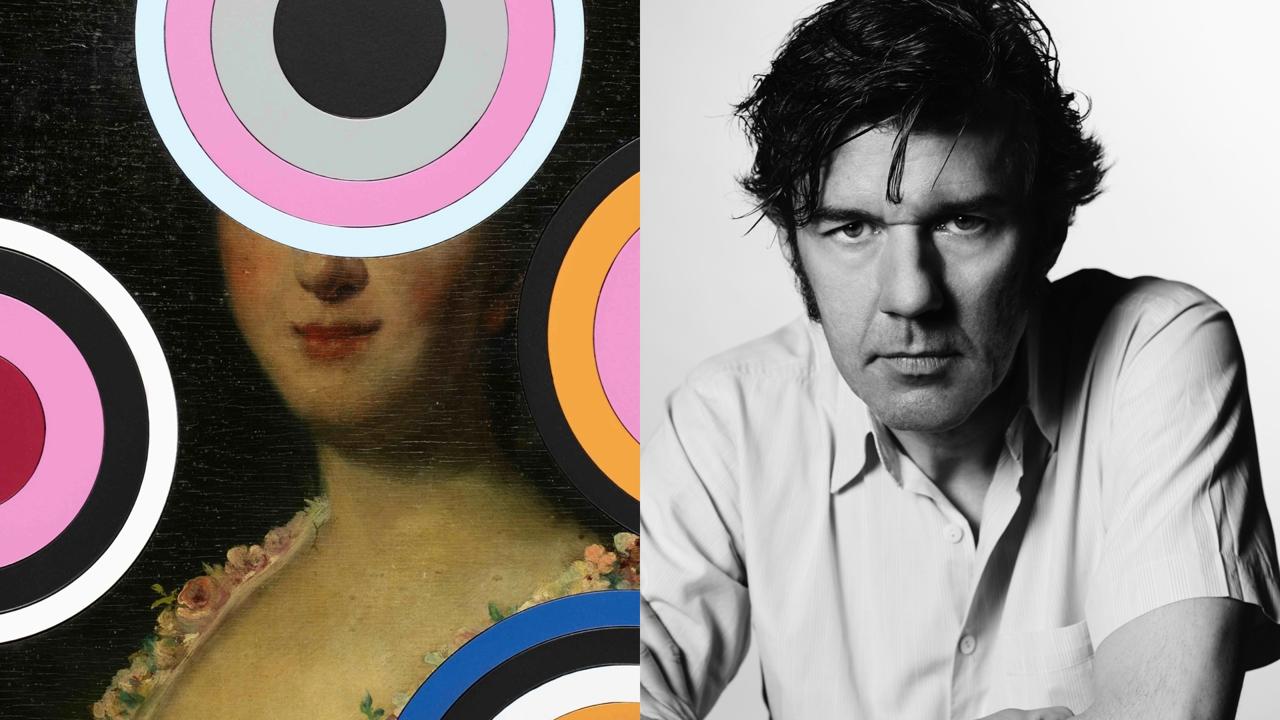
Stefan Sagmeister
Finally, something good.
Recorded live on Feb 17, 02026
at Cowell Theater in Fort Mason Center
"The world is terrible, and the world is better," Stefan Sagmeister said. "Both can be true." It all depends on perspective.
In his Long Now Talk, Finally, something good, Sagmeister urged us to zoom out. The faster the news cycle spins, and the more we scroll, the more we catastrophize. Meanwhile, the things that improve tend to do so slowly and quietly.
In this visually stunning talk, Sagmeister takes us on a journey through his body of work, transforming long-term data on human progress into striking works of art.
watch
primer
Sagmeister will be hosted by Lisa Kay Solomon, Designer in Residence and Lecturer at the Stanford d.school.
Acclaimed designer Stefan Sagmeister brings data to life to convey an uplifting message for our current times. Amid the stark reality of a world facing the aftermath of an unprecedented global pandemic, natural disasters, and political turmoil “Finally, Something Good” presents tangible evidence that, when assessed from a long-term perspective, most aspects of human development have improved.
Using relevant data from the United Nations, World Bank, and other global and national databases, Sagmeister artfully transforms the numbers into captivating visual representations that yield resonant understanding. By embedding information into eclectic mediums — antique paintings, clothing, sculptural objects, and installations — Sagmeister bridges the past and present, while telling a hopeful story of progress over time.
Why This Talk Matters Now
In a nonstop news cycle of crisis and outrage, Sagmeister’s work presses pause. This talk will give us a moment to reflect on the bigger picture. Sagmeister makes long-term progress more palpable, more perceptible, more human-scale. This talk won’t deny the present-day metacrisis, but will situate our current moment within the long upward arc of human advancement in health, education, safety, and quality of life. In doing so, he’ll challenge the helplessness that arises when we give into the panic, and falsely believe the future is in uncontestable decline.
The Long View
Sagmeister’s approach reinforces a core Long Now principle: we must see beyond the present moment to meaningfully steward future generations. His talk provides tools for thought and action to cultivate an expanded temporal awareness. Sagmeister’s work demonstrates how perspective itself is a design problem. By showing that collective human action has produced measurable gains over centuries, his work restores a sense of participation in history.
Learn More
- READ an Ideas essay by Sagmeister on why the world is improving more than we think.
- READ Sagmeister’s view on the long term
- WATCH the trailer for The Happy Film, an exploration of the psychology of happiness directed by Sagmeister, featuring Long Now alum and social psychologist Jonathan Haidt
- LISTEN to Sagmeister collaborator David Byrne’s Long Now Talk “Good News & Sleeping Beauties” from 02019
transcript
Rebecca Lendl
Welcome to The Long Now Podcast. I’m your host Rebecca Lendl, Executive Director here at The Long Now Foundation.
Why does it feel like the world is descending into chaos, even when, by many significant long-term measures, things are looking up?
That’s the tension at the heart of today’s Long Now Talk by iconic designer Stefan Sagmeister: The world can be terrible, and the world can also be getting better. Both are true.
Stefan argues that our information intake makes it harder to hold that complexity. The attention economy rewards speed and catastrophe. Good news, on the other hand, tends to move real slow.
So Stefan zooms us out. By translating long-term data on human progress into truly stunning works of art, he’s revealing the value of taking the long view: measurable gains across health, education, human rights, safety, democracy — hard-won outcomes that we fought for and we must keep fighting for.
And he keeps it practical, inviting us to ask — are we really all that useful — to ourselves to each other to the world — when we’re anxious and overwhelmed?
Widen the frame. Remember where we’ve been. Remember what’s still unfinished. Take the long view.
One note before we begin: Stefan’s work is intensely visual, and his images are his thesis. We really recommend checking out the video of this one over at youtube.com/longnow.
You’ll find a link in the show notes, as well as a ton of other great resources. After the talk, you’ll hear a fantastic Q&A with our Long Now host Lisa Kay Solomon, a Futurist in Residence and Lecturer at the Stanford d.school.
Now, before we dive in, a quick note: here at The Long Now Foundation, we are a counterweight — deepening our capacity to move wisely in these times of uncertainty. If you feel so inspired, we hope you’ll join us. Head over to longnow.org/donate to become a member and get connected to a whole world of long-term thinking.
With that, we’re excited to share with you — Finally, Something Good with Stefan Sagmeister
Stefan Sagmeister
Now, hello everybody. It truly is a pleasure to be here. Of course I have to say that, but in this case I actually truly mean it because this organization has been a huge influence on me. Some of you actually might even think that or might know a lot of the stuff that I'm talking about. But we'll start with a little survey just with a show of hands. Who here thinks that humanity will end pretty soon? So nobody here thinks humanity will end pretty soon. No, there's a couple. Five.
How about who thinks it'll be bad? Okay, do you have about 20? We'll be bored. Not so many. Carefully optimistic? Wow, look at this. Amazing. This is the most positive audience I've ever seen in my life. And who thinks things will be great? So we have number four clearly wins out there. I think things will be great and it'll be better about even now. Let's see about you personally. Who thinks that they're going to die pretty quickly? One person, first row.
Things will be bad, very few. Bored, also few. Carefully optimistic, the vast majority. And things will be great, wow. So what you've seen even in this hyperoptimistic crowd, positive crowd is that you believe that you're doing better than what the world is doing. And this is so widely spread. This is so unbelievably common that there actually is a whole field of study in psychology called the optimism gap because every single person in the world thinks exactly the same. In poor countries, in rich countries, it's not just your personal well-being, it's even opinions.
We all think we care much more about the environment than we think other people would. And this becomes the worst, the wider the circle. So you might think your family is still quite nice, the friends less so, the city less so, the country terrible and the world obssiminal. Now, I started to think about all of this when I was a designer in residence at this place. This is the American Academy in Rome. They give you a gorgeous studio with a view all over Rome. And the very, very best thing about the academy is that the food is delicious. They had Alice Waters doing a food program. The food in the American Academy is pretty much better than it is anywhere else in Rome. And the consequence of this of course is that all the 75 artists, designers, architects, writers, filmmakers, puppeteers, whoever is there, they all stay for lunch and dinner.
And while you're working all day in your beautiful studio, you're meeting twice a day for a very salon-like kind of dinner. And they have a system where you are at a different space every night. And one night I was placed next to a very smart lawyer. He worked at the European Court, he was the husband of one of the invited artists. And he told me that what we are seeing right now in Poland and in Brazil really means the end of modern democracy. And I didn't really comment much on this, but I thought it was interesting enough so that after dinner I went back into the studio when I did a little bit of research, meaning I put into Google what is modern democracy? When did it start? What's the story?
And it turned out that if you looked at it 200 years ago, there was a single democratic country, the United States a hundred years ago, there were 16 after World War I and the United Nations today say that they are 86 countries that are seen that they would say are proper democracies. It's for the first time in human history that more than half of all people live in a democratic system. So my highly educated lawyer, a guy who reads five newspapers in three languages every single day, had no clue about the world that he lives in, no idea, he completely utterly misjudged the situation that he's in. At that point when he told me this was seven years ago, we were five years away from absolute top-of-the-pops peak democratic situation. Five years before the world had never in the history of the world been more democratic and this highly educated guy thinks it's all going to end.
This, of course, I thought was a very juicy subject for a communication designer like myself, specifically because so many of my friends think exactly like my dinner companion. How did this come about? Well, one reason is that we used to have media that was yearly, like these almanacs that went to monthly, weekly magazines, daily newspapers, always on shows and constant social media. And of course the shorter the news cycle, the more negative the news because scandals and catastrophes happen to work brilliantly in that tiny short cycle. But while things that are actually good need an incredible long time to become good and they always fall out. In addition, my brain contains a shortcut, the amygdala, that allows negative news to come in but doesn't do the same thing for positivity. My brain can actually feel the danger before my eyes have a chance to send it back to the brain.
And of course, all of this comes from our predecessors in the Stone Age that really had a lot of reason for the amygdala to keep them safe. But I lead a very safe life and I'm convinced that this life would be much better informed if I would also look at it from the long term point of view. Because if I look at any human development from the long-term perspective, 10, 100, 200 years, basically everything has gotten better. Now you might say, "Well, what do you mean by better? We might have a different kind of opinion of what is good and what is bad." And I would make a proposal that in this room we actually all have a very similar kind of idea what it means to be better. I would say that we all would rather be alive than dead. We'd rather have food than be hungry.
We'd rather be knowledgeable than stupid. We would rather live in a democracy than a dictatorship. We would rather be healthy than sick and we would rather be at peace than at war. And the thing is, these things can actually be measured. And the fantastic thing is that these things actually have been measured. We have fantastic data from very trustable sources that measured over the past 200 years, and all of them have improved. Now of course you might say, "Well, this is a little cold, it's data, it's averaged, it doesn't really deal with my own life." And I'd say, "Yep, you have a point." So let's look at my family. These are my great-great-grandparents, Jacob and Johanna Sagmeister. Let's do another show of hands. Who has children here?
Wow, almost as many as happy people around here. Now I would say the many that just raised the hand, I think all of you would agree with me that the possible worst thing that could happen to you in your life, the absolute worst would be the death of a child. Now, this happened to my great-great-grandparents, not once or twice, but six times, six of their kids died and they didn't die a childbirth, they died as one, two, four, one died as an 8-year-old. These were real people, these were proud of their families and they died. Now, they were not haunted by terrible luck. It was just normal for 200 years ago what happened to pretty much any family in Central Europe, only 60% of all children survived into adulthood. My great-grandparents, the next generation of Sagmeisters didn't do all that much better. Five of their children died.
And this happened even though they actually belonged to the elite in Western Austria. And what made them part of the elite is because they could read and write and only 15% of all Austrians of their generation could read and write. And they owned a small antique store in my hometown of Bregenz and all the stuff that they couldn't sell wound up in the attic of the house that I grew up in. So I took some of these paintings and cut giant holes into them and put new canvases in them that kind of looked like minimal art but really were data visualizations.
My grandmother Josefine was actually the first woman in my family for whom it was possible to vote. And she had to wait until she was 48 years old because female voting came into Austria only in 1919. That tiny yellow dot, you can hardly see it up there is how many women worldwide were allowed to vote? Almost none. The giant purple circle shows how many women are voting now pretty much in every country around the world. The only one that does not allow women to vote is the Vatican, which is not the great record for a place founded by a woman and her baby.
So universal voting rights expanded female representation in government increased more women are working than ever before. So does that mean everything is fantastic? Does terrible AI animation show us that things are just hunky-dory? Well, of course not. In 1990, half of all Americans thought that women should go back into the kitchen. Half. This has been reduced down to now 20%, which still seems like quite a shocking number. And we want those things to be out there, not just in galleries, but also on clothes. So we created a whole little line of pieces. Every one visualizes a data set and is then inside explained by the label. Like this code shows the unbelievable drop in violent death all around the world.
500 years ago, your chances of being killed by the hand of another man were 25 times as high as they are today. And so we created a whole bunch of items. There's 12 items, but we don't do seasons. There won't be any next collections. So we probably are the single most lazy fashion brand on earth, which of course led directly to this logo, the koala stoned on eucalyptus, clearly the laziest animal in the forest. And in the same spirit, I actually did not design this koala logo myself, but I bought it for $200 on one of those discount logo websites.
When you buy something in the online cart, the koala is very happy if you take it out again, less so. This set of hand-painted glasses for the Viennese company, Lobmeyr, shows some of the small successes concerning the environment, like the rise in the signatories of the Kyoto Treaty represented by the number of leaves and scaled to actual data. When I was young, I worried about the whole bunch of things. There were population numbers exploding. You had inevitable famines, the deserts were advancing, garbage dumps were multiplying, sperm counts were lowering and the oil was running out.
And then when I moved to New York City, the Hudson was this dark, slow-moving [unknown] that you just wouldn't even have the idea that there would be a living creature in there, [let] alone, that you would eat something that came out of the Hudson. Now if you go to the New York State Public Health site, they say, "Well, if you're pregnant or below six months old, you still shouldn't eat fish from the Hudson." But for everybody else it's fine. And it looks like that we are going to have real healthy fish from the Hudson very, very soon.
Now, obviously, let's talk about the elephant in the room, the climate catastrophe. Clearly that did not happen 200 years ago. We actually started putting CO₂ into the atmosphere when we invented fire. Then we put a real turbo behind it during the Industrial Revolution. And one interesting point is that if you look at my grandmother, the one who was the first and my family to vote, she was a very frugal lady. She mended all the socks, never had a car, never ever was in an airplane, and still her CO₂ footprint was double of mine. How is that possible? Didn't do anything and had a ten-ton CO₂ footprint per year while mine, well actually mine is higher, but the average Austrian would be five. The stuff that her generation burned the coal and the wood was so unbelievably inefficient that they got up to such a incredible high footprint.
In addition, I would say that we actually did solve very large problems before. I see that many of you in this audience are old enough to have gone through all the headlines in the '90s about acid rain, the dying of the forests. We now in the United States and in Europe can say that this problem is basically gone. We actually tackled it and other countries are making fantastic progress too. Let's pivot and talk about war. So how about Ukraine?
Obviously it's terrible. I was on a podcast in Germany and the host asked me, "Would you bring this message to Ukraine?" And I said, "No, absolutely not." If you have bombs falling on your head, you have no interest in the fact that overall wars and death in wars is going down. And a week later I get contacted from a woman in Ukraine and she says, "Actually, we would love to get this message." And I said, well, I'll do this if we have a full hour of discussion possible afterwards. And this is exactly what happened. And that discussion was the first woman got up and said, "We should get your book translated in Ukrainian."
And I thought this will never ever happen. But then ultimately it did. And then somebody else said, "We should bring the exhibition over to Ukraine." And I thought, well, you can't even fly there. It says like no plane traffic. This will absolutely never happen. But they figured it out and they got a sponsor and it got created and the whole thing happened. And I found myself a couple of months later going to Warsaw, going to the border, being walking over the border, being picked up by another car from the border. Lviv of course turned out to be a completely lively city. All cobblestone streets a million people, UNESCO World Heritage status and the show was housed in fantastically converted shipping containers in the middle of the city in a park surprisingly elegant with fantastic lighting and sound. And I had a quick talk with the organizers. Should we actually show these war related paintings?
Fewer people do die in wars than in any other part in history and I wound up speaking very much like here at a place called Dysarium, 3,000 people in the room, 5,000 online, clearly all of them from Ukraine considering how difficult it is to get in the country. And I think you can see sort of the excitement part of this of course, also is just everybody was so happy that something was happening that wasn't directly talking about the war, considering how sick everybody over there is about that. And I can tell you I lost complete count by how often I've heard the message. Thank you for coming to Ukraine and bringing something so positive.
Of course, I do believe that negative news play a very important role. It does jolt us into action, but if it's all negative, people just simply stop trying. At a certain point, the apocalypse becomes background noise and a very important global survey last year with 10,000 young people from around the world between 15 and 25 only 53%, thought that humanity will not survive within their lifetimes, 53%. So that's basically the problem because this bear doesn't motivate, it paralyzes.
We've created a wall like this in various places. This really is a history of the end of the world showing some of the very smartest people from history, Isaac Newton among them that predicted the end of the world and were wrong about it. I also believe there's a certain kind of narcissism involved here. We could not have been the first people to trot on earth, so we would somehow find it sexy to be the last ones.
Now all of this is not trivial. This kind of crap is only possible when a majority of people in the country thinks everything is terrible. And it used to be so much better, and I blame the quality media. I blame the New York Times for this situation just as much as I do Fox News. If I ask Republicans, so tell me, when was it great America? 10 years ago? Couldn't have been because Obama was in charge. 20, 9/11, 50, Ronald Reagan ran with the exact same line, make America great again. So it couldn't have been great then. America was never great in the exact same way the world was never great. All this nostalgia is a complete mind trick because we do tend to forget the bad things quicker and we remember the good things and things didn't become good by themselves of course, they became good because people fought super hard for it, for women's rights, for democracy, for food, peace, education.
Obviously it didn't just happen. So this is not a call to sit back and relax. If I look at the past decades, how did social change happen? A great example would be the unbelievable success of the no smoking campaigns. Almost every country around the world cut the numbers of smokers into half. Some of them, like the UK cut them into a quarter. And if I see how these campaigns were working, it was through positive and negative reinforcements. We had fear the warning label, the terrible photos of what kind of disease you're going to get. But then you also had the promise of better health. You had the promise of all the money that you save. It really was a strategy of the carrot and the stick. And right now the media gives us plenty of the stick. And what I'm really trying to do is to offer a tiny bite of a carrot here and there.
I talk quickly about the process. The process actually is enjoyable. So I kept making more and more of these. It's actually, it feels closer to songwriting than to graphic design. We used to design a whole bunch of album covers, and when I watched these bands in the studio, it was very clear that when they wrote or when they worked on a song, it could start with a rhythm, a lyric, a mood, a guitar lick, it could come from anywhere. And this is sort of very similar because every piece can start with something different. A data set, a subject, an old painting. I normally test dozens of combinations. Sometimes the shape, sometimes the surface is in the lead. Sometimes it's a mix of meaning and form. The images look simple because the process is complex. We normally start separating the historic canvas from its frame, test the paint's flexibility, digitize the forms, cut them with a CNC machine, fold the canvas inside, then the inserts.
We paint, sand, paint, sand, paint, sand, paint again, and ultimately pour resin before they're inserted into the canvases. And we have a restoration expert on as part of the team. The overall atmosphere in the studio changed radically from a commercial graphic design office. Here we are casting bronze, which results in a new sculpture or this one. In this case I bought a 17th century Jesus that had no arms and legs. And then these arms and legs are added in bronze and then painted in automotive paint. But of course again is data based, data related. Now you might say, "So is this art or is this design?" And from a viewer's point of view, I'd say, "Who cares? Who gives a shit?"
If it moves you, it works. If it doesn't, it doesn't. I can have an experience in front of a Picasso or in front of a Milton Glaser, it doesn't really matter. But as a maker, I kind of have to care. And there I lean towards design because I do use the language of design, meaning I look at a very large subject matter, human development, a pretty large subject matter, and I try to communicate it. And so I would say that that's pretty much the definition of communication design. So I do believe this is still very much design. We also created these lenticular prints that change as you walk by. They focus on more recent data. There is a whole ton of them.
And then here and there, if a client allows us to do our subject in their space, we still do accept clients. So this is a bike path for in Arkansas, used another very long-lasting technique. These mosaics were then set directly into the concrete of a bike path. It's over a hundred different insects, all local insects from Arkansas that carry those gemstones all the way up this office building that you can bike into directly.
And then on the roof terrace, they deposit those gemstones into one of my favorite sentences in the same town, we also place these two giant fish and they're made out of hundreds of thousands of tiny little stainless steel pellets that are ultimately then animated by the wind. I stood in front of it when it was done and there were two boys, about 12-year-olds looking at it and one's at the other, I think it's made out of water. I drink between 12 and 14 cups of espresso every day. So the espresso cup is a very fine medium to drive this message home. This one shows how inequality developed over the past 100 years in the UK.
You'll ultimately be able to see the data curve reflected up from the saucer into the curved mirrored surface of the cup. When it comes down, you see, and then this is ultimately the data curve. You see that inequality actually used to be much worse, was the lowest somewhere 40 years ago and then became, went up again. The five major hospitals of Canada are actually all in Toronto and they are underground connected by these tunnels that if you need a surgery theater that is not offered in the hospital that you're in, you're going to be wheeled through one of these tunnels. Now imagine the bleakest hallway ever.
This is truly where optimism goes to die. And luckily we were asked to redesign them, the budget was low, so we couldn't really have any proper architectural interventions. We basically could paint it. So this is a before picture. And then this is after. Imagery from nature helped study had shown that calms patients, even though I think I read about a hundred studies connected to healing and design, and most of them ended with a sentence like, well, summing up, it is clear that more studies are necessary. We also didn't have the budgets to hide any of the pipes and the air conditioning ducts. So we just incorporated all of that into the design. And one of these hospitals is actually called SickKids. And of course the tunnels that led to that hospital, we created more playful and child-friendly.
Now, we had done large exhibitions like the Happy Show or we did one on beauty. And these exhibitions really sold nothing. They were about ideas, not about commerce, but this work is actually quite different. It's really meant to be bought and hung into a living room and lived with and basically used as a reminder that what was just trending on X really isn't the full story. It is not necessarily mean the end of the world. And collectors tell me that because of their odd look, they often lead to or quite nice dinner conversations. Now of course, not everybody can afford to buy a painting, so we also made these perforated posters and everybody's free to take one home. And that also seems to work quite well. There's a more detailed version of this entire idea out in a book published by Phaidon and we made some promo videos for this where a manatee is interviewing me.
We've shown this kind of work at 3,500 meters in the Alps as well as in the center of Tokyo in Ginza, in a Tadao Ando, building in Mexico and in one by Zaha Hadid in Seoul. In Korea, we use those silly air dancers, those inflatable guys that you might know from gas stations as a data biochart. You know life expectancy in Korea went from 27 to 83 years in just over a hundred years. And this outdoor installation is basically celebrating that. At the beginning, at the end, we also ran a small experiment. Visitors drew faces on ping pong balls at the very beginning of the show with some mixed results. And then at the end of the show, again, there were clearly a couple of more smiling faces all around the exhibition.
Posters also tend to carry data, and this one was from Shanghai where we also showed these embroideries created by Chinese masters in Suzhou. This is a city close to Shanghai craft-oriented city. All of this stuff is done by hand and the results are basically photorealistic. You can still read this typography in the hand embroidery. They of course do visualize the decrease of illiteracy and famines over the past two centuries. 200 years ago, 90% of all people lived in extreme poverty with only a very small elite ruling over them. And this is one of my most startling data points discovered by a Nobel prize-winning economist. The typical energy value of a meal in France in 1700 was the same as it is today in the Republic of Congo. Republic of Congo being among the most malnourished countries on earth right now.
And the United Nations actually predict that we will see the end of extreme poverty in our lifetime. The headline, 135,000 people escaped extreme poverty today could have run truthfully every single day for the past 25 years. So both of these statements are absolutely true. It literally just depends on your own timeframe. X or Twitter gives you one point of view. History will give you a completely different one. So if you post something, whether it's to your four followers or to 4 million, try posting something about the long term and this will be not so easy. There's a study in the journal nature from last year that shows very, very clearly that positive headlines just do get fewer clicks. So we could have actually sold significantly more books with this title and we could have really had a bestseller on our hand.
Let's try this again. Who thinks humanity will end? It will be bad? Five, 10. Bored? Five. Carefully optimistic? I'd say a good half. And things will be great? Unbelievable a third, yes. The most positive audience I've ever seen. So when I'm anxious, I'm really of very little help to everyone, friends, family or the world. I'm just not all that useful. If I'm doing well, I am so much better for the people surrounding me. So if you want a more balanced view of the world, I would urge you to scroll less through social media and read with the time saved more non-fiction books. You'll feel less anxious and you'll know more. Thank you so much. Thank you.
Lisa Kay Solomon
I want to stress again that so many of those magnificent data visualizations are described in this extraordinary book and they are available because I just want to hold on to every one of them. I want to go back to something you said earlier where you talked about how we are wired to take in news and how that served our ancestors, the amygdala putting us in a freeze or flight state, which is in many ways the exact opposite of what we need right now. We need to be generative and generous to handle some of the complexity. You make another point where you talk about we also seem to value critics more than we value enthusiasts, that somehow we find that they're smarter or we somehow assign an elite or an academic lens to those that are quick to come up with a critique. I wonder if you could talk a little bit about that component.
Stefan Sagmeister
Well, I think there's a survey in one of the Pinker books that shows that very clearly that the critic who hates the book is seen as much smarter, more intelligent than the critic who loves the book, who is kind of more naive, Pollyanna, and so on. I know that John Stuart Mill said it already hundreds of years ago, that we always think of the person who warns of fantastic danger as the wise sage while we ignore the positive ones. I think it's basically yes, exactly like you just pointed out, we are wired that way. And the sad part is that I'm myself am exactly the same way. You might have seen that of the album covers we designed.
We also did stuff for the Talking Heads and David Byrne and we stayed in touch and David has, I think he spoke here, no? Yes. And so for those of you who have seen this, David has a small media company called Reasons to be Cheerful that follows that basically he hires from his own money journalists to go after positive stories. And of course I follow it because I very much like David enjoy his company. But I have to admit I almost never read it. It's just so boring.
And I think that's the challenge. That's the thing. It's my suspicion and I don't have proof on that one, but my suspicion is just like the designers who always say that they are problem solvers are mostly just too lazy to tackle the very much how the problem of beauty because it's so much more difficult to solve a problem beautiful than just to solve it. 95 or 98 of all problems designers solve are super easy to solve and it's just laziness when you say, "Oh, I just want to make a utilitarian chair," like fuck you, this is like nothing. And I feel there is an equivalent going on in journalism where it's just so much easier to write to everybody wants to be interesting, to be interesting and to get clicks with a negative story that that's the default thing. And I also believe that many people in the media see their job as to report on what went wrong today. That's sort of almost the definition and all the things that actually worked out fine of course fall off.
Lisa Kay Solomon
Yeah, I mean I think we see so clearly how you tied in a way of inviting people to take a longer perspective that was much more than functional, much more than those charts and really inviting based on the selection of artifacts and how you then overlaid a new language to talk about progress that really engages people. I wonder if you could talk a little bit about that process of thinking about what would really get to that point of engaging, not boring, not something that you would turn off, not something that felt like really, look, eat your beets. It really is better. How did you think about that combination to get to that level beyond function, but really to beauty?
Stefan Sagmeister
I mean I think in the world of exhibitions as a designer, you have one significant advantage, which is that the people are in your space so you can do something with them. Now we did that extensively in those previous shows. Those very large shows were difficult to do after COVID because the museums that we can get in, which would be probably like, I don't know, like a B-plus museum, we can't get into the Metropolitan or into the Museum of Modern Art in New York because they have so many curators. They wouldn't want an exhibition that comes from outside and maybe the exhibition isn't good enough to get in there. That's very possible too, but we can get into the next year. And those museums ran out of money after COVID. So then I made very small exhibitions, but now we are enlarging again since some time away.
And there the goal is to involve the viewer as much as possible because if the viewer, if visitor, if she does something, if there is something to discover, if her and his brain have to work on figuring this out, the memory will be stronger. And so right now we are planning a big exhibition for Paris and there's definitely going to be things that also involve the viewer, which is I think a fantastic advantage of being in an exhibition. I don't really want to see interactive screens or any screens really because then I can deliver it on a website or I can deliver it to people at home. I don't need them to come here.
So I want an exhibition to create this space where you see something by yourself, but more often in a group with two, three people and you can talk about what you are seeing and what you're experiencing right there is almost no other medium, definitely TV a little bit, but not really the online, not at all. The phone, not at all. So I think that's a real big, this experience of being able to discuss something when you are in front of it with your partner or your friends or your family I think is a strong one. I think that goes without saying, we designed these exhibitions for a general audience. To me designing for designers, it's just the most boring crap. It also I think leads very quickly to circuitruchism. That's just not all that interesting.
Lisa Kay Solomon
In addition to the streaming of negative news that seems constant and the doom-scrolling, there's also another component of it, which is the attention splicing that we're distracted all of the time and yet so much of your work as seen here tonight, but also your practice in general is taking time for reflection, taking time to take in to really sit with the question. And of course you're famous for taking a sabbatical every seven years to go deep on a topic, happiness, beauty. I wonder if you could talk a little bit about the importance of reflection in the work.
Stefan Sagmeister
Well, I found that if you build anything successful, it's very much likely going to be that you're going to be very busy. And in that busyness I find myself, it's very difficult to step really back and reconsider. The first sabbatical was a big deal. I was very scared of it. I thought they're going to be forgotten. I thought it's going to look very unprofessional. I thought all our clients will leave us. And luckily it turned out that these were all assumptions in my head that didn't turn out to be true at all. Lou Reed actually moved his album date, his release date, so we could still design the cover. And then the second to third and the fourth sabbatical was super easy because I knew they're going to work. And the fact is that if you have a year to think about something, the results are just going to be different than if you have a weekend to think about something because you're going to think about different things, things of a different timescale.
We started projects in the sabbatical that we would've never started in the design studio because you can't think of starting a film when you never made one. When clients are calling and this has to be done and this has to be done. So I found it I would say looking back, because I've done four, there is something to look back on. I can say that most, not all, but most of the projects that are now dear to my heart had their origin in one of the sabbaticals, which literally means that not having done the sabbaticals, 80% of the work that I looking back think of that was meaningful for me to do, would've never existed, which is kind of crazy. So I would say it couldn't have been more fruitful.
Lisa Kay Solomon
Dare I say it's a long-term perspective on taking reflection. And also you are an avid diary keeper. And in reading some of your work that you've done about how they weave in and out from reflection to commercial opportunities, just keeping that constant ritual of having a diary also seemed to be very useful when you were tasked with some commercial opportunities. I want to talk about one more important component of the design process, which again, you mentioned a little bit in the tunnels and the hospital project, which is of constraints. That design is not just about being able to design anything for anyone, but is also about navigating constraints perceived or real. And I wonder if you could talk a little bit about how constraints have shown up in your work and maybe some ways that you tend to think of them as part of the input.
Stefan Sagmeister
I mean, I think for all designers, it's very, very clear that we work within a brief, but that includes a timeline, it includes a budget, it might include a color scheme, it might include very, very tight constraints. And I think most of us are very comfortable working within sometimes pushing against them. But it gives you a world to work in that is actually quite comfortable. And for me, when I first started to break out of the client world and well, in the very beginning it was actually clients. I see the book here. One of the first clients that had almost no constraints was a French billboard company. They just said, "We have series of five billboards, do something." And I could have done absolutely anything. And this turned out to be super difficult because what do I do when I can do anything? I was lost for a long time.
And then ultimately I found the list in my diary that said things I've learned in my life so far. And I had written 15 or 20 points underneath that and I thought I'll just publish one of these because at least I know it to be true. And ultimately, Surprisingly to me, even though I found it quite Self-centered, this series of billboards created incredible feedback. Like lots of people wrote it got republished dozens and dozens of times all around the world. So we did another one and then another one. And then because they all seemed to work as in with lots of feedback, people were interested in them, I started to talk clients into letting us do one of my things. I've learned sentences on their media that they paid for without their logo on it. So I'm pretty good salesperson, as you can tell.
Lisa Kay Solomon
I love that. And I love the one on the billboards. And I want to put a plug, which you did not ask me to do for this other book, which is just extraordinary piece of art, things I've learned in my life so far. Each one is its own maxim. And for the billboard project, it was trying to look good limits my life.
And imagine seeing that. And again, just the extraordinary breath of mediums that you use to communicate these maxims. Like there's one that's made out of 10,000 bananas that changed over time, that were live bananas and just extraordinary to see the risk-taking. And I think what's so clear about your work is the strong point of view that each piece brings. And I have to believe a lot of that is the reflection and the clarity that you have and the commitment to the craft and the process. I want to get into some of these fabulous audience questions. We have many. The first I want to bring in comes from Grace Hawthorne, who is a colleague and teacher at the d.school, author of Making Possibilities Happen, and she wonders, "Do you think the deluge of accessible content has desensitized or heightened people's sense of beauty and compassion today?"
Stefan Sagmeister
Wow. Beauty I think possibly up. I definitely see more beauty now than I did 20 years ago. And there is some, let's say if I take New York as an example, the worst three things in New York, I would say by far the ugliest things in New York other than the Facebook office. But the big institutional things would've been LaGuardia Airport, Penn Station, and the Port Authority Bus Terminal. I mean really examples of horror of where souls went to die. Even the brutalist architect Rudolph said for about Penn Station, "We used to arrive as kings, now we come as rats."
Literally loved by nobody. I've never ever heard anybody say a good word about Penn Station, and I have scientific proof how much it is hated. There is a New England large systems institute that does it with sentiment on Twitter where they can show geographically how many positive and negative tweets come out of a certain point. And Penn Station is always red, meaning more negative than positive comes out and let's say Grand Central is always green, more positive. LaGuardia has been renovated very nice, not fantastic, but a thousand times better. Penn Station is in the middle of it and the Port Authority is also going. So I think this idea that that it's all just about functionality was really a wrong idea of functionalism. Mostly between the '50s and I would say the year 2000s, and I think we reached peak ugliness around 2000 and are on a better path. Empathy, I'm not sure. I couldn't say. Yeah.
Lisa Kay Solomon
Well, that's some good news. We're on a better path of beauty. Caitlin has a great question. She wants to know what is the single most high leverage thing that can be done to translate this message and galvanize people to action.
Stefan Sagmeister
Wow.
Lisa Kay Solomon
We're optimistic and we want to move out here.
Stefan Sagmeister
The single most high level thing, well, if you are in publishing, I would say if this could become a trend in publishing that the person who can write positive and interesting, that that somehow is a goal, it's a challenge. It's a task that's much more juicy, much more interesting, much more difficult to achieve than the negativity. I think that will be brilliant. There is an example of that. There's a German weekly that looks like a paper called Die Zeit. It's a quality paper. It's super successful and it's obviously not all positive, but I would say it has a much higher percentage of positive news that is not for fluff. We are not talking about cats being rescued of trees than I think any other publication that I know. And I'm sure they're working their ass off because it's difficult. It really is.
I think if people in, and I'm sure there's a lot of people in media here, if anybody who is in charge or is part of media could somehow figure out or give me, send a mail on how to do that, to create this challenge out, that this would be a goal, that this is actually a difficult thing to achieve and work on that. I know that on my side, on my side, in the design world, I think making something beautiful is that. There I can give you the example if I have to design a chair that's just ergonomically okay and doesn't have any other things to do, I can design a hundred of these before we go for dinner because I know the height, I know the appropriate angle, and then I can steal either from history, it's just very easy to design a hundred functioning chairs.
But if that chair has to be make sense in 2026 and be beautiful, I am suddenly dealing with one of the most difficult design problems there is because I'm fighting 5,000 years of chair history. It's a really, really difficult problem. And so if that's possible in media with something that's positive but interesting, that captures the attention, I think that would be amazing.
Lisa Kay Solomon
Art Liu seems to pick up on how you've done that with this tremendous exhibit where he says, "Visualizing data as you do without labels and titles requires more work from the viewer. So here I think you are achieving this invitation to lean into something good, but also to have it make it be engaging."
Stefan Sagmeister
But also there we tried out everything. So we tried out just the paintings and somewhere else a list that you can take. We tried out QR codes, we tried out traditional labels. What I now found works the best is that I write the title and a sentence of what it is about in handwriting and then have everything else, all the data where the painting comes from, where the source of the data comes from in small set type underneath it. I found that that seems like gets people to read the most i, like everybody else hate reading in museums, you're standing, you don't want to read very long texts. So we work very hard to keep it as precise as possible. And then the actual data, specifically sources and things are really very small. For those people who really want to know.
Lisa Kay Solomon
That is a deep commitment to craft, not just iterating on the piece, but also how the piece is communicated and to keep at it. Our final question tonight, I want to offer from Kevin Kelly who wants to know if everything went right, what is the best case scenario for the future of design?
Stefan Sagmeister
Well, I recently last week joined this AI board at Adobe with a lot of caution. And I think one future that I could see that I would very much like is I had a mentor, super important to me. His name was Tibor Kalman. If there's designers in the room, you might know him. His most famous piece of work was probably Colors magazine that's still around. And Tibor could not design. He didn't know how to do a layout. He could not master the craft and the skill of design always pretended not to know what Helvetica was. He did know what Helvetica was, but the whole thing became a little bit of a shtick.
But he was very charismatic. He had a very strong point of view. He had a whole bunch of good ideas and he had a vision. And so he knew how to hire people who could do it, including me. I worked for him for a while. From my point of view, this was the best design company in New York at that time. And I could see that moving forward that a designer is a person with a very strong point of view who can make things happen with AI and with traditional means. But I could see meaning. I would think that that would be a joyful way to be a designer.
Lisa Kay Solomon
Well, again, we hear the point of view at the center and I know you have a strong point of view that things that have a human touch are always better designed. Stefan, I want to thank you so much for joining us and I have a final special gift for you. I know one of your maxims in here is to make sure that you enjoy the finer things in life, the material things in small quantities. So I could not get you your macarons from Switzerland, but I did get you some macarons from a beautiful bakery in the Bay Area.
Stefan Sagmeister
Oh, wow. Fantastic. Thank you so much.
Lisa Kay Solomon
And just six of them. Just six.
Stefan Sagmeister
Thank you.
Rebecca Lendl
If you enjoyed this Long Now Talk, we invite you to head over to longnow.org to learn more, and of course to become a member and get connected to a whole world of long-term thinking.
Huge thanks to our generous speaker, Stefan Sagmeister, along with our host Lisa Kay Solomon.
And, as always, thanks to you, our dear listeners, and our thousands of Long Now members and supporters around the globe.
And appreciation to our podcast and video producers: Justin Oliphant and Shannon Breen and to our entire team at Long Now who bring Long Now Talks and programs to life.
Today’s music comes from Jason Wool, and Brian Eno’s “January 07003: Bell Studies for the Clock of the Long Now”.
Stay tuned and onward!
bio
Stefan Sagmeister has designed for clients as diverse as the Rolling Stones, HBO, and the Guggenheim Museum. He’s a two time Grammy winner and also earned practically every important international design award.
Stefan talks about the large subjects of our lives like happiness or beauty, how they connect to design and what that actually means to our everyday lives. He spoke 5 times at the official TED, making him one of the three most frequently invited TED speakers.
His books sell in the hundreds of thousands and his exhibitions have been mounted in museums around the world. His exhibit "The Happy Show" attracted way over half a million visitors worldwide and became the most visited graphic design show in history.
A native of Austria, he received his MFA from the University of Applied Arts in Vienna and, as a Fulbright Scholar, a master’s degree from Pratt Institute in New York.
Join our newsletter for the latest in long-term thinking
Subscribe