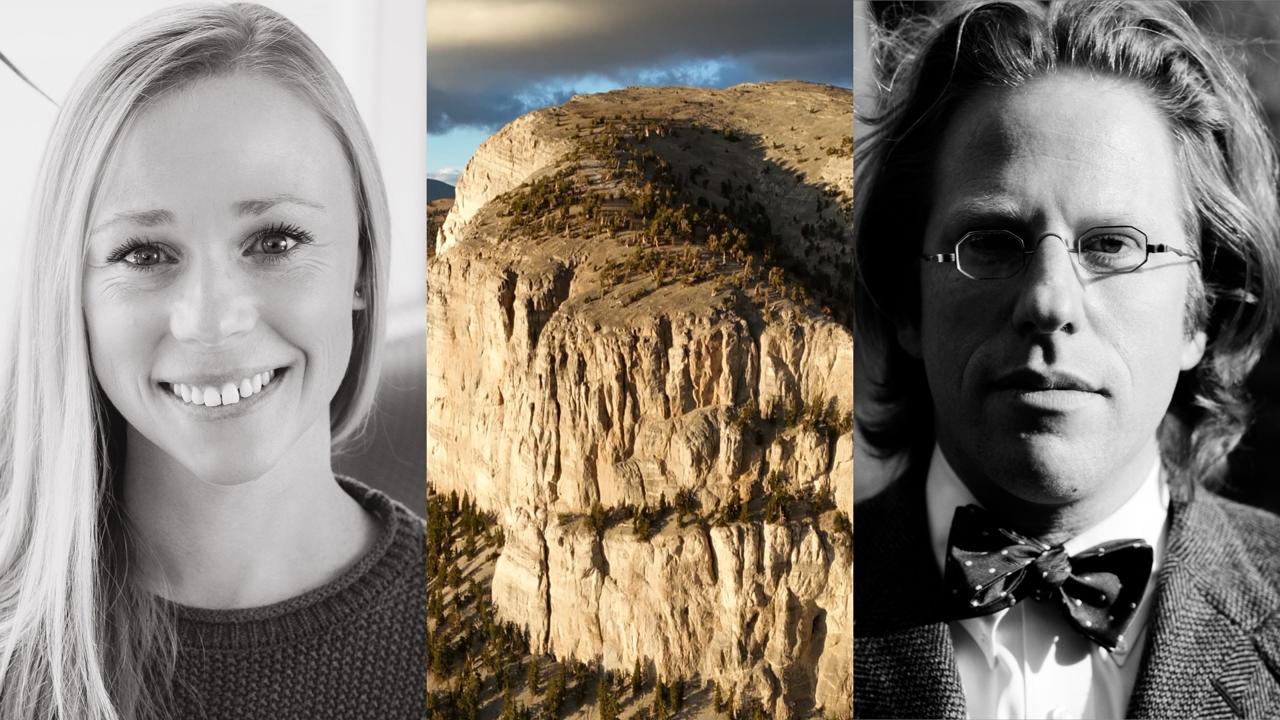
Anne Heggli, Jonathon Keats, & Adam Csank
Art & Science at the Nevada Bristlecone Preserve
Recorded live on Sep 29, 02026
at The Interval at Long Now
In a remote corner of the driest state in the country, Anne Heggli's team has been keeping watch over some of Earth’s oldest beings. Since 02012, Heggli’s NevCAN network has recorded conditions at the Nevada Bristlecone Preserve every eight minutes. The result is more than 120 million data points and a high-resolution portrait of how a bristlecone pine thrives.
Paleoclimatologist Adam Csank showed how bristlecone microcores reveal the droughts and floods these trees survived long before us, a history that fine-tunes models of what's ahead. Artist and philosopher Jonathon Keats went further. “The most accurate clock,” he said, “is a tree.” His monumental artwork Centuries of the Bristlecone keeps bristlecone time, a clock calibrated to the trees' own growth over millennia.
Together, Heggli, Keats and Csank made the case for long science: patient, continuous observation that will help us answer future urgent questions. “Data at this resolution,” Csank said, “is like a Rosetta Stone” for understanding nature’s resilience. At fourteen years young, the bristlecone record is just beginning, Heggli said, but it already holds the key to questions like these: How will bristlecones adapt? What happens when the droughts and floods they've weathered for millennia arrive faster and more frequently? “We can't answer the questions if we're not watching,” said Csank.
“We are the stewards of this data,” Heggli concluded. “This is why we need long science.”
watch
primer
For the first time in over a decade of research, Long Now Research Fellow Anne Heggli will present her synthesis of high-resolution climate data collected using paradigm-shifting long science principles at Long Now's Nevada Bristlecone Preserve in the Great Basin.
Since 02012, Heggli’s team has monitored an eight-station transect running from the floor of Spring Valley, up through Nevada's subalpine zone, and back down into Snake Valley. Among the bristlecone pines, the Nevada Climate-ecohydrological Assessment Network (NevCAN) collects data every 10 minutes, around the clock. It records the environmental ingredients that trees use to grow, ring by ring — from temperature and precipitation to soil moisture. In a way, this data can be used as a recipe book to grow a bristlecone. In this talk, Heggli will introduce NevCAN and unearth the value of high-resolution environmental monitoring taking place in the Snake Range of the Great Basin.
The evening will also feature Elders of Time, a documentary following the installation of Centuries of the Bristlecone, a multi-millennial artwork by Jonathon Keats commissioned by the Nevada Museum of Art in partnership with The Long Now Foundation. The piece has two components: a monumental arboreal clock and a land art installation sited at Long Now’s Nevada Bristlecone Preserve. Jonathon Keats will join us to discuss “bristlecone time,” his tree-calibrated temporal standard, and how it exposes the limitations of Universal Standard Time.
Adam Csank, paleoclimatologist and dendrochronologist, will present the science behind bristlecone time, introducing his new long-term studies of bristlecone growth rates at the Preserve in support of Centuries of the Bristlecone.
Why This Talk Matters Now
There has been very little long-term multi-decadal work studying bristlecone regeneration until now. The Great Basin is a region with high climate variability both interannually and interdecadally. As the long science is drawn out, bristlecones have lessons to teach us about resilience and adaptation over vast timescales.
The Long View
“Long science” is research designed to unfold across decades, centuries, and beyond. Long Now is committed to advancing this type of study, which we believe is integral for meaningfully stewarding our planet. Long science requires patience, continuity, and the ability to think beyond a single human lifespan, qualities that bristlecone pines themselves inspire.
Learn More
- READ Anne Heggli’s Long Science in the Nevada Bristlecone Preserve in Long Now Ideas
- READ the interview with Great Basin scientist Scotty Strachan
- LEARN more about the Great Basin Mountain Observatory for Long Science
- WATCH the preview for Elders of Time
bio
Anne Heggli is a passionate snow, water, and climate scientist focused on improving observational methods and actionable environmental data. Her work focuses on long-term monitoring of mountain hydro/biosphere systems that informs the understanding of larger scale processes and water resources. Her entrepreneurial background in international weather monitoring, hardware development, and sensor systems consulting has perfectly prepared her to advance practical climate and weather research in the academic and public agency space. Anne is also a research scientist at the Desert Research Institute, and completed her Ph.D. in Atmospheric Science at the University of Nevada, Reno. Her peer-reviewed work has been published in iScience, the Earth and Space Science Open Archive, the Bulletin of the American Meteorological Society, and Western Snow Conference Proceedings. She has presented at the Southern California Academy of Sciences, the North America MtnClim Conference, Ecological Society of America, the California Cooperative Snow Survey Conference, the Airborne Snow Observatories Workshop, and the International Atmospheric River Conference. Anne has been awarded previous Fellowships by the Nevada NASA Space Grant and Southwest Climate Adaptation Science Center, and is a Graduate Dean’s Merit Scholar at the University of Nevada, Reno.
Jonathon Keats is an artist, writer and experimental philosopher. His conceptually-driven transdisciplinary projects explore all aspects of society, adapting methods from the sciences and the humanities. He has exhibited and lectured at dozens of institutions worldwide, from the Los Angeles County Museum of Art to Stanford University to the Triennale di Milano, and from SXSW to CERN to UNESCO. He is the author of six books on subjects ranging from science and technology to art and design – most recently You Belong to the Universe: Buckminster Fuller and the Future, published by Oxford University Press – and is the author of a weekly online art and design column for Forbes. He has been an artist-in residence at the Fraunhofer Institute for Building Physics, UC Berkeley's Sagehen Creek Field Station, and the LACMA Art + Technology Lab, a Black Mountain College Legacy Fellow at the University of North Carolina-Asheville, an Imaginary Fellow at Arizona State University’s Center for Science and the Imagination, and a Research Fellow at the Nevada Museum of Art's Center for Art + Environment. He is currently a research associate at the University of Arizona’s Desert Laboratory on Tumamoc Hill, a visiting scholar at San Jose State University’s CADRE Laboratory for New Media, a research fellow at the Highland Institute, a consulting philosopher at Earth Law Center, a Polar Lab artist at the Anchorage Museum, a Flux Exchange Artist at Flux Projects, and an artist-in-residence at Hyundai, the SETI Institute, and UC San Francisco’s Memory and Aging Center. He co-directs the Center for Climate-Adapted Heritage Cuisine and serves as curatorial director of the Museum of Future History.
Adam Csank is a paleoclimatologist and paleoecologist with expertise in stable isotope geochemistry and dendrochronology. His primary research involves the use of stable isotope dendrochronology to reconstruct past climates and the impacts of climate change on trees over time periods ranging from the Pliocene to the present. Csank also works at the intersection of human and physical geography in the growing area of critical physical geography using historic timbers to study legacies of exploitation related to the timber trade. Csank also works to understand historic land use patterns and to find novel ways to use paleodata to inform climate adaptation by understanding risk, vulnerability and resiliency. Past projects include studies ranging from climate reconstructions to land use change to studies of drought and tree mortality. Ongoing projects include reconstructions of climate and ecosystems in the Arctic, the response of trees to climatic change, reconstructions of large-scale atmospheric patterns, streamflow and lake levels and reconstructing historic atmospheric pollution. In his research Dr. Csank has worked in diverse settings both locally and internationally including the Canadian Arctic, Greenland, throughout the western US, eastern Canada, Bermuda, Jamaica and Italy.
Join our newsletter for the latest in long-term thinking
Subscribe