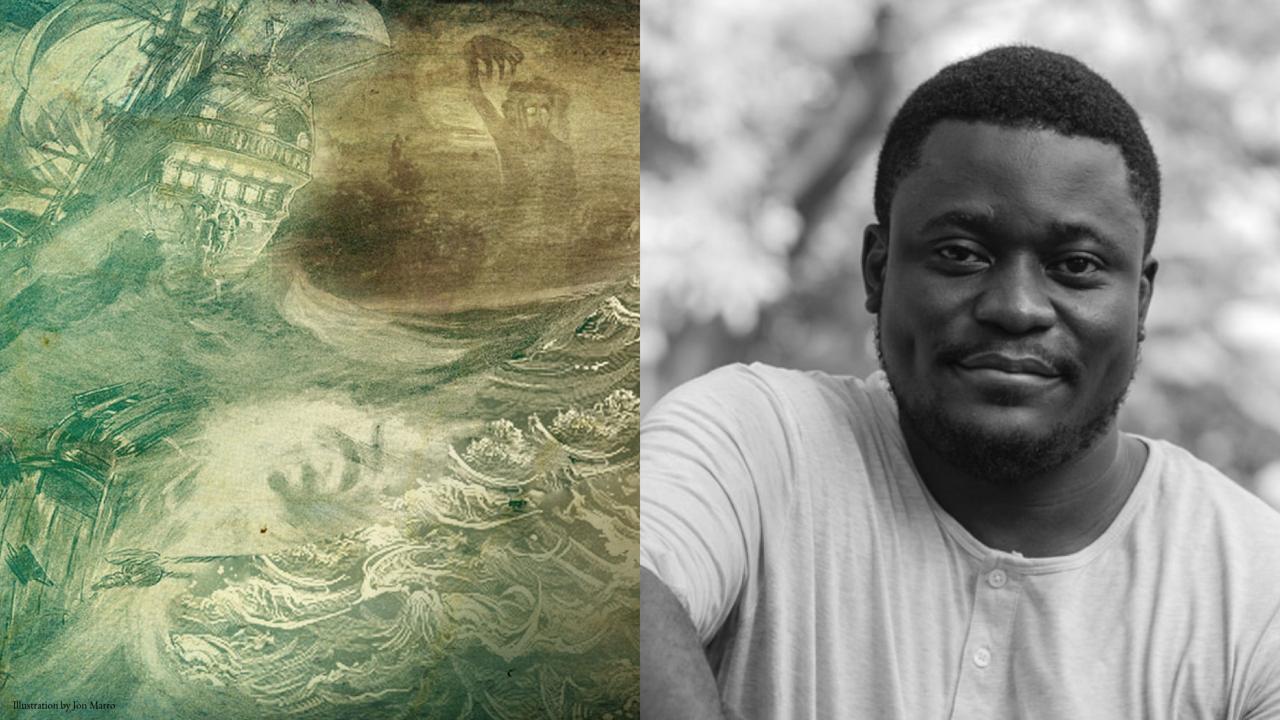
Bayo Akomolafe
The Untimely
Recorded live on May 5, 02026
at Cowell Theater in Fort Mason Center
In his Talk, poet-philosopher Bayo Akomolafe presented a riveting critique of linear time, and gave a persuasive invitation to step sideways, to slow down, to notice the cracks in our temporal systems. Through Yoruba cosmology, slave ship histories, and decolonization strategies, he invited us to look at the space between the tick and the tock, to sit in the uncomfortable and incomplete. Only here, in what Akomolafe calls “parapolitics of the untimely,” can we ask, “What does untimeliness make possible?”
watch
primer
This talk is co-presented by Ayin Press, publisher of Akomolafe's next book, Selah: A Báyò Akómoláfé Reader. Akomolafe will be hosted by Eden Pearlstein, cofounder of Ayin Press.
Temporal droppings.
Autistic meanderings that stray from linearity.
Little sedimentations, little curls of temporality.
Dense knots clogging the otherwise smooth materiality of time in its totalizing productions.
Mischievous bebops lurking between the tick and the tock, upsetting the steady count.
The clock's disability.
These are some of the many ways Bayo Akomolafe wrestles to articulate what he calls the “untimely.” But perhaps his most pressing meaning can be discerned from the scandalous question he asks: “What if time misbehaves?” What if time - far from being a simple line that carries on into steady futures through mediating nows and exhausted pasts - careens off the highway, swirls into circuitous paths, and produces monstrous bodies that the imperial tick-tock cannot metabolize?
Why This Talk Matters Now
In an Anthropocenic moment when the Doomsday Clock inches closer than ever to midnight; when climate scientists tell us we have less time than we think to get our act together; and, when the pillars of global coordination are being dismantled by the rise of authoritarianism, the bitter urge is to argue with the gods for more time, or to imagine ourselves returning to a safer place on the timeline. But Akomolafe argues our “fixes” often reproduce the problem, and offers alternatives to progress narratives as the default response.
The Long View
Akomolafe urges us to deepen the practice of long-term thinking by exploring other temporal dimensions. He asks us who gets to move through time seamlessly in the first place, and what gets buried or forgotten when a single framework is universalized.
Learn More
- WATCH “A New Theory of the Self” with fellow Long Now Council member Indy Johar on entanglement, selfhood, and the crisis of the individual.
- LISTEN The Edges in the Middle series on For The Wild podcast — ongoing conversations with Naomi Klein, john a. powell, and others.
Book cover image courtesy of Ayin press, designed by Melissa Weiss, illustrated by Krista Dragomer
transcript
Bayo Akomolafe
That’s my sense of the untimely. Not the time counting, not a future that we know, but a staying with uncertainty, staying with failure, staying with that which doesn’t fit. It’s the invitation of our moment.
Rebecca Lendl
Welcome to The Long Now Podcast. I’m your host Rebecca Lendl, Executive Director here at The Long Now Foundation.
We are, by nature here, an institution that takes time seriously, operating within the context of the next and last 10,000 years. So what happens when a thinker comes along who playfully refuses the architecture of past, present, and future altogether?
That's philosopher Bayo Akomolafe, and his provocation in today’s episode is that the clock that we've been trying to escape is producing something far more interesting than time. Between every tick and every tock, Bayo says, there's a surplus — an interval, something beyond the count, something generated in between.
And this is what Bayo calls The Untimely: not an alternative to clock time — because an alternative, he argues, only reinforces the logic — to be anti-clock is to repeat the thesis of the clock.
Instead, look closer. The cracks are openings, and in those openings are different kinds of futures and different kinds of pasts.
Now, the energy in the room for this one was absolutely electric — so you’re in for something very special. For more, please check out Bayo's new book Selah, published by Ayin Press. You'll find a link to that and a ton of great resources in our show notes.
Now, before we dive in, a quick note. Here at The Long Now Foundation, we are a counterweight — deepening our capacity to move wisely in these times of uncertainty. If you feel so inspired, we hope you’ll join us. Head over to longnow.org/donate to become a member and get connected to a whole world of long-term thinking.
With that, we’re excited to share with you — The Untimely with Bayo Akomolafe and our guest host Eden Pearlstein, cofounder of Ayin Press and editor of Selah.
Bayo Akomolafe
Good evening. Thank you for coming out to listen to this talk on the Untimely. I'm still working on what this means, but I thought that we could share together and create theory together, which is the best kind of theory, the incomplete ones. I want to give thanks to time. Okay? We rarely do give thanks to time, right? We just imagined time, like Eden came out a while ago and said, "Time is just there." There's this presumption that time is just this universal backdrop, right? But I want to thank time in a way, at least in the popular imaginations that we have about time. In a sense, we are a time's story, right? This is, in a sense, time's tale, its own speech. If there were any grand narrator of the emergence of the universe or the emergence of species, it would be time with David Attenborough’s voice.
But yes, we seem to be living in time's story. We're speaking about beginnings, we're speaking about time. It's been by ending, we're speaking about time. Time seems to be all in all. I grew up in Nigeria and we had songs that basically came down to the idea that time is money, right? And you must invest your time. And we went to time management classes. How many of you have been to time management classes? Just raise your hands up. Don't be shy. How many of you actually got good with managing your time from those management classes? Oh, oh, okay.
Right? They're just like the work-life balance classes that don't actually balance anything out. But that's how we see time is this massive wallpaper, this background, this eternal witness to everything that persists and exists. And yet it seems we're in a time when time is misbehaving, right? It seems we're in a moment when time isn't doing what we expect it to do. I said to some folks yesterday that it seems that time now is calibrated to our extinction, right? We call that the anthropocene. It's the idea that we are in a sense already dead and we're just moving inexorably towards that threshold of no return. And so you hear people speaking about there's no more time or that we have two more years. That's the new one. In 2028, we would have crossed the threshold of no return and climate effects would kick us into oblivion or out of the Garden of Eden, right?
And that's the new prognosis. That's the new idea. We keep on running out of time. Simon Steele, he's the executive secretary of the UNFCC. I'm not sure how many C’s there are. He's the dude that is in charge of the UN's framework for climate change. And he said in 2025 or 2024 that we had two more years. So the world is supposed to end around this time, according to him, where in a day and a time when time seems to be winding down and there's something scary and upsetting and unfurling about that. And so what we're doing is we are proliferating all the kinds of temporalities in response. And so we have indigenous time and some people speak about spiritual time and some people speak about yoga time and some people speak about hammer time.
We're proliferating the clocks, aren't we? Too many times. We're proliferating clocks as if to create an alternative to the massive disappointment that classical time is, right? The standard time is isn’t treating us too well. So let's proliferate all the clocks. There's long time, there's deep time. You've heard about long time, right? It's what exactly my brothers and sisters in this organization are doing. Let's build the 10,000 year clock, right? But there's something about building 10,000 year clocks or deep time, it's deep geologic time considering the massive scale of our emergence, right? Billions of years. If we consider that, maybe that would be something to do other than what we are already incarcerated in in classical time. But long time, which is preservationist and deep time, they don't quite dislodge us from the logic of modernity, which is the logic of our supremacy, because you can extend time and still keep yourself in the seat of mastery, right?
You can say, let's think 10,000 years into the future, but you still keep yourself central in that analysis. And deep geological time isn't really shaking us off from that orbit either because it's the idea that if we thought millions of years into the past or millions of years into the future, we might be humble, but I don't think it's making us humble at all. In fact, what it's doing is giving us the sense of pride that look at us with the capacity to calculate millions of years into the future. So it seems the centrality of humans is maintained no matter how deep you go, how far you go, how far you travel. So that is a problem. If all the kinds of alternatives we're creating to upset standard classical time is just repeating the logic of centrality, then we're stuck and we're going around in circles and we're really stuck in time and there's nothing else to do at first glance. And this is where my suspicion kicks in. As a black studies scholar, I am programmatically suspicious of time.
I don't take time for granted. It comes from my training. It's not just Frantz Fanon. It's not just CLR James. It's not just Fred Moulton. It's not just. It seems that all the people who nourish me have from a distance taught me to look with squinted eyes at this notion of time, because of the ways that we've accepted it as a category. So I want to speak tonight about time differently, not in the ways we are programmed or habituated or taught to think about time. I want to take a step back and think about time in different ways and then introduce this concept of the untimely. And what I mean by the untimely will be unpacked gently. And remember, I'm still working this thing out, okay? It's still unfurling, but there's such promise in the unpacking. To do this, I want to tell you a story, and some of you have heard the story before. Some of my siblings have heard the story before. It comes from Nigeria. So here's a question. How many of you know the country that has the most twins.
On the planet? I've said this before. Some of you may ... If you know the answer, keep your hands down, okay? But if you don't know the answer, you're my people, right now. You know where the earth produces more twins than any other place on the planet. Just raise your hands up. There's a prize. There's money involved in this. If you get it right. Can't see your hands really. No, no. Absolutely not you. I'll just tell you, it's Nigeria. Nigeria has more twins than any other place on the planet. You can check it out on Google if you want. The last time I checked, I think our averages were so far beyond the global average that it's a phenomenon. Like scientists travel to a place in Nigeria called Igbo-Ora. It's a Yoruba place. You people know the Orishas and you've heard about the Yoruba people, right? Have you heard about Nigeria?
It's just next to Wakanda. I shouldn't do that. Okay. So Igbo-Ora produces more twins than any other place on the planet. And as a result, we have twin sensitive technologies and rituals. For instance, the way we name our children, according to their birth order and according to their proximity to the twins, the first child that comes out, right? The first child of the peer of twins that comes out is always named Taiwo. Okay? And the second born, any twins in the house? Good. Okay. I'll tell you stuff about yourself. The second of the pair is called Kehinde. So Taiwo means I came out first to see the world, right? That's what it means literally. I came out first and Kehinde means I came out after the dude that came out first. I came out after person, right?
And so if you travel to Igbo-Ora in Nigeria, the second on the list is India, by the way, Nigeria's first and India second, I don't know who's third, but if we traveled there and you asked the people, how come you have twins all the time? What's the secret sauce? They don't know themselves. It's been the study of multiple documentaries. No one understands why we have twins at this rate. Why are we producing twins? Anyway, I digress. Taiwo comes out first, Kehinde comes out second. But according to the Yurobah people, some queer story is happening there because in the tummy of the mother, Taiwo is actually the younger one, okay?
Not Kehinde. Taiwo is the younger one. Remember, Taiwo comes out first, but in the belly, Taiwo is the younger one. So the story is Kehinde who is older in the belly says to Taiwo. So you go out into the world, check things out, see if things are fine, and if they're fine, I want you to scream loudly, and that's the cue that I will ... And I'll follow suit. So that's the idea. So Taiwo comes out first, and in our own temporality, Taiwo is older because Taiwo comes out first, but Taiwo in the belly is the one that’s sent to go see the world first, right? Now, I tell you this story because I met a woman in 1980 ... No, I mean, she told me her story, not that I met her in the 1980s, I was born in 1980s. She had twins in 1981.
I don't remember the month, but that's inconsequential now because when she had those twins, the day she had the twins, her boys, they died. The same day she had those boys, they died. The first one came out too soon. Taiwo came out too soon and died, and the second one was incubated, and the nurse handling this boy did not handle him appropriately. And so this woman tells me that her son was killed. She used the word murdered, that my son was murdered. And of course, it's a horrible thing to lose one child. Not to speak of two children in a single day. I know this woman because she's my mom, she's my mother, and I only got to learn this story recently in all its dimensions. It was a family secret, but not quite a secret. It was kind of floating in the air and never quite landing for gestation, for digestion.
And I've been speaking with my mom and writing a new book about this right now. And I came after my brothers died. I came afterwards, and there's a story here as well, because the child that comes after the twins also has a special name. So it's Taiwo and Kehinde and Ìdowú according to the Yoruba people. And Ìdowú also means something very simple. It means I came after the twins. That's what it means, right? And I came after the twins. I was grown in that field, the sweltering heat of trauma and came out into the world, but there's something really powerful here because according to the Yoruba people, Ìdowú is older than the twins.
Ìdowú is the oldest. Why? Because the Yoruba people say that twins come with a feverish energy into the planet or into the world or out of the world, right? They come with such charge and speculative power. In fact, it is believed that a single soul comes into the world and takes two bodies, right? That's how twins are born. But there's something about twins that could quickly debilitate the community that hosts them. And so it is said, this is a proverb, a real one. It said that a mother who has twins, but does not have an Ìdowú who will grow mad, right? That you must have an Ìdowú and the Ìdowú’s work is to hold the charge of the twins. I don't know how true that is in your experience, but the one who comes after the twins in Yoruba cosmology is to hold the twins, not to resolve them, but to kind of be in excess of them, to be beyond them in some sense, to host them, to be hospitable to them, not to resolve the binary, but to hold the binary, just to kind of compost the binary.
So Ìdowú's work is challenging, it's beautiful. And my elders tell me now that, of course, my brothers have been sublimated into the atmosphere, and so I must meet culture as if it's my brothers, right? I must hold the binary of modernity as if those are my brothers. And that's the way that I want to enter into the story of the untimely, right? Because the untimely is Ìdowú. When I'm thinking about the untimely, I'm speaking about Ìdowú and Ìdowú is the excess, the residue, the surplus of temporality. We're speaking about that which cannot be resolved in time. And I'm inviting us with this concept to not try to create logics of alternatives. I think to myself most of the time that one of the most devastating things that activists said to my retachers, there is no alternative was to insist that there are alternatives because to create an alternative is to repeat the logic of what you're escaping from.
Like, "Oh, there's an alternative to capitalism. What's that anti-capitalism?" And then capitalism is like, yes, yes, indeed, right? How do I make a product out of anti-capitalism? How do I make it juicy and productive? And then that's exactly what we do when we create alternatives. We create the same logic and we duplicate it. And it's like twins, we just replicate it. What we are being invited to by trickster cultures, by feminist epistemologies, by indigenous cosmologies, by black studies, is to notice the excess, the excess, the surplus. And so my provocation this evening is that the clock is what we should turn to. The clock we've been trying to get away from, because in my opinion, the clock is producing much more than time. The clock is secreting a strange kind of Ìdowú. It's not just the tick and the tock. There's something in between the tick and the tock.
There's something in between. It's the Ìdowú. There's something older than the count that wants to get our attention. And I want to speak about that. I want to speak about that and go through a little bit of history. I don't want to take too much time to speak about time, but the invitation is to stay in the places where the clock is not quite itself.
I had some things that I wrote when I was introducing this topic to the public. I wrote temporal droppings. Temporal droppings, that's when I take the shit. Artistic meanderings that stray from linearity, little sedimentations, little curls of temporality. I'm trying to describe something that almost resists language. But my best way to describe it is as Ìdowú. The excess. The third that is not part of the count, but that breaks the count itself. It's not one, two, three. It's one, two. That's what Ìdowú is: it breaks the counting. There's something about the clock that produces something in excess of itself. But let's go back in history. Let's go to the black Atlantic to consider the clock and why I'm saying the things I'm saying about timeliness or untimeliness. Frantz Fanon, anyone know the dude? Upcoming intellectual.
He had lots of things to say about time. He had lots of things to say about black bodies. Sylvia Winter, Hortense Winters. These are people that I think with today. They had things to say about the man. They had things to say about the flesh and the hieroglyphics of the flesh. A particular story that bears upon my mind right now is the story of the middle passage. 400 years on the black Atlantic, the carrying of bodies across the Atlantic. On some of those voyages, bodies would be brought out. Black bodies would be brought out from beneath the ship or within the hull of the ship to the surface to be aired out. And what were they asked to do? They were asked to dance. You must have heard about this, right? It's called dancing the slave. They were asked to dance. And the surgeon who recommended to these enterprises and captains to dance their slaves had a justification for this exercise.
The justification was you need to keep these commodities marketable. You need to keep them economic. They need to let blood go through their veins. So dance them on the surface. Let them dance. And so they will be brought to the surface. I'm not sure what they were being danced to, right? I'm not sure if the music was that good, but they were made to dance. And they were made to dance to the beat, right? There was a whip involved and they were shackled to the ship. And so think about this, if you can, for a moment. What it means to dance under such circumstances. When your leg and your ankles are grating against the cold and the brutality of the steel that has been incarcerating your body. So every time you move, it cuts a little bit of your flesh, but they were made to dance anyway. And so the whip was there and the whip had a count. Anyone know about the metronome here?
Right? The metronome, the upbeat and the downbeat. The downbeat was the whip. It was now. And the whiplash was the command. It created the temporal subject when it landed on their backs and then they were made to dance just to jump their bodies and make their bodies viable for the trade. And they danced and they danced, but something was created that the whip did not anticipate. Because you see as they danced and as their bodies moved to the beat, as their bodies grated against the steel, and as their bodies adjusted to the heave and the ho and the winding and the zenga of the ship, some other movement besides their movement was happening, a movement that was not part of the ledger, a movement that was not anticipated by the whip. You see, they were creating something in excess of what they were commanded to create.
An interval, a gap, something stranger, something that became the forebear of what Brazilians today called capoeira. Has anyone heard about capoeira? Right? Capoeira is the body swaying. I'm not saying there's a direct causal link between these punishments and that beautiful dance that was developed in the plantation, but they all came from the same underbelly of the ship. They were made to dance and capoeira came from the swinging of the body and their bodies were swinging. And the master did not realize that in that swinging, there was resistance.
In their movements, there was resistance. In the dancing, there was resistance. They could not have anticipated that. It was like the body was beside itself doing something that the whip did not anticipate. It was the upbeat. It was the body syncopating coloniality. It was disturbing the count. That was dancing the slave. They danced me, they made me dance. I danced for them, but as I was dancing, I was dancing the ship. I was dancing my destiny. I was dancing new futures, right? The clock created an interval, a new gap, a new thing that was in excess of the count, but that wasn't the only story from the black Atlantic. There was also the tolling of the bell. This is one of the reasons why black scholars recoil from time, right? Because when the plantation manager came out and rang the bell, the tolling of the bell was a command to do something or stop doing something.
Eat now, stop eating now, go to the plantation now, come back from the plantation now. The bell created the subordinated subject. Time has a prestigious history of colonizing bodies within the metronome of anticipation. And so the bell rang and then we show up. It's always a showing up. It’s I'm here now. You can tick me on the ledger. I'm here. But you see, every time the bell creates something, every time a mark is created, it also creates the not mark. Do you understand? Right? Because if you create an exit, you've created an entrance in the same gesture, right? Every time they marked the script, every time the ledger made an imperial signature, every time the mark was created, the bell tolled, it created a gap. And in that gap, they created songs. And in the song, they created jazz and jazz became hip hop and hip hop became reggae and reggae became the blues.
I'm not saying there was a causal link. It's not exactly ... It didn't exactly happen that way. But all those things came from the gaps between the times. They came from the spaces, the intervals between the times. The bell tolling created all these musical genres that we celebrate today. And the third thing that I want to speak about, but not at length, is two papers that were released three days ago. This one came out May 3rd. And the first one, I read two of them. I don't quite understand them. They're in quantum physics.
It takes some expertise to read through the math of it, and I'm still digesting it. But two of those papers say the same thing. That time is not settled, right? That the more accurate our precision measuring instruments are, the more we come to the fatal realization that time is speculative, that time is a superposition. And let me explain what a superposition is. A superposition is when something is here and there at the same time, right? It's strange to contemplate in classical imagination. It's here and there, and it's creating two different things at the same time, like Taiwo and Kehinde. And yet these papers suggest that time is not the one thing. The closer we come to what time is, the more we recoil because time is speculative. Time is not fully realized. Time is fundamentally undecided. And this is what these black scholars have been suggesting, that it's not that coloniality can stake its claims to our bodies in a final way.
It's that time itself is jiggly and wobbly and shaking and twerking, right? It's doing things it's not supposed to do and the clock covers that. The clock masquerades the dancing that has always been happening. So these stories from quantum physics and from the black Atlantic tell me that we are in such a time when we have to revisit our claims to mastery, our claims to mastering time or mastering the clock. We're being invited to stay in the spaces of excess where our bodies can do other kinds of things. The invitation is to open ourselves up to times on syncopation. That is the invitation of our time, not to produce and mass produce other kinds of alternative clocks, which is one thing to do, but we always run the risk of repeating the logic when we purport to create an alternative. Instead, notice that the clock itself is masquerading its incompleteness. The clock has never been complete. You were never locked into the plantation. The temporal disciplines that make us good, pretty subjects of the nation state are fugitive and doing crazy things at night. If you watch Toy Story, you know what I'm talking about.
And that is the invitation of our times. That is the stunning invitation of our times to stay still with the idea that the clock has a lot going on between its tick and its tock. There's an Ìdowú in every second and that excessiveness is enlisting our bodies to do other things, to feel other things. Now, I want to make a critical claim here. And that is to suggest that we live in a thing that I call an accommodation. I'll explain what I mean by an accommodation. An accommodation is like a house. It's like a field. It's where bodies gain legibility. It's where we become visible. It's where we take on the shape. The accommodation of modernity is a machinic operation. It hates cracks. It hates anything that is not complete. Modernity works on categoricity. I'll explain what that means. It works on the categoral or the categoric.
It wants to finalize what you are and nail you down and say, "I figured this out and I'm done with it, " because that's modern power. If it can figure you out, then you're archivable, you're surveillable, you're incarcerateable. I can lock you up if I know what you are. If I can draw a steady line around your boundaries, that's modern power. And that's the accommodating force that we're in as a species right now, right? But something lies in a sense beneath this accommodating force. I call it the paraterranean. Don't worry about it we’ll talk about it later.
I call it the paraterranean. The paraterranean is like the underbelly that is never quite resolved. And notice how I do my fingers. I'm not sure why I’m doing it that way. It's like the thing that tickles the marbleesque stones of the accommodation reminding that you're not quite done yet, right? You're not full and complete. You're not resolved yet. But the accommodation does a lot to keep its shape. One thing that it does is to include, right? It includes things that it doesn't understand. Modernity is the history of the pathologization of monsters. The history of modernity is the history of the pathologization of monsters. Anything that modernity doesn't understand, it will either include and say, "I will give you a seat on my throne so that you can be known. I'll give you a seat at the table so that you can be celebrated, so that you can be seen.”
What's that apocryphal Chinese curse? Do you know it? Three, three of them. Does anyone know? It's apocryphal so there's no empirical evidence that this is actually real, but it's apocryphal. The first one is, may you live in interesting times. It's a curse. May you live in interesting times. The second one is, may you be seen by the emperor.
Speaking truth to power, I want to be seen. Yeah. May you be seen by the emperor. And the third curse is the cursiest of all curses. It's may you get what you want. What you're striving for may you get what you want and that's a curse, right? So the accommodation plays its game by offering you what you want, because you believe that what you want actually comes from your own self, and it's not actually ecologically engendered within the accommodation. And then you name it freedom. You say, "I have the choice to choose between Pepsi and Coke. I'm free." But there's some kind of ecological ventriloquism happening here. Even when you speak truth to power, your legibility is exactly how the accommodation gets on, how it reminds itself that it's worth it. So back to the point, the accommodation has different ways of covering up the untimely.
It tells you that you're either late or you're not punctual or that you should do more time management, right? We in Africa are perpetually late. We have African time, right? We tell ourselves that we will never quite meet up with the West, right? Not only civilizationally, but even in gatherings, we tell ourselves we're starting late again. We should do more time management. But the problem is I think something in our bodies resists the punctuality of colonization. Something in our bodies is not available for imperialism. We just don't know how to notice it, but the accommodation that we're in helps us pathologize that. It says that's the thing you should get rid of. So the accommodation has many dynamics for creating a field where you misname the thing that wants to work with you to create new kinds of futures.
And that's what accommodations do well. But every time it sweeps, every time it sweeps and clears the stage, every time it renews itself, it always creates something in excess of itself. So in these days, as we're becoming more precise in our technologies, as we're becoming more endangered in the ways we live our lives, as we become more technologically sophisticated and creating genocide across the world, as we do all of these things, the untimely the cracks are showing up everywhere and we are feeling it in our bones, I think. We're feeling the wafting, sweltering movements of something that doesn't fit to the clock but is off the clock. We're feeling it in our bones. We're feeling grief. Grief that is not even our own. That's part of the untimeliness of these moments. We're feeling a sense that agency is not enough. Solutions are not enough. Justice kneels on our necks, so it's not enough just to cry out for justice.
We need something else. And I think that is a politics. That is an invitation. That is something to stay with. I call it the parapolitics of the untimely, not the politics. Politics is about being seen. When I say parapolitics, I'm speaking in the cadence of Dubois. I'm speaking in the voice of Fred Moulton and Nahum Chandler and Saidiya Hartman. I'm thinking along with them that the ways that we have been cradled by modernity is too violent. Something else in excess of ontology, in excess of the world wants to meet us in our most vulnerable places. And that's my sense of the untimely. Not the time counting, not a future that we know, but a staying with uncertainty, a staying with failure, a staying with that which doesn't fit. It's the invitation of our moments. I'll end with a story that comes from my people as well.
It's also a part that I left out when I was telling you about Idowa, because the Yoruba people suggest that Eshu, how many of you know who this guy is, Eshu? Just raise your hand if you know Eshu. Eshu is the trickster in our cosmology. He's the one who straddles worlds. He's the one that lives at the crossroads. You probably have seen Eshu before in many forms, in many guises. For instance, if you've been to Washington DC, there's a phallic structure.
And that in our stories is the erect penis of Eshu. And I'm not even kidding. Right? Speaking about go back to Africa, the dude is here. If you've watched the movie, the Alien from Ridley Scott, I think from the 1980s, the very first one, right? And the other ones that came afterwards, there is a monster there called the Xenomorph, right? The thing, right? The alien thing, that’s Eshu. The person who designed that monster modeled the monster after Eshu, right? So Eshu lives in popular culture in ways that we don't even recognize. I know Beyonce likes Oshun, that's why she wears yellow, but Eshu is the trickster, par excellence, right? Now Eshu is called Ìdowú in our stories. We say that Eshu comes after the twins, right? And I end with this story, a story that I love so much that I learned from my elders about the middle passage of the transamantic slave trade, that when the ships came, when they arrived, that Eshu did not fight the clock.
He didn't build an alternative to mastery. He invaded mastery from within to seek out the excess within its incarcerated body. And so Ìdowú went into the slaveship Eshu is Ìdowú. He went into the slaveship and with going into the slaveship, he unpackaged the slaveship. He undid power from within. That's the kind of operation that we're being invited now to do. Decolonization cannot be about creating another kind of world. Decolonization is about insisting that the world that is upsetting us is not complete. Decolonization is the radical incompleteness of things, not just proliferating alternatives, which as I said over and over again, often repeats the thesis of what we're up against, right? But decolonization is about noticing the cracks in everything and inhabiting it with experimentation, with cooking together, with reading together, with gathering together in the untimeliness of genocide and loss and suffering and climate change and pandemics and fascism and presidents that insist are Jesus Christ.
All of that. All of that becomes the invitation to stay with the trouble long enough. So to the prophets who insist that we're out of time, yes, we are out of time. There's no more time, but there's sanctuary. There's sanctuary. And sanctuary is not something we build based on projects. It's not a new project that we have to do on Tuesdays and Thursdays. Sanctuary is what the world is conspiring to create with the cracks in our own bodies. So it's not something for you to do. I do not consider myself a humanist, like a human centered speaker that would say, okay, you've learned about the untimely, go do it. It's not something you go to do. It's not like go do it now. We're going to practice bias and untimely. No. It's not something you practice. It's something that practices you. It's something that enlists you and is already enlisted you.
The sensitivity now is to stay alive to what it's inviting us to do, not to gloss over the cracks and insist that we just want to buy more time. Instead, we stay with the places where sensibility, sensitivity, perception, and ancestrality, all those things are being challenged. I feel like ending properly with a story about my son. And the reason why I call the untimely autistic time is because of my son. My son is Kyah. He's eight years old and he doesn't understand time in the ways that we do. For instance, I said this yesterday, he has this knack for saying Merry Christmas every day.
And he did this in 2023. We were living in Germany. He just woke up every day and said, Merry Christmas. Unironically, just Merry Christmas with the joy that is required for such a declaration. Merry Christmas. It got so intense that we had to purchase me a Santa Claus costume and I needed to put the beard and the whole thing and EJ, my wife would need to decorate the house. It was that severe. In April, April, right? One day I got fed up and out of exhaustion, he woke up and said, "Dad, merry Christmas,” April. And I said, "Kyah, you know it really isn't Christmas, right? Christmas happens one day of the year, just one day of the year, December 25th." And with tears in his eyes, he said to me, "But it’s Christmas. But it’s Christmas." And something about that wounded me or broke me open and I carried that wound to a dear brother of mine.
You might know his name Orland Bishop. And I took that to him and we're traveling around the world doing this documentary called Three Black Men with my other brother, Resmaa Menakem, and we were somewhere in California and I told Orland this story and Orland paused for a while, looked down, looked up at me and said, "Bayo, why are you gentrifying this boy? Why are you gentrifying this boy? What if the way he perceives time is radically different from the way your neurotypical mind perceives time? What if the reason why he's perceivably slow to buckle his shoes and all of that is because his head has to pass through the Milky Way to get to his feet."
What if he's in a different time? What if he's participating in different temporality, right? And I've never left that. I've held that close, that there's something else. There's an Ìdowú, there's an excessiveness to this moment that we as good modern citizens are being separated from because we have to go through the motions. We have to pay the bills, which is important to do. Please pay your bills. But the discipline of citizenry, the discipline of subjectivity blinds us to the ways that the world is in excess of all our imaginations of it, blinds us to the idea that the world has never been in short supply of enchantment, and that there's something more, not something else per se that we can create, but something more. The things that we see all material life is speculation, that the things that are seemingly solid and resolved are quite undecided and unsettled.
And so my son walks around in circles. He often does that, just walks around in circles. And one day I challenged him, I said, "Why do you walk around in circles?" And he said, "Dadda there are things I have to do that you know nothing about?" And that's the untimely. That's the untimely. The untimely is something to do that we know nothing about. It's not a blueprint, it's not a project, it's not a plan, it's not a foundation. It's something to do that we know nothing about, and yet we are being enlisted in the doing of it. The bodies that were taken across the Atlantic didn’t have a plan, right? It wasn't an economy flight, right? It wasn't a GPS system. As Édouard Glissant says, they were being dragged into the mist, but that taking away, that being spirited away, blessed them strangely with new kinds of sensibilities.
And I think us as a species, at the thresholds of modernity, we are also being spirited away by untimely ships that have gathered to take us, and we're being taken away into grief, into different notions of ancestrality, into recapitulations of trauma, into stories of twins that haven't quite left us, into new ideas of the future, our work is to stay with it, to travel with it, to listen to it. And I think if we do so, and if we gather again and again in this intergenerational work that none of us will figure out in one fell swoop, but if we stay here together, we'll be met by something greater than ourselves. I will know that Kyahn promise, that promise of Kyah that there's something to do, something untimely to do that you know nothing about. And that's it. Thank you.
Eden Pearlstein
I'll just throw out a couple things and see what lands, what sticks, what inspires, sparks. But you spoke a lot tonight about the excess of time, the spillage, the things we know nothing about, the spaces in between the ticks and the tocks. Thinking about the book that we worked on together, your latest book Selah, you speak about a number of different concepts. One of them that I think might be productive as a way deeper into this concept of the untimely, and I'm curious if you feel the same way, is how you relate to and speak about grace. Grace. And the monstrousness of grace and the opportunity afforded when grace appears on one's doorstep and how that's different than the beautiful, smooth, more complete vision of grace that many people cultivate. So I was wondering if you'd be able to share a little bit of how you relate to the concept of grace and how that might speak to this concept of the untimely.
Bayo Akomolafe
Okay. Everyone knows here the song, Amazing Grace, right? Yeah. Amazing Grace. I think of Grace as awkward, not amazing. It's awkward grace. And I'll tell you why. There's a book and an author, one of my favorite authors, his name is Fyodor Dosteyevsky. And I read his Brother's Karamazov, anyone fans? Wow. I read this a long time ago and there was a parable, there's a parable in that novel that is the parable of the returning Christ. And if I recall correctly, it's about the Christ returns to the church. And as all returning messiahs do, you expect a grand welcome, you expect the committee has done their work well to accept your second coming, but the church did not bring out the red carpet. They did not pull out all the stops. They actually did the opposite. They incarcerated the Christ. They locked him up and when the Christ is like ... “I mean, it's right there in the book, the second coming, you know?
I'm expected at this time,” the church basically leans into him Eden and say, "Well, you're disturbing too much. You're spoiling our business. You're not supposed to be here. You're ruining too much.” And I think that is a powerful, potent exemplification of grace. That grace is not the calmly beautiful thing we usually depict it to be. Grace is monstrous in its appearing. And by monstrous, I don't mean the Disneyesque pathological criminalized idea of the monster that we're used to. I mean it in the folkloric, cultural, indigenous sense. The monster is that which reworks time, reworks bodies. It's right there in the etymology of monster. It means to rework demonstrum to work again, right? It's right there. So the monster is not a good thing or a bad thing. It's the one that reworks the middle, that reworks the binary. Okay? So grace is a reworking.
It's the thing that shows up when we're desensitized to movement, when we're desensitized to agency. I'm going to give an ungentlemanly example, if you're ready for it. Is it okay? Is anybody a lady or a gentleman here? I suspect as much. Because ladies and gentlemen, don't come to my stuff. Farting. Okay? It's a famous thing we do.
Eden Pearlstein
I've heard of it.
Bayo Akomolafe
Okay. Someone humorously told me part of this feminist art. I digress. Imagine in this room, as in many plane rides that I've been on, someone just released one, right? And it just fouls the whole air, I mean the place up. We wrinkle our nose. We don't know who it's coming from because we never do. We do the stare to throw off and parry the suspicion coming our way. We do that. And over time, we kind of get used to it because this person is just releasing it and we get used to it. We're desensitized to it and it's now a part of the room. We accept it. Our bodies have acclimatized to the new regime.
And then someone enters the room, brother. Someone just comes into the room and squints and wrinkles their nose and says, "What's that foul smell?" Right? The inclination, according to most sociologists, is that we will point our fingers at this person and name that person the monster because the monster is that which introduces us to our desensitization, right? The monster comes in and we say, "How dare you do that? " But it's not the monster bringing the chaos. The monster is introducing us to the chaos we're already in, right? So that's what grace is. Grace is the monster showing up at the door, reminding us that we're not well put together and that's fine because if we were final and complete and categorical then there's nothing else to do, we're stuck in coloniality. Grace for me is the entrance of movement. It is the delimitation of the body. It is the introduction of possibility to a sterile, clinical, carceral, colonial dimension.
Eden Pearlstein
Amen. All right. Our time is running out, so I'm going to keep us moving here. I would love to hear you in the context of thinking about time, early, late, origins, teleologies, all of these are baked into our stories of time. I think in our contemporary society, the word progress comes to mind. What constitutes progress? Who gets to decide what is progress doing to us? And how does our society's conception of time support or standardize these values or definitions of progress? And to what end?
Bayo Akomolafe
So progress is teleological, of course. It is purpose driven. It is the sterilization, the dyscretization of life worlds to fit the imperatives of the highway. It's how we construct and are constructed by time as an arrow, right? It moves from the past to the present to the future, right? Was it Emma? No, it was, I forget the sociologist that basically put all civilizations on a linearity and put the United States and the global north and Europe at the end of the spectrum and put Africa and Asia on the other side. And basically the story is that you have a lot to catch up to, right? And so in Africa, we still have the idea of the catch up imperative, right? The catch up imperative is the idea that we're not good enough as we are. We need to catch up. We need to look more like California in order to be fully ourselves.
And so education becomes education about where we're going. And that's why I learned more about United States presidents than about our own presidents. I learned more about how to speak English, approximating the cadence and the accent of a BBC speaker or a newscaster than how my grandmother spoke it. So there's something about progress that empties the world around you. It empties locality. It makes place space, right? It empties it out. And so it's about traveling forward, right? And there's something that progress needs to get rid of in order to do its work, ancestrality.
But ancestrality has been mistaken as some kind of romanticized past, right? I notice this in the United States especially, there's a heavy originalism that is at work. Let's go back to how it was, or that the ancestors are in the past. It's the romanticization of indigenous people or indigenous cosmologies as if you can pick them up from a shelf and just apply them, right? Just use them. It's the magical negro in other forms or with other names. And I think as ancestrality is not the past, ancestrality is the immediacy of other bodies in the room. It's the idea that the world is not empty. One of my favorite psychologists, James Hillman, speaks about how texture and intensity and geometry is a God or a spirit or poetry, that the world is replete with life, the anima mundi, right? This is what progress needs to get rid of in order to travel straight, but we are too crooked to travel straight, aren't we? It's a disability. It's a beautiful disability, right? That no matter how modernity wants us to walk straight, we must limp, and that limping is our salvation.
Eden Pearlstein
Beautiful. So you spoke tonight and also last night a bit more about time as a device of accommodation. What would it take or mean for time to be a medium of collaboration? How would it function differently? How would we function differently in relation to time?
Bayo Akomolafe
Well, there is ... Oh, this one, I have to be quick with this one. There is a place called the Great Dismal Swamp. Anyone heard about it? Okay. Just “yoow” there. Thank you, sister. Correct me if I'm wrong, but it's between one of ... Is it between North Carolina and Virginia? My geography is wrong. It's correct? Right. Good. So it's not exactly as buoyant. It's a swamp, right? But it's not exactly as expansive and as vast as it once was, right? It's been drying up. But I mentioned this because the bodies that were escaping from the plantations in the antebellum South would travel to the Great Distal Swamp. Not to there. It's not like they had a GPS system and they knew where they were going, but somehow their bodies took them there, time took them there, circumstance took them there, and they found themselves hosted by this strange place that was beyond the clock time of the plantation. I mean, the clock time of the plantation was the tick tock, tick tock, and that was the downbeat.
And this place had a different temporality altogether, so much so that it prohibited the dogs and the masters from entry. It's a fascinating story of how life worlds are built in the cracks, right? And it changed a lot. And I think archeologists are still digging out the technologies, the things, the tools that they used to live in that very, very hostile and also hospitable place. So I think that we are meeting each other in shadows with calendar appointments, and we're showing up in all the ways that modernity tells us to show up, but there are other ways of showing up that are not on the books or in the ledger or on the cards. Those ways are not inscribable or speakable. They can only be uttered with poetry. They can only be said with the words of an autistic boy who is traveling around in circles.
They are invitational, but they don't offer us a blueprint of where to go, right? It's again, the only way to think about the untimely is to use the idea of the slaveship going into the mist, not knowing where it's going. This is with Glissant speaking, right? So I cannot offer you like, this is what the untimely is. I don't know. I cannot nail it down and say, "This is what it is. " I refuse to do that, right? But I can say that something is working with you, your bodies, your ancestralities, your temporalities now that is not leaving you still and steady and tidying. And you kind of know what that is already. Whether it's a dream that keeps you up at night or something that fails to cohere, whether it's a critical lack of punctuality and your auto failure at time management classes, but there's something getting in the way of you being a good citizen and that thing is the untimely.
It's the tentacular reach of the untimely. And maybe that's how we reach each other in compassion for our failures, in holding each other at this place and hugging each other, even though you know it's a stranger hugging and doing stuff like this. That's the untimely.
Eden Pearlstein
I have a couple questions from the audience. How do we learn to be friendlier with time instead of fearful?
Bayo Akomolafe
Friendlier? Take a time management class.That is a good way to be friendlier. I don't want to be friendly with time. My body is not quite amenable for those kinds of friendly encounters with time. It's positioned very differently to modern temporality. I'm looking for fugitive spaces. I want out of this arrangement. So yeah, I'm certainly not the person to ask about that. There is a TEDx person or some motivational speaker
Eden Pearlstein
In lieu of money, time as currency, attention, thoughts.
Bayo Akomolafe
Say that again. Say that again.
Eden Pearlstein
In lieu of money, comma. Time is currency, ellipses, parentheses, attention. Thoughts. Question mark.
Bayo Akomolafe
Yes, I mean, let me just speak about time as currency. Whiteness, which if you know my work, again, I say this, it's almost like a caveat that I have to utter every time I'm with my siblings in thought, is to remind us of the utter inadequacy of reducing whiteness to white bodies, right? It's critically, and it's pervasive, especially in the United States, right? To reduce whiteness to white bodies, and it's important to mention that that is an operation of whiteness. Whiteness wants you to think of the individual as the field, right? It wants you to see the atom, the reductionistic, separate and separable, isolated subject as the agential lord of the field. And I refuse to do that as well. So I don't see white bodies and pathologize white bodies as exemplars of whiteness.
They are part of the field of whiteness, but they're not the bodies. They're not the carriers of whiteness. I come from a country that's the blackest nation on earth and we are pretty white. Not because we look white, but because whiteness is a practice, it's not an identity. It's a practice. And I'm not even going to say that, that's Fred Moulton. Whiteness is a practice. We do whiteness. It's not something that we own as identities. Okay? I'm not sure where I was going.
Eden Pearlstein
Time is currency.
Bayo Akomolafe
Time is currency.
Eden Pearlstein
In lieu of money.
Bayo Akomolafe
In lieu of money. You're making it worse for me. The currency part is that white modernity arranges value in particular ways that are co-terminous with settlement, right? Whiteness needs value to justify settlement. It's like, I've said it elsewhere, it's like frequent flyer miles. You can only spend it within the establishment that created it. There's a thing about value that is spent within white modernity, that repeats and reproduces white modernity. And that's one way to think about currency. Time is also valuable in that sense. It circulates white modernity, and that's why we have phrases like time is money. The more time you have, the more valuable resources you have. It's a way of justifying settlement, right? The point here is not just to notice time as currency. There's nothing utterly or necessarily generating about that, but to notice that what else is this currency doing?
What rivulets are created in its circulation? What eddies? In what way is time pooling in some place, misbehaving, going around, but not quite completing the circuit? That's interesting. That's the thing that I want to investigate more and more. How time is autistic, how time misbehaves, how time goes where it doesn't contribute to investment, how philanthropy fails, right? How it becomes like gift instead of as an investment. That's more interesting to me.
Eden Pearlstein
One final question. It's not really a question. I'll just throw something out, thinking of the untimely, of grace, of Walter Benjamin and the angel of history and the strange answer or answer as question of in two times that is messianic. There's a short quote from the Talmud that says, "Three things come when you're not looking for them." A Scorpion bite, a lost object, and the Messiah. Parentheses. Thoughts. Question Mark. Ellipses. But this idea of the not of the not looking, the not focusing, what's happening when you're not looking. You're working on something and these three things are something that will not occur if you're focused on them, if you're trying to meet them on time, let's say.
Bayo Akomolafe
So I'm trying to stretch out in my work, what I call the intentional. In my new writing, I'm exploring the idea that no one actually pays attention. Notice the way that that is phrased pays. It's something we give. I think that attention is not something we give. Attention is something that is like a weather. It's like weather. It kind of holds our bodies. For instance, I mean, a sister told me this from Brazil. She said she entered into a room with a PhD, with a white guy, right? And she said some stuff that she considered brilliant. She's a brilliant thinker. She said stuff and no one quite paid attention to what she said. Now, the other dude who was sitting next to her repeated the same thing and everyone gave a round of applause, right? And she was thinking about that with me. Why is it that ... It's not that the audience is bad.
It's that this space, the way attention, the infrastructure of attention is bent towards value. It congregates around value and value is perceived as the one with the PhD, the white handsome guy, the one who's presentable, the one who has knowledge, right? The intentional is much more than what we give. It's what we're participating in, as if it's a geology. So I call it the intentional, right? So to merely say, let's pay attention to this, it obscures too much, right? It takes away from too much. I want to investigate with y'all. I want to investigate how the intentional drags our bodies and magnetizes our bodies like gravity to places that repeats the logic of modernity. So I don't want to think about the attention. I'm looking for the cracks in the intentional, right? Maybe the Messiah comes through the cracks, not from the sky, but through the cracks. Maybe that's where new futures are buried in the cracks of attention, and the cracks of attention are not distraction either, but that's a longer story. We'll talk about it another time when you come.
Eden Pearlstein
Thank you brother.
Bayo Akomolafe
Thank you.
Rebecca Lendl
If you enjoyed this Long Now Talk, we invite you to head over to longnow.org to learn more, and of course to become a member and get connected to a whole world of long-term thinking.
Huge thanks to our generous speaker, Bayo Akomolafe, along with our guest host Eden Pearlstein. And, as always, thanks to you, our dear listeners, and our thousands of Long Now members and supporters around the globe.
And appreciation to our podcast and video producers: Justin Oliphant and Shannon Breen and to our entire team at Long Now who bring Long Now Talks and programs to life. Today’s music comes from Jason Wool, and Brian Eno’s “January 07003: Bell Studies for the Clock of the Long Now”.
Stay tuned and onward!
bio
Bayo Akomolafe (Ph.D.), rooted with the Yoruba people in a more-than-human world, is the father to Alethea Aanya and Kyah Jayden Abayomi, the grateful life-partner to EJ, son and brother. A widely celebrated international speaker, posthumanist thinker, poet, teacher, self-styled ‘trans-public’ intellectual, essayist, and author of two books, These Wilds Beyond our Fences: Letters to My Daughter on Humanity’s Search for Home (North Atlantic Books) and We Will Tell our Own Story: The Lions of Africa Speak (along with Professors Molefi Kete Asante and Augustine Nwoye), Bayo Akomolafe is the visionary founder of The Emergence Network, a planet-wide networking project and inquiry at the edges of the Anthropocene that seeks to convene new kinds of responsivities, sensuous solidarities, and experimental practices for a posthumanist parapolitics. He is host of the postactivist course/festival/event, ‘We Will Dance with Mountains’ and curator of Dancing with Mountains, the educational consultation.
Dr. Akomolafe is the Hubert Humphrey Distinguished Professor of American Studies in Macalester College, Saint Paul, Minnesota, USA (August 2025) and has previously lectured at the Pacifica Graduate Institute, California. He sits on the Board of many organizations.
In July 2022, Dr. Akomolafe was appointed the inaugural Global Senior Fellow of University of California’s (Berkeley) Othering and Belonging Institute. He is also the inaugural W. E. B. Du Bois Scholar in Residence for Trans-public Intellectualism at the Schumacher Centre for a New Economics, the Inaugural Distinguished Philosopher-in-Residence at the John Randle Centre for Yoruba Culture and History (Onikan, Lagos, Nigeria), the Inaugural Scholar in Residence for the Aspen Institute, the inaugural Special Fellow for the Council of an Uncertain Human Future, as well as Visiting Scholar to Clark University, Massachusetts, USA (2024). He has been Fellow for The New Institute in Hamburg, Germany, Visiting Critic-in-Residence for the Otis College of Art and Design, Los Angeles (2023), and 2025 Hildegarde and Elbert Baker Visiting Scholar in the Humanities to Case Western Reserve University, Ohio, and an Expert Consultant for the Futures Literacy section at the UNESCO headquarters, Paris. He was named Centenary Philosopher (Scots Philosophical Association) by the University of Dundee in March 2024. He is a Member of the Club of Rome and an Ambassador for the Wellbeing Economy Alliance.
Dr. Akomolafe graduated summa cum laude in Psychology from Covenant University (Nigeria) in 2006, becoming the first to complete his undergraduate studies with first class honours from the College of Human Development. He has a Ph.D. in Clinical Psychology from Covenant University in Nigeria (2014). He is the recipient of an Honorary Doctorate from the California Institute of Integral Studies (2023) and has been Commencement Speaker at CIIS and Pacifica Graduate Institute. He is also the recipient of the New Thought Leadership Award 2021 and the Excellence in Ethnocultural Psychotherapy Award by the African Mental Health Summit 2022. In a ceremony in July 2023, the City of Portland (Maine, USA) awarded Dr. Akomolafe with the symbolic ‘Key to the City’ in recognition of his planet-wide work and achievements.
A frequent keynote speaker and guest lecturer, Dr. Akomolafe has taught, and has been a guest, at Harvard University (USA), Simon Fraser University (Vancouver, Canada), Schumacher College (Totnes, England), Swaraj University (India), Middlebury College (Vermont), Sonoma State University (CA, USA), Duke University (North Carolina, USA), Massachusetts Institute of Technology (USA), University of Massachusetts Amherst (USA), Massachusetts College of Liberal Arts (USA), Case Western Reserve University (Cleveland, Ohio, USA), Tufts University (Boston, USA), the University of Turin (Turin, Italy), among others. Central to Dr. Akomolafe’s explorations is his critically popular expression, “the times are urgent, let us slow down”, with which he attempts to frame new concepts (such as ontofugitivity, the Afrocene, iatropolitics, curapoiesis, white syncopation, ecocognitive assemblage theory, cybomarronage, postactivism and parapolitics) that reframe and renaturalize human action, agency, and responsibility in an immanent, agonistic worlding of possibilities for life-death.
Drawing inspiration from Edouard Glissant, Gilles Deleuze, Gregory Bateson, Maurice Blanchot, Octavia Butler, Fernand Deligny, Chinua Achebe, and the still-ongoing adventures of the Yoruba monster-trickster and crossroads figure, Èsù, Bayo seeks to organize an always creolizing planetary, para-political process of the carnivalesque that is alive to minor gestures, open to sensorial mutiny and ontological apostasy, and committed to the formulation of new modes of encountering a more-than-human planet.
Dr. Bayo Akomolafe’s work is widely published, cited, and – much to his delight – very often transmuted into song, lyrics, theatrical performances, poetry, paintings, public installations, and even a publicly accessible, quirky bench from reclaimed wood in Detroit, Michigan. He has appeared on innumerable podcasts, radio interviews, and television programs (most notably being the focus of a lengthy interview and secondary segments exploring his thought on Swiss public television, SRF); and, he has been featured in several film documentaries including the award-winning ‘Regenerar: Possible Paths on a Damaged Planet’ (2022), ‘Where We Find Ourselves’ by Darren Bender (2025), ‘Closer to Home: Voices of Hope in a Time of Crisis’ (2024), and ‘Three Black Men’ (2025), in which Bayo travels around the world in the company of two other Black public intellectuals and leaders to enunciate an end-time emancipatory vocation of blackness during perilous times. A feature documentary focused entirely on Dr. Bayo Akomolafe’s work, life, and thought is being developed, called ‘The Times are Urgent, Let Us Slow Down’ – as well as a short, animated movie by Emmy-winning director Carolyn Scott, focusing on Dr. Akomolafe’s notion of postactivism.
He is currently writing his third book, ‘An Ocean of Milk: Morality, Desire, and the Monster at the Edge of the World’.
Join our newsletter for the latest in long-term thinking
Subscribe