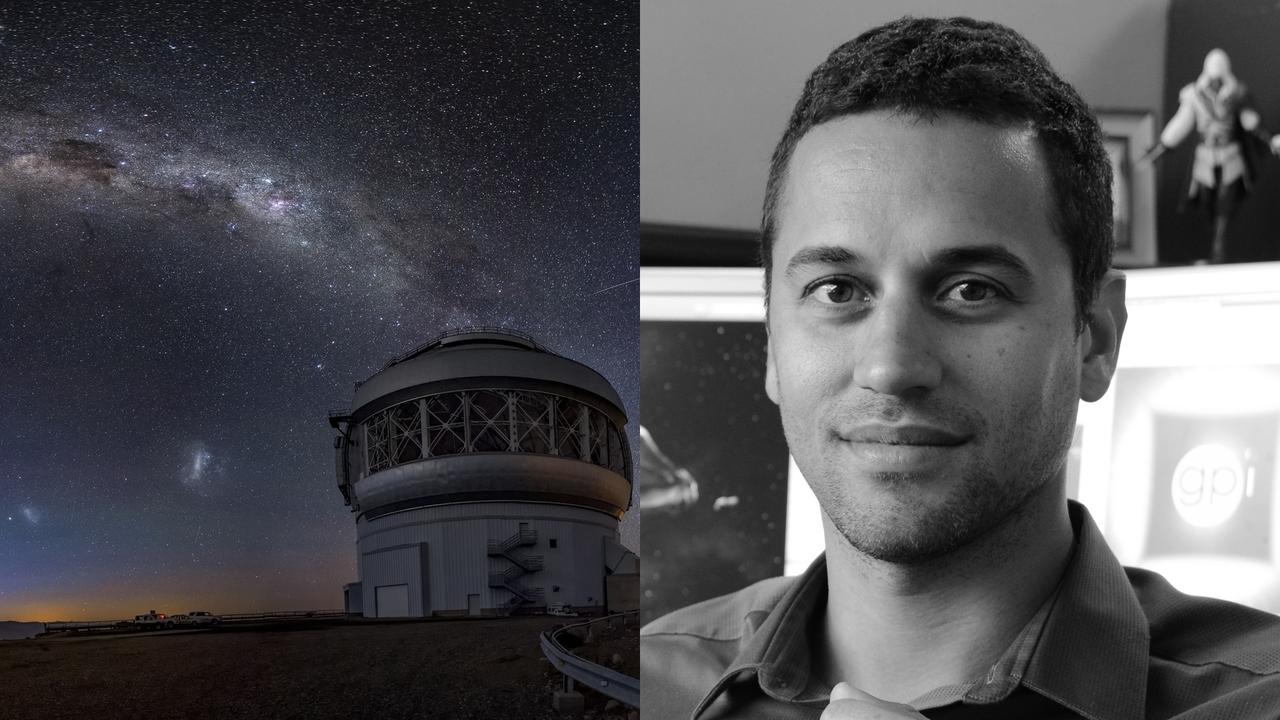
Franck Marchis
Another Pale Blue Dot: Inside SETI Institute’s Search for Exoplanets
Recorded live on Jan 16, 02018
at The Interval at Long Now
New science and tech are vastly accelerating the search for exoplanets: an effort that’s only decades old. How long until we find Earth 2.0? SETI Institute’s Senior Planetary Astronomer updates us on the latest work to find planets like Earth.
Dr. Franck Marchis has been a Principal Investigator at the Carl Sagan Center of the SETI Institute since July 2007. Over the past 15 years, he has studied our solar system using mainly ground-based telescopes equipped with adaptive optics (AO). He made the first ground-based observations of the volcanoes on the jovian moon Io. His recent work includes the Gemini Planet Imager, an extreme AO system for the Gemini South telescope which will image and record spectra of exoplanets orbiting nearby stars. He holds a PhD from Toulouse III university in his native France.
bio
Dr. Franck Marchis is a Principal Investigator at the Carl Sagan Center of the SETI Institute since July 2007. Over the past 15 years, he has dedicated his research to the study of our solar system using mainly ground-based telescopes equipped with adaptive optics. He made the first ground-based observations of the volcanoes on the jovian moon Io, using the first Adaptive Optics (AO) systems available on the European Southern Observatory (ESO) 3.6 m telescope at Chile’s La Silla Observatory.
Recently he has been working on a new generation of AOs; developing algorithms to process and enhance the quality of images, both astronomical and biological, using fluorescence microscopy; and developing the Gemini Planet Imager, an extreme AO system for the Gemini South telescope which will image and record spectra of exoplanets orbiting around nearby stars.
He holds a PhD from Toulouse III university in his native France. His doctoral research described the application of adaptive optics to the study of the solar system. The asteroid 6639 Marchis was named in his honor in 02007.
Join our newsletter for the latest in long-term thinking
Subscribe