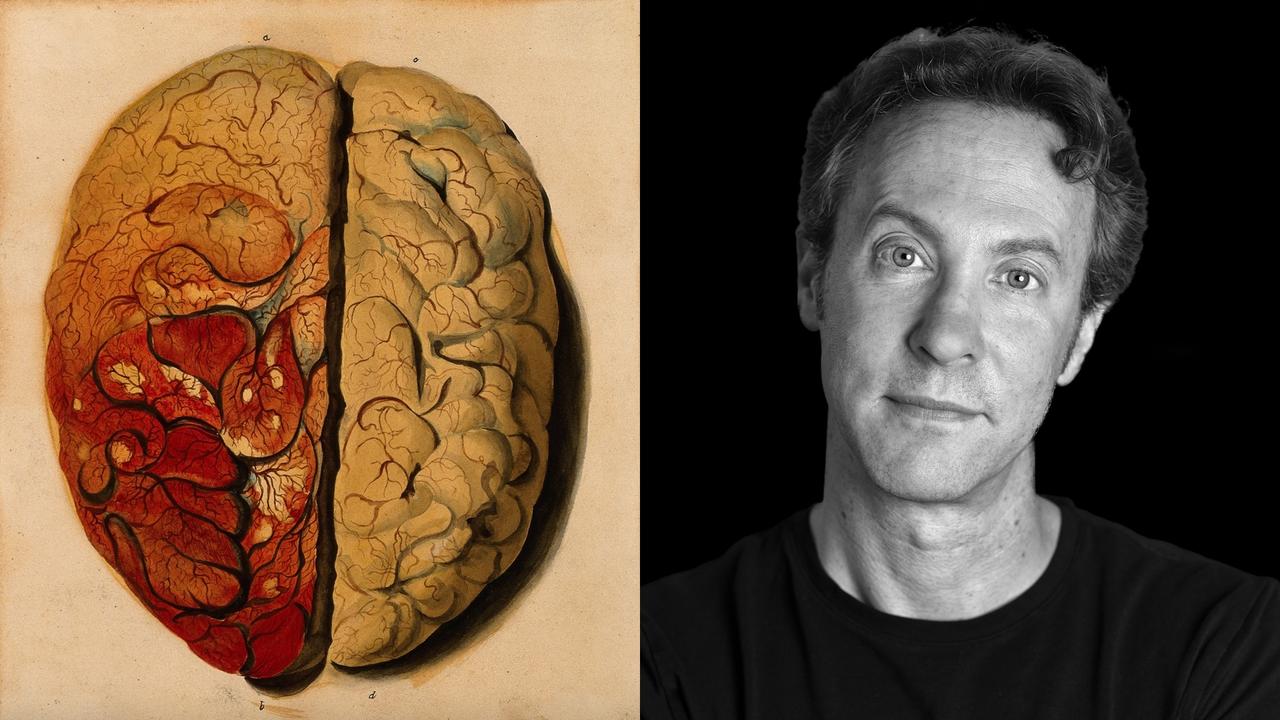
David Eagleman
The Brain and The Now
Recorded live on Oct 4, 02016
at Cowell Theater in Fort Mason Center
The Brain’s Now
Our perception of time raises all sorts of questions, Eagleman began. “Why does time seem to slow down when you’re scared? And why does it seem to speed up as you get older?”
With an onscreen demonstration, Eagleman showed that “Time is actively constructed by the brain.“ His research has shown that there’s at least a 1/10-of-a-second lag between physical time and our subjective time, and the brain doesn’t guess ahead, it fills in behind. “Our perception of an event depends on what happens next.” In whole-body terms, we live a half-second in the past, which means that something which kills you quickly (like a sniper bullet to the head), you’ll never notice.
In order to manage a realistic sense of causality, the brain has to calibrate the rate of different signals coming into it. When that system malfunctions, you can get “credit misattribution”—the sense that “I didn’t do that!” It may explain why some schizophrenics think that their normal internal conversation is voices coming from somewhere else, and it might be curable by training their brain to manage signal lags better.
Is “now” expandable? Why do you seem to experience time in slow motion in a sudden emergency, like an accident? Eagleman’s (terrifying) experiments show that in fact you don’t perceive more densely, the amygdala cuts in and records the experience more densely, so when the brain looks back at that dense record, it thinks that time must have subjectively slowed down, but it didn’t. “Time and memory are inseparable.”
This also explains why time seems to speed up as you age. A child experiences endless novelty, and each summer feels like it lasted forever. But you learn to automatize everything as you age, and novelty is reduced accordingly, apparently speeding time up. All you have to do to feel like you‘re living longer, with a life as rich as a child’s, is to never stop introducing novelty in your life.
watch
bio
David Eagleman is a neuroscientist at Stanford, an internationally bestselling author, and the writer & presenter of the PBS series The Brain. He studies time perception, sensory substitution, synesthesia, and neurolaw, and has 3 startups that have spun out of his laboratory. Eagleman is a Long Now board member. His scientific publications appear in Science, Nature, Nature Neuroscience, and Neuron, and he serves on the editorial board of several scientific journals.
Dr. Eagleman has written several neuroscience books, including the New York Times bestseller Incognito: The Secret Lives of the Brain, Wednesday is Indigo Blue: Discovering the Brain of Synesthesia, and the upcoming Live Wired: The Dynamically Reorganizing Brain.
Eagleman has also written an internationally bestselling book of literary fiction, Sum, which has been translated into 27 languages and was named a Best Book of the Year by Barnes and Noble, New Scientist, and the Chicago Tribune. Eagleman and Brian Eno recently performed a musical reading of Sum at the Sydney Opera House, and Eagleman has teamed with German composer Max Richter to translate Sum into an 02012 opera at the Royal Opera House in London.
Dr. Eagleman has written for the New York Times, Discover Magazine, Atlantic, Slate, Wired and New Scientist, and he appears regularly on National Public Radio and BBC to discuss both science and literature.
Join our newsletter for the latest in long-term thinking
Subscribe