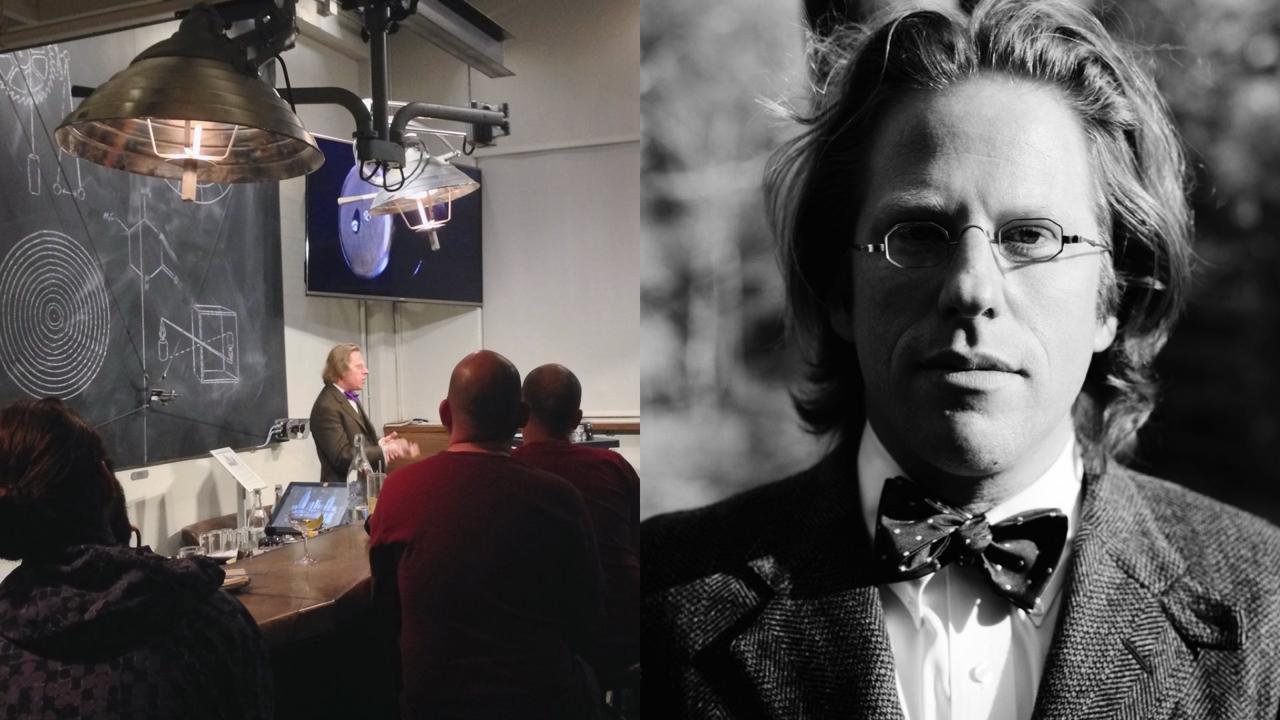
Jonathon Keats
Envisioning Deep Time
Recorded live on Apr 7, 02015
at The Interval at Long Now
Philosophical inquiry and scientific absurdism meet in the conceptual precision and ice dry wit of Jonathon Keats. In his talk at The Interval, Keats discussed his forays into very long-term photography and other deep time projects. He also announced a site-speciific collaboration with The Long Now Foundation that will create a long-term art work on our Mt. Washington property in Eastern Nevada.
As an experimental philosopher and conceptual artist, Jonathon Keats has applied general relativity to time management, personalized the metric system, sold real estate in the higher dimensions of spacetime, and epigenetically resurrected historical figures including George Washington and Jesus Christ. Those are some of the projects he touches on in this talk.
Currently Keats is building pinhole cameras of his own design with exposure times of 100 and 1,000 years to document long-term change in cities from San Francisco to Berlin. The Berlin century cameras debuted in 02014. Each person who secretly installed one will eventually inform a child of its location. In 02114 that child is responsible for retrieving the finished photo and returning the camera to the gallery. Where they can get their deposit back. The first millennium camera was installed recently at the Arizona State University Art Museum.
But his next time art project is five times as ambitious. Keats reveals for the first time in this talk a project to turn bristlecone pines into calendars--living calendars. Bristlecones live up to 5000 years, so they are unique in the duraton they track time through dendrochronology. The artist needed to find a place where these ancient trees are already growing that would work with him to create this project. And happily we at Long Now could do just that. The story of the Centuries of Bristlecone will be a long time in telling. But stay tuned.
watch
bio
Jonathon Keats is an artist, writer and experimental philosopher. His conceptually-driven transdisciplinary projects explore all aspects of society, adapting methods from the sciences and the humanities. He has exhibited and lectured at dozens of institutions worldwide, from the Los Angeles County Museum of Art to Stanford University to the Triennale di Milano, and from SXSW to CERN to UNESCO. He is the author of six books on subjects ranging from science and technology to art and design – most recently You Belong to the Universe: Buckminster Fuller and the Future, published by Oxford University Press – and is the author of a weekly online art and design column for Forbes. He has been an artist-in residence at the Fraunhofer Institute for Building Physics, UC Berkeley's Sagehen Creek Field Station, and the LACMA Art + Technology Lab, a Black Mountain College Legacy Fellow at the University of North Carolina-Asheville, an Imaginary Fellow at Arizona State University’s Center for Science and the Imagination, and a Research Fellow at the Nevada Museum of Art's Center for Art + Environment. He is currently a research associate at the University of Arizona’s Desert Laboratory on Tumamoc Hill, a visiting scholar at San Jose State University’s CADRE Laboratory for New Media, a research fellow at the Highland Institute, a consulting philosopher at Earth Law Center, a Polar Lab artist at the Anchorage Museum, a Flux Exchange Artist at Flux Projects, and an artist-in-residence at Hyundai, the SETI Institute, and UC San Francisco’s Memory and Aging Center. He co-directs the Center for Climate-Adapted Heritage Cuisine and serves as curatorial director of the Museum of Future History.
Join our newsletter for the latest in long-term thinking
Subscribe