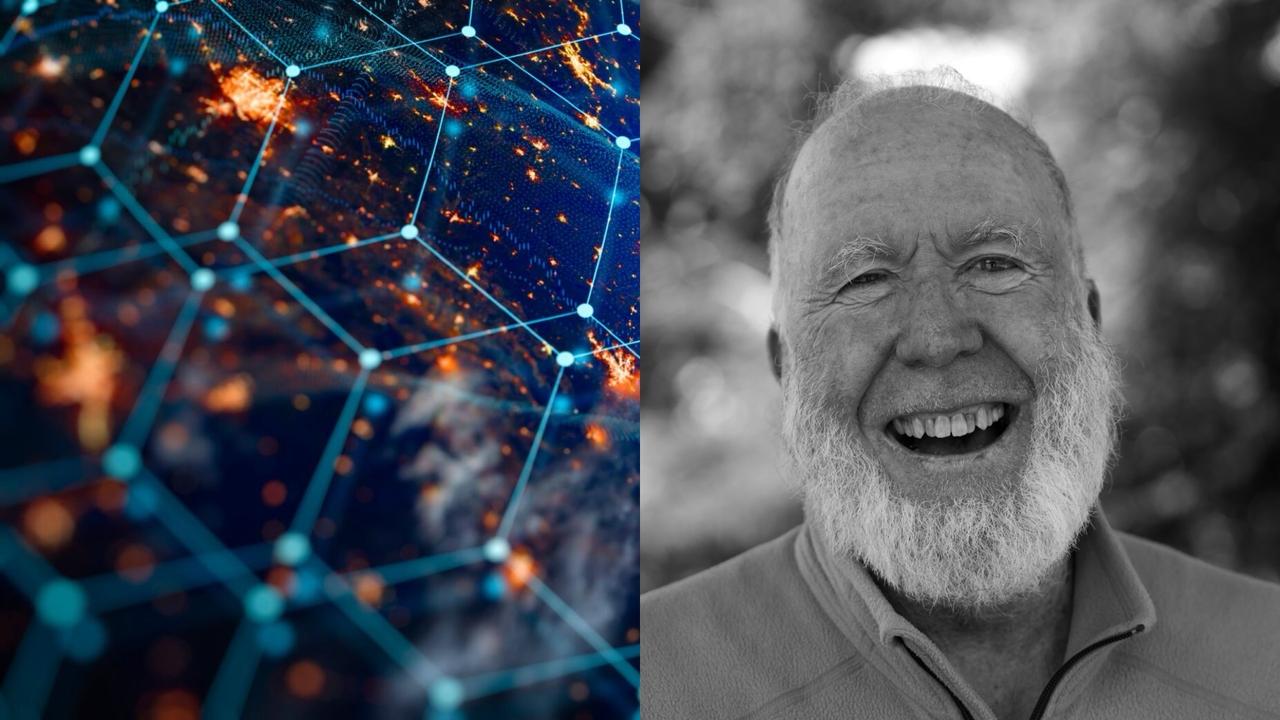
Kevin Kelly
Technium Unbound
Recorded live on Nov 12, 02014
at SFJAZZ Center
Holos Rising
When Kevin Kelly looked up the definition of “superorganism” on Wikipedia, he found this: “A collection of agents which can act in concert to produce phenomena governed by the collective.” The source cited was Kevin Kelly, in his 01994 book, Out of Control. His 02014 perspective is that humanity has come to dwell in a superorganism of our own making on which our lives now depend.
The technological numbers keep powering up and connecting with each other. Their aggregate is becoming formidable, rich with emergent behavior, and yet it is still so new to us that it remains unnamed and scarcely considered.
Kelly clicked through some current tallies: one quintillion transistors; fifty-five trillion links; one hundred billion web clicks per day; one thousand communication satellites. Only a quarter of all the energy we use goes to humans; the rest drives Earth’s “very large machine.” Kelly calls it “the Technium” and spelled out what it is not. Not H.G. Wells’ “World Brain,” which was only a vision of what the Web now is. Not Teilhard de Chardin’s “Noosphere,” which was only humanity’s collective consciousness. Not “the Singularity,” which anticipates a technological event horizon that Kelly says will never occur as an event—”the Singularity will always be near.”
The Technium may best be considered a new organism with which we are symbiotic, as we are symbiotic with the aggregate of Earth’s life, sometimes called “Gaia.” There are pace differences, with Gaia slow, humanity faster, and the Technium really fast. They are not replacing each other but building on each other, and the meta-organism of their combining is so far nameless. Kelly shrugged, “Call it ‘Holos.’ Here are five frontiers I think that Holos implies for us…”
- Big math of “zillionics” ---beyond yotta (10 to the 24th) to, some say, “lotta” and “hella.” 2) New economics of the massive one-big-market, capable of surprise flash crashes and imperceptible tectonic shifts. 3) New biology of our superorganism with its own large phobias, compulsions, and oscillations. 4) New minds, which will emerge from a proliferation of auto-enhancing AI’s that augment rather than replace human intelligence. 5) New governance. One world government is inevitable. Some of it will be non-democratic—”I don’t get to vote who’s on the World Bank.“ To deal with planet-scale issues like geoengineering and climate change, “we will have to work through the recursive dilemma of who decides who decides?” We have no rules for cyberwar yet. We have no backup to the Internet yet, and it needs an immune system.
There is lots to work out, but lots to work it out with, and inventiveness abounds and converges. “We are,” Kelly said, “at just the beginning of the beginning.”
watch
bio
Kevin Kelly is Senior Maverick at Wired, a magazine he helped launch in 01993. He served as its Executive Editor from its inception until 01999. From 01984 - 01990 Kelly was publisher and editor of the Whole Earth Review, a journal of unorthodox technical news. He co-founded the ongoing Hackers' Conference, and was involved with the launch of the WELL, a pioneering online service started in 01985. Kelly edited, published, and wrote much of Signal, a pre-Wired compendium of digital tools. He authored the best-selling New Rules for the New Economy, a blueprint for the emerging digital economy, and wrote the classic book on decentralized emergent systems, Out of Control. His newest book is called What Technology Wants, due out in the Fall 02010. He is also editor and publisher of several very popular websites including Cool Tools, True Films, and the Quantified Self.
Kevin Kelly's writing has appeared in many national and international publications such as the New York Times, The Economist, Time, The Smithsonian, Harpers, Science, GQ, Wall Street Journal and Esquire. Before taking up the consequences of technology, Kelly was a nomadic photojournalist. One summer he rode a bicycle 5,000 miles across America. For most of the 01970's he was a photographer in remote parts of Asia, publishing his photographs in national magazines. His photographs have appeared in LIFE and other national magazines. In 02001 he co-founded a scientific initiative called the All Species Inventory to discover and describe all the living species on Earth. That project eventually became the Encyclopedia of Life.
Join our newsletter for the latest in long-term thinking
Subscribe