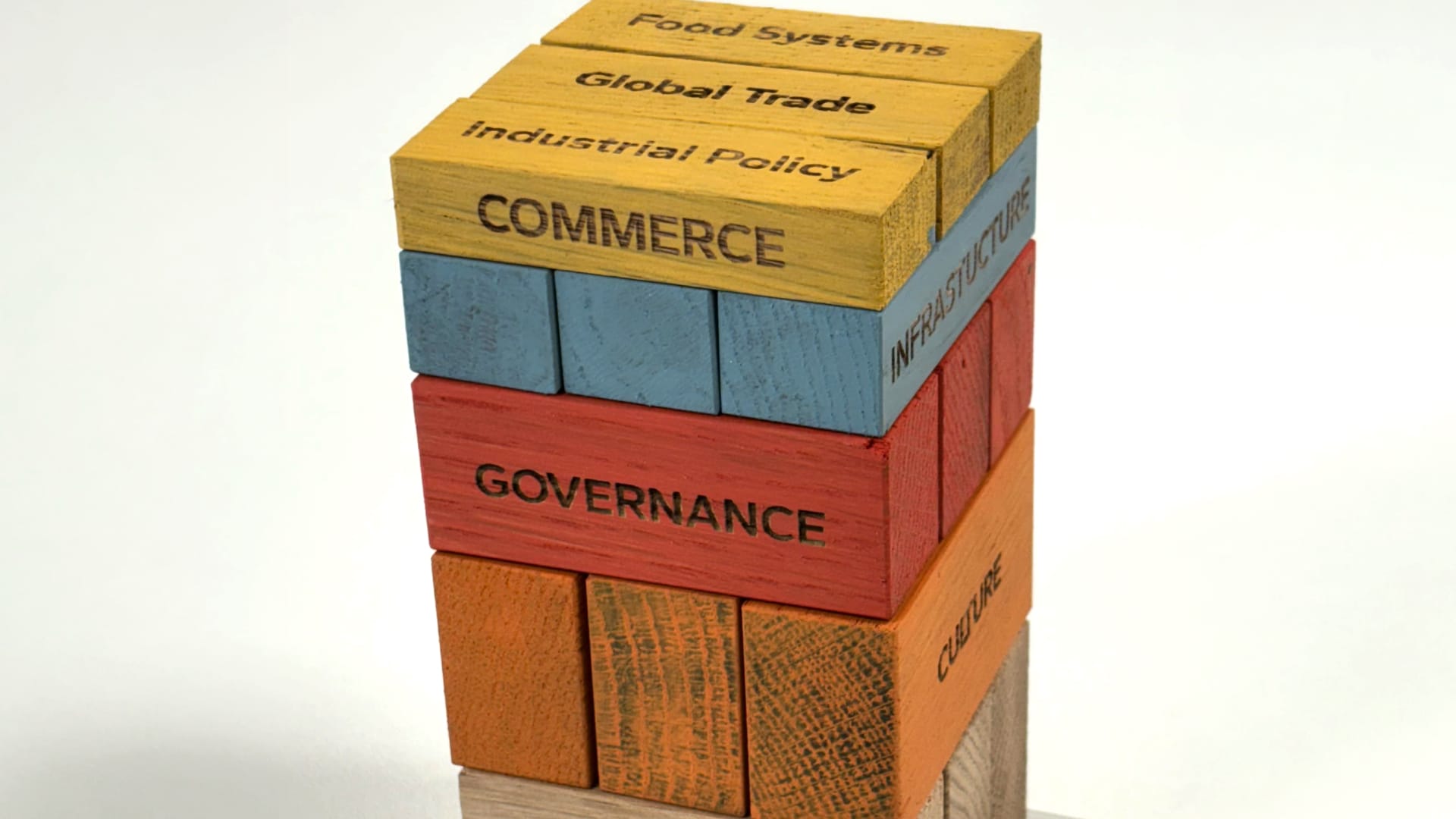
“I want to put that on my desk.”
In my world, CEOs don’t attach that phrase to reports, charts or slides. Physical space on a leader’s desk is precious and not given up lightly. This CEO, however, was about to make an exception. What he wanted was Layer Player: a Jenga-style tower of wooden blocks that brings Long Now cofounder Stewart Brand's pace layers framework to life.
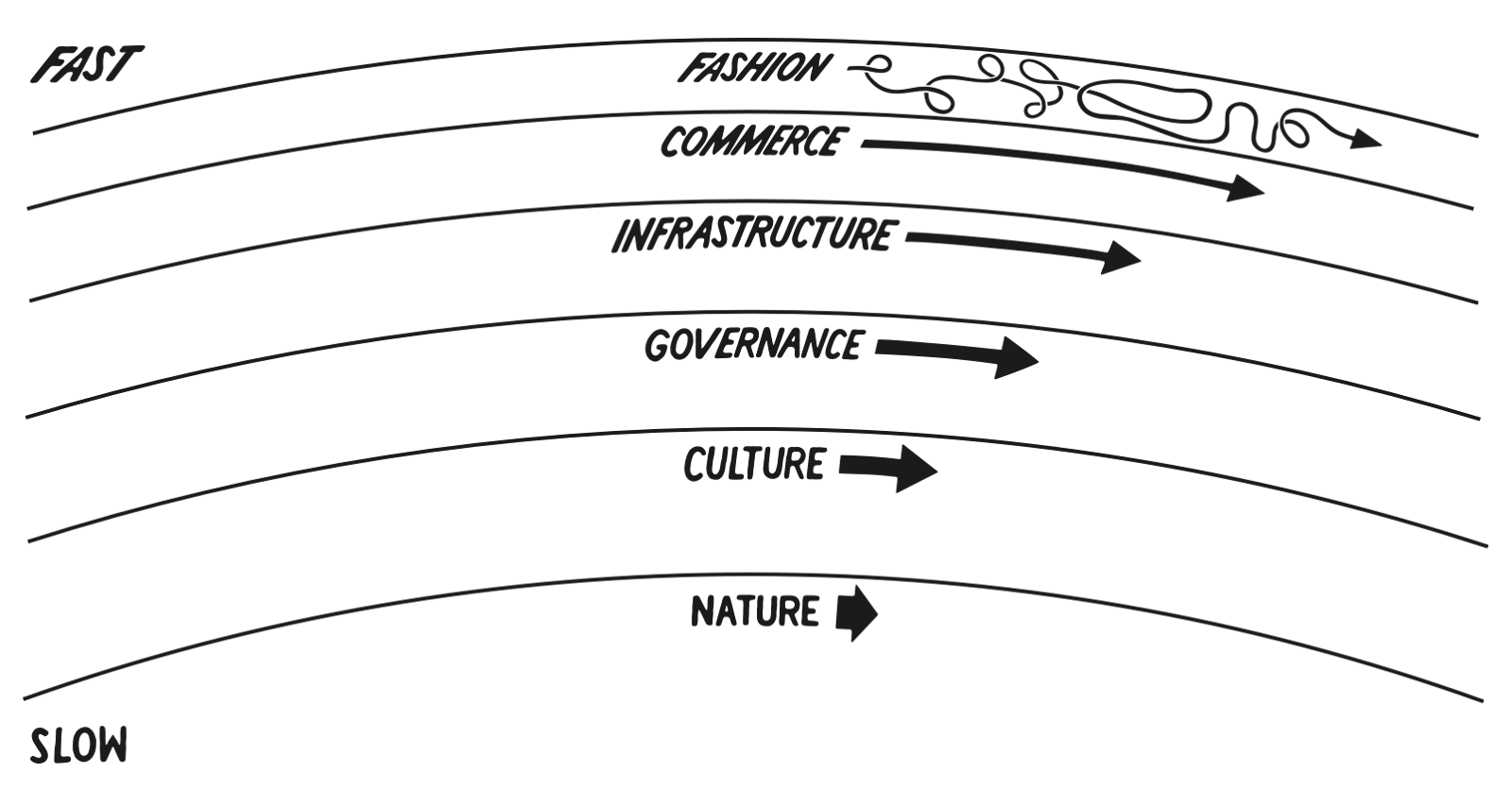
For many years I’ve advised leaders about the benefits of foresight, helping them extend their thinking beyond quarterly cycles and annual reports. One of the challenges of this process is to provide insights at the right level, at the right frequency, with the right frameworks.
One model that consistently resonates with leaders is the pace layers framework. It is simple but not simplistic, an elegant way of describing complex system interactions while highlighting the nature of interdependencies in the modern world. Changes in one layer usually create friction with the layers above and below. The top layers draw attention because they move fast and are characterized by relentless “noisy” headlines. The base layers, by contrast, have all the power: they move much slower and emit far fewer but much more important signals.
While the framework clicks, it doesn’t stick. CEOs are busy people, and their attention is limited. The lesson I’ve learned for holding that attention: when working on key projects for the leaders of large organizations, make the key outputs very visible.
I successfully experimented with this idea in 02012 when I was engaged by a Cabinet Minister. The brief was to analyze and report on how government agencies had encouraged long-term thinking and innovation during a crisis. During the engagement process, I observed how Ministers were shadowed by an aide at every meeting. In some meetings, the sole purpose of that aide was to politely accept a lengthy written report and place it in a pile of other reports.
With this observation in mind, when our work was finished, I created two key outputs. One was the report. This was mandated in the contract. The other was the heavily summarized list of recommendations, printed on heavy card. This card was folded and glued to form a self-standing, tent-shaped, triangular structure that stood about 10 centimeters tall. One side of the ‘tent’ card had a three-point list of the actions that government officials could take to kill innovation. The other side listed three solutions to grow innovation. All the text was printed in a large font that could be read from two meters.
In the meeting where I presented the report to the Minister, I watched for the obvious. Predictably, the report went to the aide, who placed it on a pile. The tent card, however, almost triggered cardiac trauma for the hapless assistant. Here was something so awkward that couldn’t be folded or filed and definitely didn’t fit on the pile. The Cabinet Minister ended up holding it himself. Once the Minister returned to his office, the tent card didn’t fit in his shelves, so he put it on his desk, where it remained for six weeks. The messages must have resonated, because I heard that he took it to meetings with senior officials and waved it around, highlighting the key findings.
Success was a simple metric: impossible to file and easy to share.
At the start of 02025, my team began work on a foundational report for a cohort of 10 non-competing companies in the same sector. The CEOs had limited comprehension of foresight, and even less understanding of the complex system interactions shaping the world. We needed to get them up to speed on a wide range of interacting and overlapping topics: the implications of fast-moving technologies on governance, for example, or the friction between national/grand strategies and free trade. Pace layers became the choice of mental model that would enable a new set of information to be categorized and understood. The challenge was similar to the Ministerial tent card: how could we bring pace layers to life and simultaneously make it impossible to file?
We went through many iterations of physical manifestations that had suitable analogies. Sedimentary layers and onions were quickly discounted. No amount of design thinking would tempt a CEO to clear space on their desk for boxes or dirt, or tear-inducing vegetables. The physical object also had to encourage people to play with it in a way that brought home the key principles of pace layers. If the base layers change too much, for example, all the layers above suddenly become unstable.
This was the key insight that led us to the popular wooden blocks game.
Each of the pace layers would have its own color, and the size of the blocks would be relative to their influence on the system. The three Nature blocks at the base of Layer Player are the largest; the blocks at the top are a fraction of that size.
Each Layer Player is as tall as about one and a half iPhones, and comes with a plexi-glass ‘sleeve’ that fits over the entire model. The sleeve serves two purposes. Practically, it makes it easy to transport the Layer Player without spilling blocks everywhere. At a more abstract level, the sleeve holds the blocks in place. It embodies an era of stability, with little movement between layers and few sparks between systems. The world is no longer in that era. Once you remove the sleeve, and start to move the blocks, you begin to grasp the fragility of systems, and how ricochets can reverberate up and down the layers. It’s relatively easy to move a blue block in the Infrastructure layer, and a red block in Governance, while keeping the Commerce layer at the top stable. As soon as you touch the largest blocks in the Nature layer at the bottom of the stack, however, the whole tower threatens to come tumbling down.
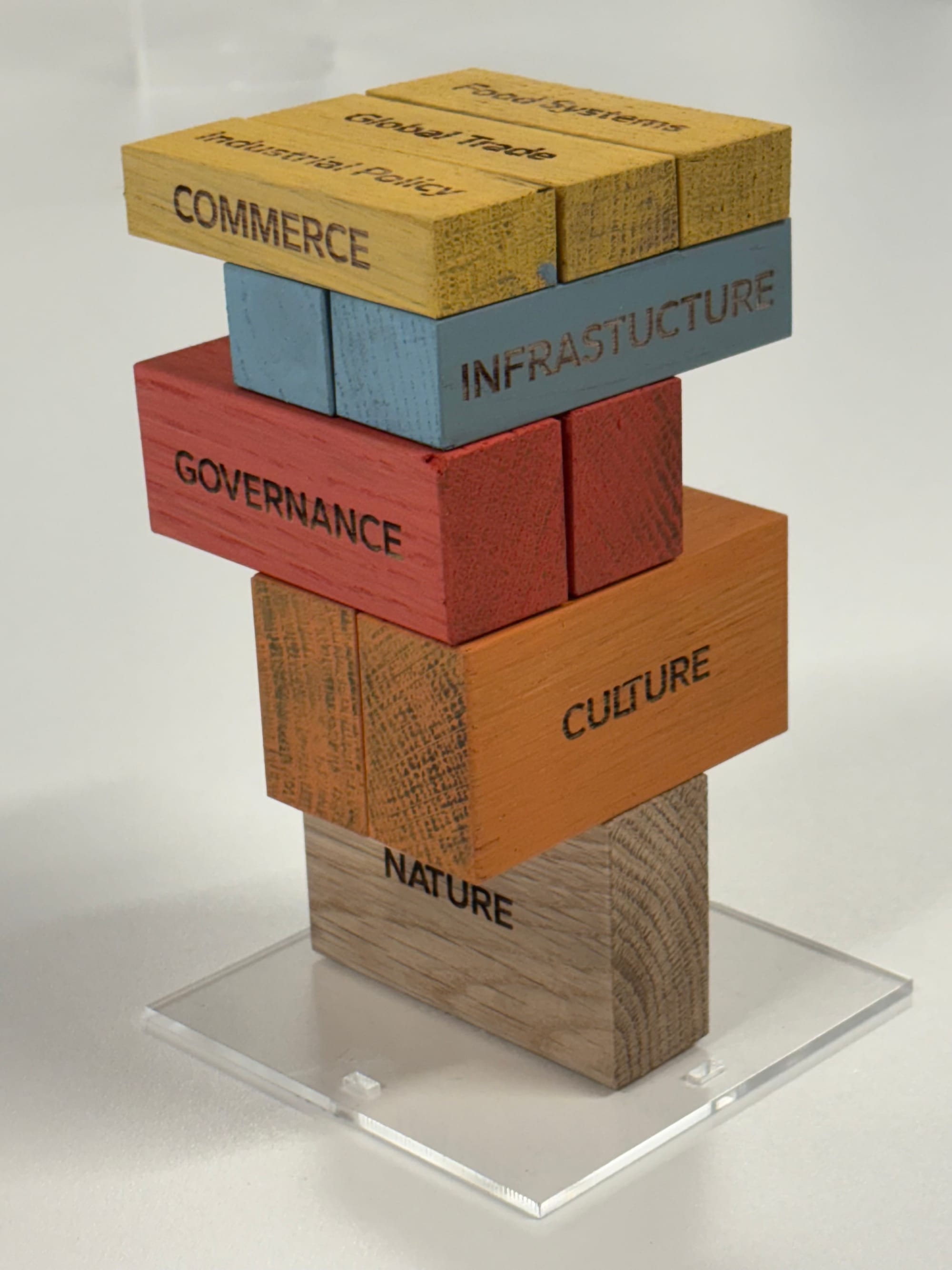
I also removed Fashion as a layer. This was not a comment on the mixed levels of sartorial elegance of the target audience, but a decision that reflected the limited attention of the business leaders I was working with. By placing the Commerce layer at the top of the stack, it increased the likelihood of engagement by immediately highlighting a familiar concept. I suspect my decision would have been more challenging if I was advising the leadership team at Vogue.
In interacting with the Layer Player, you can see how Commerce has historically discounted planetary boundaries in pursuit of growth, or how the increasing polarization of societies in the Culture layer scrapes against Governance, which in turn affects Infrastructure and Commerce. Or take AI, which I placed in the blue Infrastructure layer. Deployment of increasingly capable AI models clearly moves up the stack to impact Commerce, but at the same time these models create friction down the stack. Governance is immediately below the Infrastructure layer, and advanced AI clearly has potential implications for leadership systems that manage populations.
The lessons of long-term thinking that the pace layers teach become intuitive when you can hold the framework in your hands. Or, when you put it on your desk.