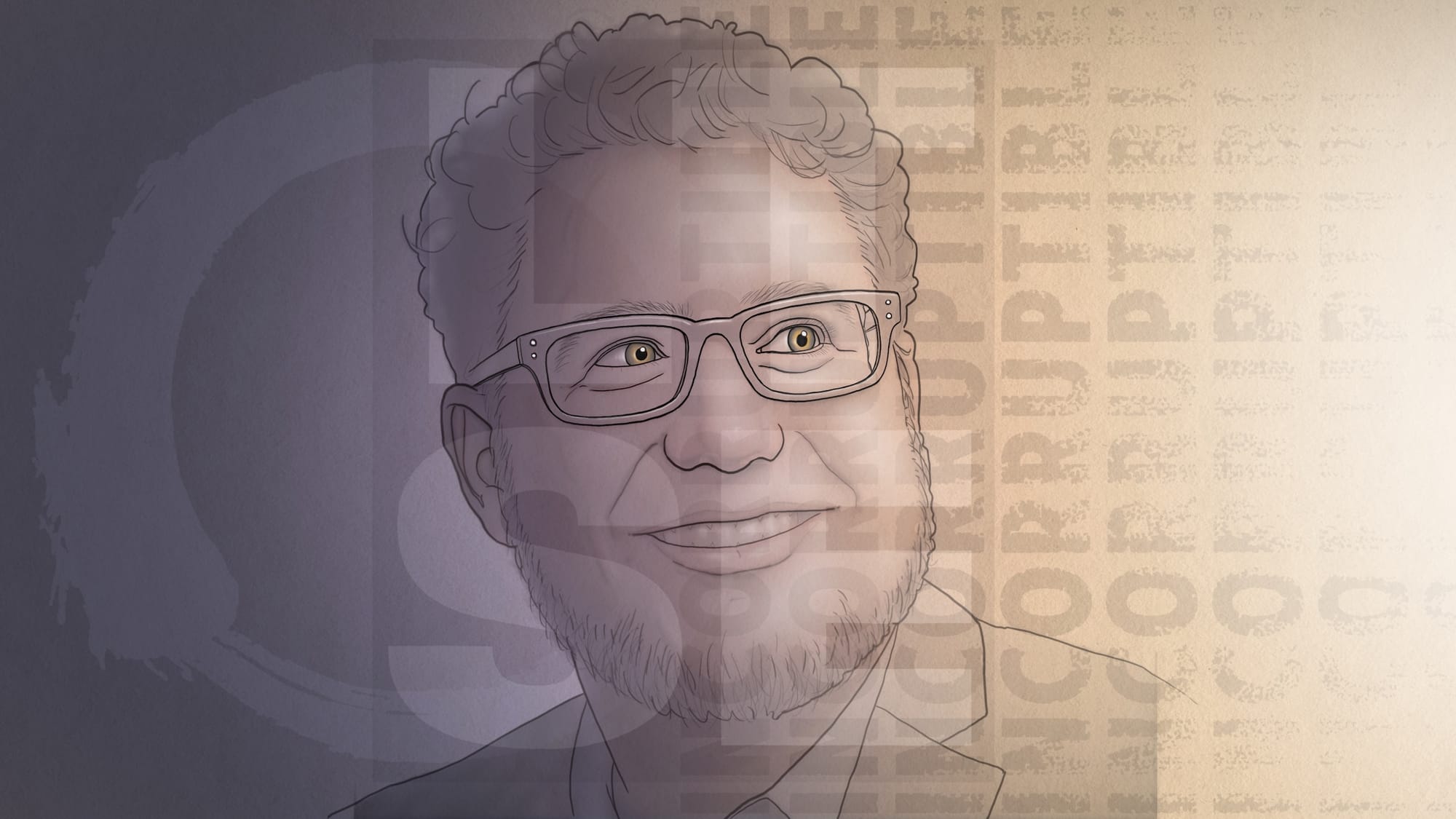
Eric Ries Takes the Long View
The author of Incorruptible and the Lean Startup speaks with Long Now about what Homer got wrong about the Bronze Age, the lost prophets of management science, and why finance was never meant to be an end in itself.
Eric Ries is the creator of the Lean Startup method and the author of the New York Times bestseller The Lean Startup; The Leader’s Guide; and The Startup Way. Ries, a Long Now Council Member, also spoke at Long Now in 02020 about the Long-Term Stock Exchange.
His new book, Incorruptible: Why Good Companies Go Bad…and How Great Companies Stay Great, is available worldwide on May 26, 02026.
What contemporary innovation do you think will still be relevant in 1,000 years? 10,000 years?
To answer this question, you have to look at how we see people in the distant past. Humans consistently put anachronisms into the stories we tell. We’ve been doing it since the Iliad was composed. Looking back at the Bronze Age, which he was so much closer to than we are, even Homer couldn’t avoid it. The Iliad anachronism I always think about is iron. The poem is set in the Bronze Age, but iron keeps showing up as prizes in funeral games and in everyday farming equipment. By the time it was composed, iron was everywhere. It was so fundamental to daily life that Homer couldn’t fully imagine a world that ran without it, even though that’s exactly what he was supposed to be describing. Finding something so essential that you can’t imagine it ever had to be invented is the highest compliment a civilization can pay an idea.
Honestly, I don’t think very many of our ideas today will meet that standard. But if I had to pick one, it’s that human beings have agency over the future — that the human condition is not fixed, and that it’s our job to make it better. That idea is only a few centuries old — it would have been incomprehensible to most people who have ever lived — and we’re still getting it wrong in important ways. We confuse it with the idea that progress is inevitable, which breeds complacency or worse. We also confuse it with the idea that progress unfolds in some predetermined sequence, like a video game tech tree, where you just unlock one advance after another. Those are dangerous misunderstandings, and we’ll rightly be criticized for them. But underneath the errors, there’s a genuinely new conviction that the future is something we can shape, and that we’re obligated to try. We already project this belief backward. When we describe the great thinkers of the past as people who were “ahead of their time,” we’re projecting this new belief backwards in the same way that Homer projected iron into the world of the Iliad. They weren’t ahead of anything. We just can’t see them any other way because we can see in retrospect that they were right.
I have to hope that keeps going so that people a thousand years from now can’t help but imagine we embraced the idea that it’s both possible and our life’s work to make things better a little more fully than we actually do.
What’s the most surprising way history has repeated itself in your field?
In the world of management science, there have always been fads around a specific management idea that moves the field forward. The original one of these was scientific management. Its creator, Frederick Winslow Taylor, was a massive celebrity who became famous when Louis Brandeis, the future Supreme Court Justice, defeated a railroad rate increase by using his testimony in court to prove that the railroads were acting in an inefficient way. Taylorism became a huge pop culture phenomenon, whereas now it’s viewed negatively.
But that kind of hype, which makes business people aware of a new idea, is still really important. There tend to be pairings of a theorist, like Taylor, with a practitioner – Henry Ford, in his case – that drive an idea forward. It happens again with W. Edwards Deming and lean practitioners, and with Alfred Sloan at GM and Peter Drucker. There’s a hype cycle, partly because the penetration of ideas into management is very slow and inefficient. It means a lot of good ideas get left behind because people’s attention is focused on the famous one. In my new book Incorruptible, I tell the story of Mary Parker Follett, a contemporary of Taylor’s, the so-called “prophet of management.” She was way, way ahead of her time but completely removed from the historical record. We’re always chasing the next big thing, so management science has fits and starts rather than being actually a smooth ramp.
What’s an overlooked piece of wisdom from the past that we should carry into the future?
Aristotle made a distinction between the two different ways of making money: oikonomia, the making of productive things, and chrēmatistikē, the making of money from money itself. We would now say value creation and value extraction. In 01944 a Hungarian political economist named Karl Polanyi called this distinction “probably the most prophetic pointer ever made in the realm of the social sciences.” In ancient writing and medieval writing, it’s an old and very powerful idea that shows up again and again but it has been erased in the modern world. It’s time to recover it. The Latin root word of the word “profit,” facere (“to make or do”) is also the root of the words “manufacture,” and “efficiency.” Meanwhile, the Latin root of finance is finis, which means “an end or a boundary.” It’s about how things are defined or finished. It’s a very simple idea. Finance is supposed to be accounting for another, profitable, activity. When finance and making money becomes an end unto itself, it’s like treating car exhaust as an indicator of its speed. You’ve made a category error.
What’s one book you would recommend for inclusion in The Manual For Civilization, our crowd-curated library of 3,500 books of essential civilizational knowledge?
If we only get 3,500 books we can’t waste any. But we are surely going to need at least one on statistical process control and automating large-scale production in such a way that it preserves craftsmanship and quality. You could include a book by Deming or a later book like The Machine That Changed the World. But my vote would be for Toyota Production System by Taiichi Ohno. Ohno isn’t that well known outside of manufacturing circles, but his writing is more philosophical than we would expect. Toyota Production System isn’t only about the technical aspects of how to achieve mass production. It’s also about how to harness creativity and preserve the dignity of the human beings engaged in that production process.
Join our newsletter for the latest in long-term thinking
Subscribe