Phil and I shared an unusual kinship for college freshmen in 02011: neither of us had a smartphone. I had always considered myself a late adopter of technology, but Phil was a genuine technophobe: near impossible to reach, a master of the drop-in, his offline apartment filled with stacks of paper volumes and notebooks.
“I found digital technology ugly from day one,” he later told me. He associated it with the kind of sameness — and illusion of freedom — he knew from his youth in suburban Canada.
But by the time we parted ways at the end of college, I had fallen into the tech addiction typical of my generation. I filled awkward silences by scrolling Twitter and passed long nights glued to the endless feed. Before long, I was a social media editor in a major newsroom. I was miserable.
Phil, meanwhile, hadn’t changed. When I met up with him again a decade later, he still checked his email just once a day. Then he would close his laptop and go enjoy the real world, unencumbered by the dozens of notifications and alerts that seemed so important to me. I remember reflexively reaching for my phone several times while we were catching up and feeling a sting of shame.
Today, there are ever more people who aspire to be like Phil. Every month brings reports of a new technophobic trend: “friction-maxxing,” “obstacle parenting,” “tech minimalism,” “dumb phones.” On r/digitalminimalism, a subreddit for tech rejecters, top posts celebrate users making the switch to MP3 players and notebooks. “For extra next level shit, pick up a typewriter,” one user writes. Comments roast commuters absorbed en masse by their phones; they lament an “incredibly sad” child’s drawing of their mother, placid smile on her face, stretched out on bed, scrolling on her phone.
What unifies these trends is a dawning awareness that the benefits of the technology on which we have become dependent are increasingly unclear. It can numb our brains, destabilize our reality, stunt our attention span, and steal our precious time — not to mention endanger our increasingly precarious jobs. And it’s getting worse, often by design, as the companies behind our digital experience degrade their own products for profit. More and more, people feel the only option is to shut out the digital world we’ve created, to withdraw to a life of offline simplicity.
It would be easy to dismiss this current wave of anti-technology sentiment as mere nostalgia, as a romanticization of a past that barely, if ever, existed. But if history is any guide, the desire to withdraw from the present during times of collective crisis might be about more than a simple yearning for what once was.
It may be something closer to a mass immune response — a near-atavistic instinct to preserve the best parts of civilization for what is yet to come.
It will surprise few to learn that today’s moment of technophobia has many precedents in history. As early as the fourth century BCE, Plato was worrying that the then-new technology of writing would erode our memory and fill our heads with “false wisdom” not gained from experience. Technophobes blamed telephones for undermining the rail industry, elevators for causing crime, and bicycles for causing “bicycle face”: “an anxious, worn look” caused by the “nervous strain” of staying upright. Fear about new technologies, and nostalgia for a world without them, appear to be as old as technology itself.
But at crucial points in history, that instinct to recoil from presumed “advancements” in society has been powerful enough to birth wholly alternative modes of living. In his influential study of the people of upland Southeast Asia, the anthropologist James C. Scott suggested that their nomadic societies were not survivals from some pre-agrarian, uncivilized past, but the result of deliberate choices to reject the immiserating “state-making projects” of the valleys: “slavery, conscription, taxes, corvée labor, epidemics, and warfare.”
Scott saw these currents throughout history, from the very moment the new technology of agriculture first transformed nomadic societies into sedentary ones. But they were, almost by definition, marginal. This kind of elective non-participation rarely succeeded in supplanting mainstream society — except, perhaps, in one important case.
In the sixth century, a growing number of laypeople in the declining late Roman Empire found themselves increasingly at odds with society. “The social fabric was overgrown with the corruptions of a thousand years,” wrote the 19th-century historian and theologian John Henry Newman. “It was too large for public spirit, and too artificial for patriotism, and its many religions did but foster in the popular mind division and scepticism.”

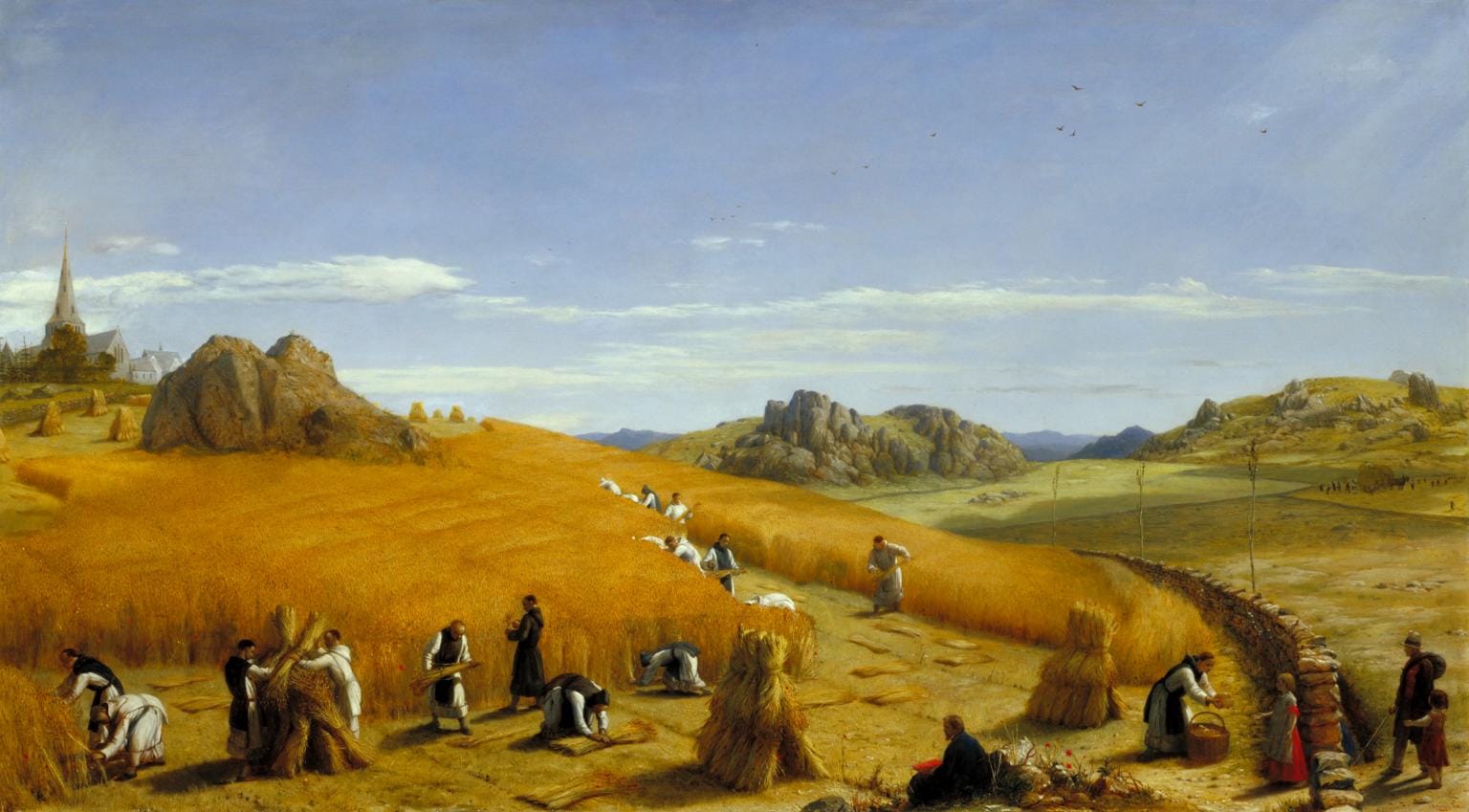
Into this world was born a noble son in a once prosperous but now marginal district. According to his hagiographers, Benedict of Nursia was sent to the capital to study, only to be repulsed by the society he found: vain priests and bishops swamped in perfumes and golden vestments; a love of money so intense it bordered on idolatry; decaying cities and corrupt courts used and abused by literal Vandals. Sneaking away from his handlers, he withdrew for three years to a cave above a valley outside Rome, living as a hermit and despising the world around him.
Benedict’s withdrawal followed a path well-trodden in late Roman society. Early Christianity was partly defined by the mad influence of wandering holy men. The early Christian canon is dominated by the Desert Fathers, hard-bitten monks who rejected society to live in unfathomable hardship in the wilderness. As social life deteriorated in the late empire, the proliferation of monasteries shows it was a path that became ever more popular. “The troubled, jaded, weary heart, the stricken, laden conscience … turned their backs upon the wrangling forum, the political assembly, and the pantechnicon of trades,” Newman wrote. “All they wanted, all they desired, was … flight from the world, and nothing else.”
It’s a sentiment that many of today’s tech rejecters could identify with. But just like the siren call of social media often lures us back to the rocky shores of digital life, Benedict could not resist the attraction of the society and hierarchy of his own day. The sixth-century Dialogues of Pope Gregory I detail how the young Benedict was wooed to oversee a group of nearby monks, only to have them attempt to poison him and corrupt him with prostitutes.
The next time he would start a community, he would begin with his famous Rule, one of the earliest in Western monasticism.
The Rule of St. Benedict stands out for its balanced approach, reflected in its famous motto: ora et labora, prayer and work. Benedict understood that complete withdrawal could be self-serving and unproductive. He reserved the isolation valorized by the Desert Fathers for those who had already completed “a long and successful training in a monastery,” according to his Rule.
Instead, Benedict viewed his project as one of building a virtuous alternative, rescuing the elements of Roman society worthy of saving from the fires burning throughout the empire. James Clark, a professor of history at the University of Exeter and author of a series of books on monastic history, told me the Rule of St. Benedict is full of allusions to late Roman civil law and the values of its learned elites, like literacy, enforced through mandatory reading and the obsessive copying of manuscripts. “They’re withdrawing from the city life into which they have been born, but they’re not shedding the cultural values that have been learned there,” Clark says.
This practical civility was one reason why Benedict’s Rule was so quickly adopted in so many different contexts across the continent. The Rule provides for the management of wealthy estates and the acceptance of abandoned children. It prescribes productive labor for all, but demands that goods be offered as charity. It regulates discussion of the outside world within the monastery walls, but recognizes the necessity of many journeys out into it. In short, the Benedictines were not really “withdrawing from the world,” Clark says. “They are simply creating an alternative.”

Such was the influence of Benedict’s Rule — on the economic organization of the countryside, the governance of social relations, even the importance given to literacy and visual arts — that it has been credited by many with sustaining and renewing European culture over the next 1,000 years. It is one of few examples of a marginal critique becoming the foundation of a new modernity — and one from which the rejectors of today’s tech-dominated landscape could likely learn a lot.
How did the Benedictines accomplish all this? In some sense, it is precisely because Benedict and many like him were so enmeshed in the dominant but declining culture of the day. “What they’re doing is radical, but they’re not social outcasts,” Clark says. “Like so many of the most consequential social movements, they’re born out of a kind of bourgeois elite.”
In other words, the Benedictines were pointedly un-revolutionary. They did not seek to transform a broken world, merely to transform themselves within it. Looking at a degrading social order, they saw the good within it — but instead of trying to save it, they simply salvaged what they could.
When digital technology first emerged, there were many who saw it as a force multiplier for the margins, a new tool for upending the existing, degraded social order. Among a subset of hippies informed by the techno-optimism of the 01960s, the computer presented an opportunity for a great experiment in cultural anarchism. “Netheads” and hackers imprinted their libertarian ethos on the early internet — and for a time, their communities were genuinely countercultural.
For some, emerging digital technology would be the means to creating a long-desired “post-industrial” future, characterized by a “global village” practicing decentralized, tribal democracy — a vision the countercultural historian Theodore Roszak quaintly dubbed “forward to the Neolithic.” Even well into the 02000s, their utopian, communitarian spirit could be found on the message boards that connected obsessive hobbyists and found solidarity in niche identities of every description.
If there is something worth saving from our digital lives, it is perhaps the blind optimism and openness of these neophyte online communities. But as anyone who has spent serious time in these spaces knows, it often does not last for long. The last two decades have proven how the same tools that connect model train enthusiasts and sustain LGBTQ+ youth can also embolden racists and incels. The more influential a community becomes, the more likely it is to attract bad actors and tyrannical moderators. It’s hard to create a global village without village idiots.
This is a danger that was foreseen by some early critics of digital technology. In the 01990s, a group of self-styled “Neoluddites” mounted a campaign against a rash of emerging technologies, from nuclear power to genetically modified organisms to cable television, which they deemed a “centralized mind-controlling device.” Most prescient by far was their condemnation of the computer. In her Neoluddite manifesto, the activist Chellis Glendinning said computers would “remove people from direct experience of life.” Like Plato, she worried that a new technology could erode the foundations of reality.
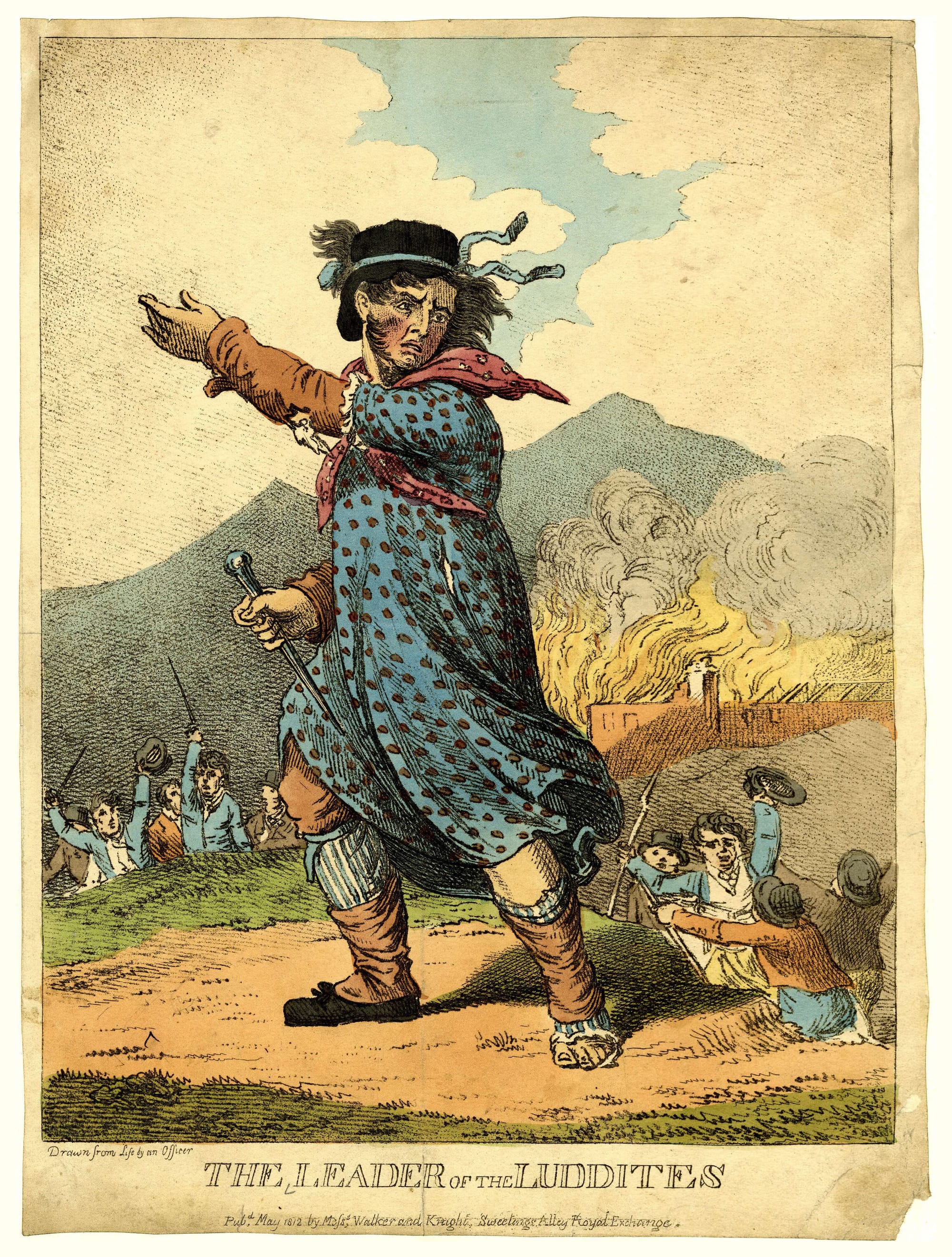
Perhaps the key difference between computers and previous technological shifts — like the introduction of mechanized looms that prompted the original Luddite uprising — is the way that digital technology, and the internet, can constitute a second, constructed reality. In the anarchic early internet, this enabled the kinds of spaces that fostered new identity formations: secret online lives as furries or anime enthusiasts or genocidal white supremacists. (It was always a mixed bag.) But as the internet predictably consolidated under corporate control, this power was channeled into market-tested forms: Instagram filters for every Myers-Briggs type, rabid fandoms for every corporate intellectual property.
The great shock to the hippie-hacker generation was that people seemed to prefer it this way. Walled gardens like MySpace, Facebook, and Instagram offered a way to speedrun identity formation and pick a tribe. In the end, the starry-eyed optimism of the world’s Wozniaks proved no match for the dead-eyed calculation of its Zuckerbergs. “There is an insurmountable hostility between the large-scale technology on which the computer industry is based and the traditional values that the counterculture wished to salvage,” Roszak observed.
As the internet’s consolidation accelerated, and as more of our social interactions were channeled through its medium, paradoxically, its inhumanity grew. With the advent of artificial intelligence, it has reached a final phase: the few remaining social components of the internet are now being crowded out by algorithmically optimized, computer-generated content, designed to fuel the same outrage and paranoia that has defined social media for two decades. The future of our digital environment could well be a sea of inbred AI slop — machine hallucinations feeding on hallucinations.
The most online among us may not even notice. In 02025 a global survey found that two-thirds of users trust AI chatbot output without evaluating it for accuracy. Wasting little time, AI companies have already begun subjecting their chatbot users to advertising.
Intriguingly, in this brave new world, Benedict’s church has been among the first to sound the alarm. Following lengthy investigations into the use of AI, Pope Leo XIV came out against evolutions in tech he says risk robbing our societies of what humanity remains. “When simulation becomes the norm, it weakens the human capacity for discernment,” he posted on X. “What is at stake is not merely the risk of error,” he wrote, “but a transformation in our very relationship with truth.”
Or, as he put it in a widely celebrated encyclical published in May 02026, “Humanity … is today facing a pivotal choice: either to construct a new Tower of Babel or to build the city in which God and humanity dwell together.”
If the digital world of 02026 is our own crumbling Roman Empire (complete with scandalized popes), what might a modern Benedict look like? Glendinning, with her Neoluddite manifesto, surely thought that she could be it. But her movement failed to popularize the “older, more decentralized” model of living she desired.
In 02017, another figure took up the call. In a book he titled The Benedict Option, the conservative columnist Rod Dreher made his own pitch to become a 21st-century saint. Writing in the context of the 02015 Supreme Court same-sex marriage ruling, Dreher called for his fellow reactionaries to stop identifying “the continuation of civility and moral community with the maintenance of American empire.” Instead, he advocated for a “historically conscious, antimodernist return to roots.” Quoting the Scottish-American philosopher Alasdair MacIntyre, he called for “the construction of new forms of community within which the moral life could be sustained, so that both morality and civility might survive the coming ages of barbarism and darkness.”
Dreher understood the virtues of a tactical retreat from society in a time of crisis, but he ultimately failed, like Glendinning, to channel the real spirit of St. Benedict. That’s because Benedict did not write a manifesto — he wrote a Rule. The inward focus of his movement was key to its success in modeling an alternative mode of society.
For a humbler example of a modern Benedict, you need look no further than my friend Phil. His commitment to intentional withdrawal does not end at email habits. In fact, ever since college his work has been quite deliberately modeled on the life of St. Benedict.
Every summer, Phil — full name Philippe Mesly — takes leave from his own doctorate, and meets up with his collaborator Julia Henderson, a researcher and PhD candidate in medieval mystical theology. Together, they travel to a farm on Lake Huron’s Manitoulin Island, and lead philosophy discussions and lessons in permaculture with a small group of dedicated students.
“I had the same kind of desire that I see with a lot of young men these days, to feel useful and experience my own agency,” Mesly told me. Much like many tech minimalists’ experience with the digital realm, the academy made him and Henderson feel like “disembodied heads.” They searched for examples of places where deep thought and physical labor were unified components of a purposeful community. “I think we accidentally found that monasticism had been doing that for a long time,” he said.
The Great Lakes Institute for the Public Humanities, or GLIPH, as their summer school is known, is itself a kind of radical withdrawal. It’s an intentional alternative to the modern accredited university system, which trains individuals for the “profession of scholarship,” Mesly says, rather than respecting the “intrinsic value” of deep thought. Henderson says many of the students that seek them out “feel frustrated and out of place in the world.” They are searching for a kind of groundedness the modern world often doesn’t provide.
Mesly says many of his students locate the root of that feeling in an explicit antipathy to technology: “They say, ‘I’m sick of my relationship to the internet. And I’m hoping to address that.’” But in response, Mesly and Henderson do not offer a new Neoluddite manifesto. They do not deride the social values of mainstream society like Dreher, or rally the masses to take arms against the data centers that power AI. Instead, they invite these seekers to a quiet, secluded place where they can experience the peace of purposeful labor and thought; where virtue can emerge naturally, the fruit of time and contemplation.
Even as a person who greatly enjoys many aspects of modern tech, I find it hard to deny the magnetic appeal of this idyll. It is not as easy to dismiss as, say, tradwife influencers (who have been known to employ secret staff offscreen), or grifter pseudo-historians extolling the virtues of a mythic past. That’s because GLIPH is not anti-modern, as they are: it is alt-modern. It refuses the nostalgia of wishing for a different, better past. It does not deny the value of technology or the communities it can create. It simply values our present time differently than our digital society does, and seems to offer peace and depth in doing so.
Of course, not every model of tech withdrawal needs to be wholly Benedictine. Canadian journalist Michelle Cyca coined the term “obstacle parenting” to describe, in part, her tactic of giving her children access to only outdated technology. Her kids find themselves frustrated and bored more often, but in the process they learn “focus and endurance,” she writes. The result is a similar kind of insight to that cultivated at GLIPH. “What a lot of technology is designed to insulate us from, is this thing where you should be making choices about your time, and how to use it,” Cyca told me.
Could this kind of withdrawal save the best parts of digital culture, as the Benedictines did with Roman society? Older tech may indeed force us to preserve skills, like coding or graphic design, and capacities, like patience and critical thinking, that current technologies seem designed to erode. But the greatest benefits may be in resisting the endless pull to digitize our society, preserving what little is left of offline life: reading instead of scrolling, social clubs over Facebook groups, perhaps even the unscheduled drop-in in place of calendar invites. As a self-described “e-commerce specialist” put it in a recent viral post, “It was kind of nice [when] the internet was a single, solitary, unmoving place instead of a terror that extends to everywhere.”
Today’s technobenedictines aren’t withdrawing from the world. They’re withdrawing back into it.
—
JOHN LAST is a freelance writer, journalist and producer based in eastern Canada. His work focuses on lesser-known stories at the intersections of history, politics, and culture. He has previously reported from Italy, Arctic Canada, the American South, and the Middle East.