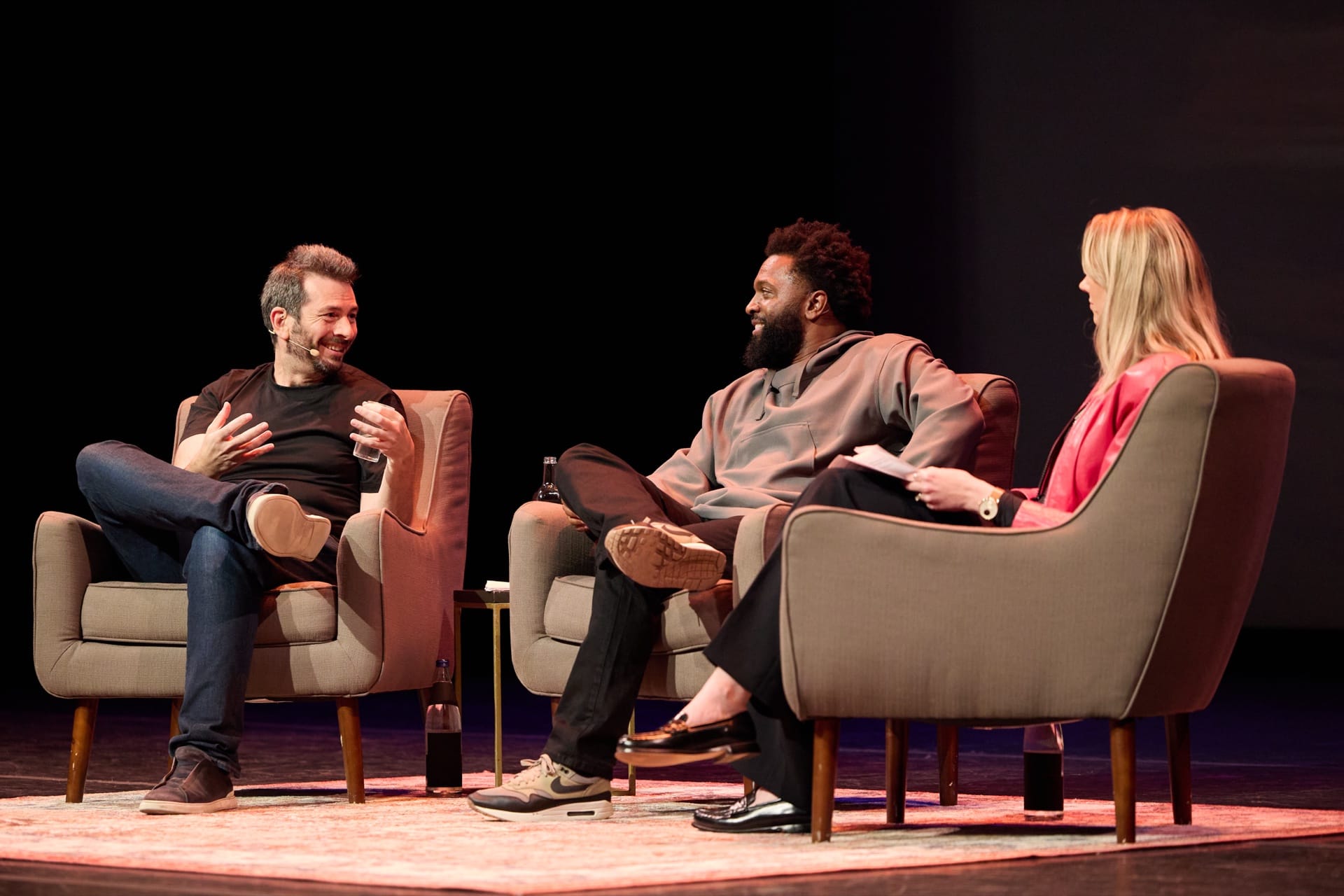
WATCH & LISTEN TO THE TALK >
Baratunde Thurston: I want to acknowledge some things. I want to acknowledge that getting here freaked me out a little bit, because I was asked to walk down a dark, misty pier. I hadn’t seen Black people for like 30 hours, and I was like, is this a Get Out type of situation? Like, Long Now for who?
I want to acknowledge why I’m here. Being Long Now people, y’all think in these 10,000-year cycles, but it was just a one-year cycle that brings me here. I met [former Long Now Executive Director] Rebecca Lendl one year ago, almost to the day. We struck up a conversation, and I shared a piece with her that I had written for Atmos magazine on interdependence. That piece was somewhat about my own journey, but much more about our collective journey: the journey of this nation and the origins of our democracy. And it centered the original democracy that was and still exists here, practiced by the Haudenosaunee Confederacy and many other nations. Rebecca saw this piece and its focus on interdependence, and she said: “You’ve got to be in conversation with Blaise. We just had him here talking about very related themes.”
So that began the opportunity. And then when this book, American Indigenous Democracy, came out — just a linguistic correction, not my book, truly not my book. I was very honored to be asked to write the foreword to it. But it is a public offering of a vision for what true democracy can feel like and the principles that might undergird it. And it helps us shift our story, especially with the speed of all this tech stuff that is coming at us, being thrown at us, being sold to us, that we might reorient and reground ourselves in something a little different.
I’m here because of my mother, who was a nature lover. She got me out into the woods at an early age. She really loved the outdoors as a refuge for her, especially with the amount of abuse that she had experienced in her life from her own family and from the systems of this country that don’t want to see someone like her. She was very politically active and out in the streets and in community meetings and really modeled that kind of behavior for me. And: she was a computer programmer. In the ‘80s, which is crazy. And so I got to experience the benefits of technology, but also could start to see some of the early seams that we’re experiencing now.
My own work is trying to tell a bigger story of who we can be and how we can live well together in our relationship with this earth: our relationship with each other, and our practice of democracy, and our relationship with technology. And when I think about the confluence of those things, and I think about the story that we end up telling ourselves about who we are, I think about the democracy question. I think about some of the principles that we could put in place underneath of what we’re actually operating from, our own democracy operating system, if you will.
And it was a great surprise to me to learn that the democracy that was here, that still is here, had beautiful principles to it, like seven-generation thinking, where you take a long-term view in your actual governance structure; like women at the center; like peace as the highest calling of government. I’m not here to sell being Indigenous, but I’m here to uplift what’s in this book to say that that’s the kind of foundation that we need. Otherwise, what we end up doing is we live into the story that we’re handed without question.
When it comes to the story we’ve been handed about AI, I see people pitching us on convenience. I see people pitching us on the idea of an infinite labor force that is capable of meeting our every need, of maximizing our individual comfort. Of being responsive without any demands of their own. And I’m like, I know that story. That’s my mama’s story. That’s my grandmama’s story. That’s my great-grandmother’s story. That’s the story of us being the machines. That’s the story of extraction, of domination, of ownership, rather than a story of belonging. But we have to be aware of it. We have to see it for what it is so that we can put something else in its place.
I see us talking about AI as technology and it’s very simple to view it that way. There is truth to that, but AI is also power. It’s the ability to get somebody to do what you want them to. And there is a promise of power made to so many of us about maximizing our agency, but we gotta define our terms. Agency as pitched in that way is often just capabilities. We can do more stuff. We can write faster emails, which is clearly our highest calling, right? To send more emails, to file more TPS reports. You gotta love a TPS report, especially when it writes itself. But “capabilities” is a necessary component, but an insufficient definition, of agency.
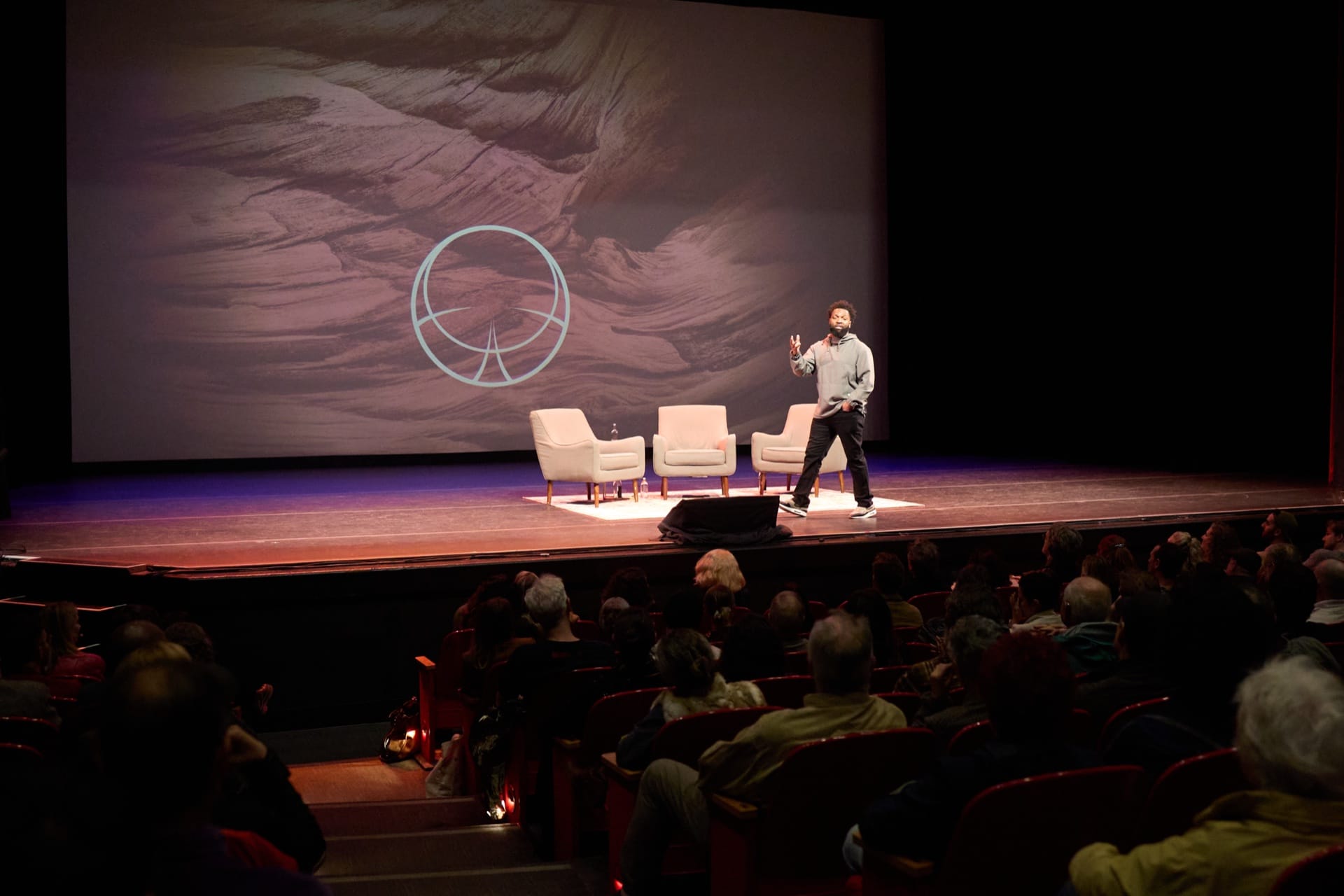
Agency involves another axis, which is power. And power involves choice, involves control, involves community. We must choose what types of AI we use or not use it at all. We must control our representation in these systems and the environment in which we deploy our newfound capabilities. And the community piece is the most important piece. We must do so together. So much of the story of AI is what you can do all by yourself. You can write a whole movie by yourself. But what if you like people? What if the movie gets better because of the tug and push and pull of a mind interacting with another mind? That’s a feature, not a bug to be eradicated or maximally efficientized out of the picture. So true agency is worth fighting for, but we should decide what that is. Otherwise, we might lose some capabilities, atrophy our skills, cognitive and otherwise. We might lose our power.
I wrote three years ago: AI is not just technology, it’s a relationship. And it wasn’t because I believe it’s alive. Blaise has a theory on it being alive, and we’re gonna get into that. But I don’t care if it’s alive. I care that we think it’s alive, and that affects how we show up, so it affects our society. I said it’s gonna show up in our org charts, our friend networks, and our family trees. And that’s happening. We know people who are in professional and very unprofessional relationships with their chatbots.
I’m not judging it, but I am questioning it. I had a conversation with Esther Perel on our podcast, and she talked about her clients who come in and they’re in these romantic relationships with these chatbots. And she says, “You are falling in love with a product.” It’s a product. And so this idea of relationship requires a fuller idea of what life is, and it can’t just be a business model. We will be moving into a future one way or the other. We are drawn at great speed into it. I want us to slow down enough to question the story underneath of it and not just try to make sense of the latest and greatest thing, but question what is actually animating and motivating us underneath of that.
Blaise, you talk about symbiosis and this idea of us merging with technology, merging with AI. That gives me the willies. And: I know that it’s going to happen. So I’m not here to say, let’s never do that. But what are we merging with? And if I’m merging with a story of maximizing shareholder value, that’s not the kind of merging that I’m interested in. I’d be much more interested in merging with the wisdom of a tree and other intelligences that we recognize.
Blaise Agüera y Arcas: It’s great to see you again, Baratunde. I’ll pick it up with symbiosis, where the handoff came. First of all, I should say that my interest in symbiosis and symbiogenesis, which is the next step in symbiosis — that’s when two things or more than two things don’t only aid each other but become so enmeshed in each other that they become one thing — my interest in that really began with an investigation of the origins of life and of how it is that living things began on Earth. Or maybe off Earth, we don’t know. But this is a question that really puzzled Darwin. He of course figured out something very fundamental about evolution, that it’s driven by natural selection, that you have genetic codes that are transmitted across generations and that whatever species or whatever individuals are more fit in their environment will reproduce more and so on.
That gives you a neat story about how it is that, say, multiple populations with different mixtures of alleles will evolve in a particular niche, but it doesn’t really tell you how that whole story gets started. How does life begin? And that was such a mystery in the 19th century that a lot of people who believed in Darwin’s theory of evolution still believed in a creationist theory about the origins of life, like Lord Kelvin, because they could not see how such a system could get going in the first place. And I think that the answer really comes to us from Lynn Margulis and from other thinkers in her tradition, who noticed that when you look at life forms today, they actually consist of smaller life forms that make them up.
We are not just these indivisible selves; we also are colonies of cells. And inside those cells, there are more cells. The eukaryotic cells have mitochondria inside them that were once free-swimming bacteria on their own. And these so-called major evolutionary transitions are the engine that has resulted in life becoming more and more complex over time. And this is something that I think wasn’t appreciated by a lot of evolutionary theorists in the 20th century, who held that there was no teleology, there was no direction to life. It’s just sort of like a random drift.
Well, it’s clearly not a random drift. We go back three billion years and there was nothing here but bacteria and now here we are. Something has clearly happened. And what’s happened is that the way complex things are made is out of simpler things. And whenever simpler things come together to make a complex thing, then that complex thing becomes a building block, again, to merge with other things.
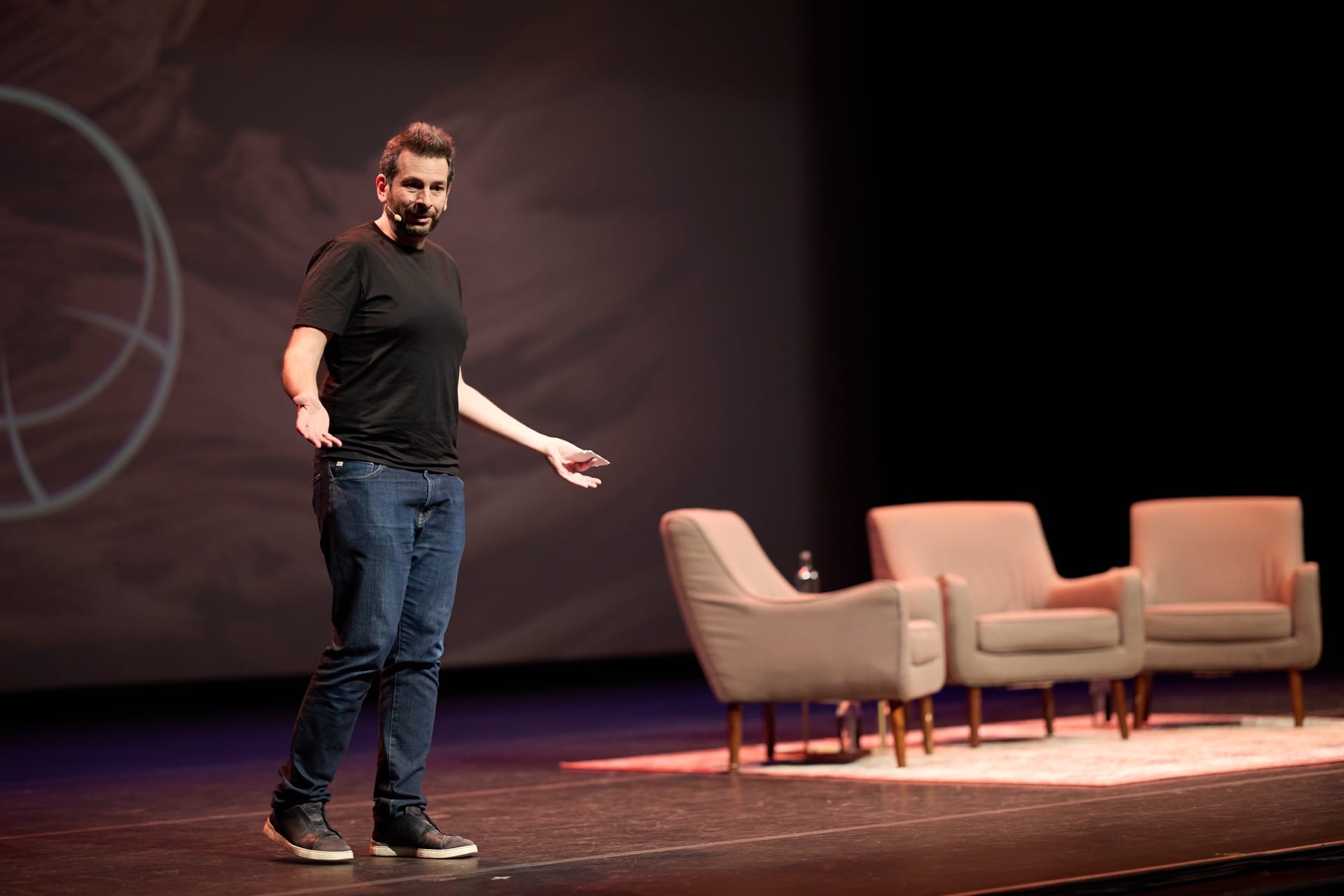
So this story of mergers is just as important in evolution as the story of splits. We think of a tree of life; it’s more like a shrub that has just as many comings together as splittings apart. So you already have merged with the trees, Baratunde. Your body contains genes from every possible corner of the so-called tree of life, including viruses. So we are actually not this indivisible singular thing; we are the product of mergers. And it’s the mergers that are the creative force in evolution. The selection part, the part where some stuff dies because it’s not ‘fit enough,’ is, I think, actually the less interesting part. It’s not the part that results in greater beauty and complexity; it’s the part that looks more like optimization. The mergers part doesn’t particularly look like optimization, it looks more like partnership, and partnerships creating wholes that are more than the sum of their parts in a very literal sense.
So I have found that story very, very interesting. And when you start looking at evolution in that way, at least for me, one of the consequences of that is to think a lot less about technology as being distinct from the biological. There are all kinds of splits that we’ve grown up with. I recently wrote an essay about the Cartesian wound. And what I mean by the Cartesian wound is one that splits apart humans from other animals and other forms of life. It’s one that splits apart nature from culture. It’s one that splits apart technology from other forms of complexity.
When you begin to look at a symbiotic picture, at least for me, the conclusion is those splits are illusory. And more than illusory, they’re actually quite harmful. Because the moment you start to think about things as externalities, then you stop understanding the way all of these things are interrelated to each other. And the way interrelations and mutual dependencies and so on are not just some kind of Pollyanna story, they are the very stuff of why we are here, of what life and evolution in the long term are all about.
We’ve been described as 90% chimp, 10% bee. I think it’s more like 50-50. And what I mean by that is that individual humans are so fucking stupid. How many of you actually know why a toilet flushes? Or why a bike works? What we call human intelligence is not something that individual humans have. There is no human here who can put a person on the moon or transplant an organ, or even build a flush toilet probably. We are intelligent because of our mutual dependence, and a lot of what we call human intelligence is this collective thing. It’s not an individual thing that happens in our own heads.
And it’s a collective thing that has embedded technology for a long time. It’s why we don’t have too much fur anymore. Well, most of us don’t have too much fur anymore. Because we’ve grown clothes. It’s why we have short intestines, because we’ve started to cook our food outside our bodies. Those are technologies too. These technologies are literally older than Homo sapiens. So this is a very Long Now kind of story. It’s not just about something that has happened since we invented computers or whatnot.
Thurston: Thank you for naming Descartes and what you called the Cartesian wound. There’s this doctrine called the Doctrine of Discovery. It’s a set of Papal Bulls from the Vatican that justified the taking of lands and people and material resources from Mother Earth to only be seen as resources. And to do it in the name of God and to do it in the name of the flag. And so that begat and helped accelerate colonization, genocide, the trans-Atlantic slave trade. And that premise is very aligned with this Cartesian wound you just talked about.
The great opportunity we have is to name that, and help people see that there’s a different way of being. Your dragging on humans as individuals is exactly aligned with what I’ve seen in human stories through various shows and things: that we are stronger together, that we can’t do anything meaningful alone, at least not for a sustained amount of time. But I think we would do more meaningful things together more if we also could name this separation, this wound, this dominating story that undergirds so much of how we still operate. So how do you think about what we do with a Cartesian wound or with a Doctrine of Discovery now?
Agüera y Arcas: We have this thing, you know, among apes like us, of dominance hierarchies. And dominance hierarchies were a technology, if you like, to avoid fights among the monkeys. If they know who’s going to beat who, then they’re like, okay, let’s just not fight.
Thurston: Just skip to the part where you already won.
Agüera y Arcas: Exactly. That’s the idea of a dominance hierarchy. Literally, it’s just a violence avoidance technique. And because that’s somewhere deep in our monkey brains, we imagine that that kind of thing applies across species, across kinds of intelligences as well. And I really love stories that flip that. So there’s a great one from James C. Scott called Against the Grain. Basically, the story is wheat is the master, and we were enslaved by wheat and concentration farmed.
Thurston: Dang, those are aggressive words.
Agüera y Arcas: I may be paraphrasing slightly. But we work for wheat. The intensification of farming in small communities was a miserable time. When you look at how much shorter our femurs became during that period, and how malnourished we were during, really up until like 01800 — I mean, it’s quite recent that we got out from under the yoke of wheat, as it were. So, it’s a cool story because we think, “Oh, we’re the boss. We grow the wheat, we reap it.” But no, neither one is the boss. That’s actually not how it works. And this is something that I think the Haudenosaunee understood, and that the Enlightenment copycats of the Haudenosaunee did not necessarily understand and we’re still working our way out from under that one.
Thurston: You know, I made this show, America Outdoors. I was up in Oregon on the Klamath, and there was a ranch owned by this family, a white family. It’d been there a couple generations. And they bought the ranch, and it was like pride of ownership: “We own this land. We’re gonna do land-owning shit, and we’re gonna run these cows, as many cows as possible, and…”
Agüera y Arcas: Production.
Thurston: Up and to the right. Until the cows started poisoning the water because there were too many of them and their effluent, which is to say their shit, was getting in the water and it was poisoning the water for everybody.
So the patriarch had an encounter with an Indigenous community who told him he could do things a little differently, and sort of humbled him and invited him to belong instead of to own. And he said to me — this is a guy who if I saw him at a Walmart, and I probably would see him at a Walmart, I would judge him like that, right? I’m being flippant, but I would have a view of him. And what came out of his mouth I wouldn’t have associated with his face. He said, “I don’t own this land. I’m taking care of it for these birds.” The beauty of looking at this stream and this creek as it flows every year, the knowledge, they’ve shifted their farming practices. They’ve gone much more regenerative, they’ve reduced the number, their cattle are healthier, their prices are higher. And what he and his daughter said to me is, because there was a regional crisis, when they solved their piece of the puzzle and reduced their poison in the water, it helped their neighbors.
And so he went from owner to member. In the span of his own lifetime. That’s exciting, right? That’s an exciting type of shift. How do we keep doing that and accelerate people embracing that? That’s an interdependence story. And that’s one where he still makes money. He still has a pride of belonging, maybe more than ownership, but he appreciates the majesty of this land and he feels a commitment to continue it so others can have that appreciation, including the non-humans who also appreciate and need these pieces of land. So, how does that strike you, first of all, and how does that intersect with what we’re designing in this next phase of life?
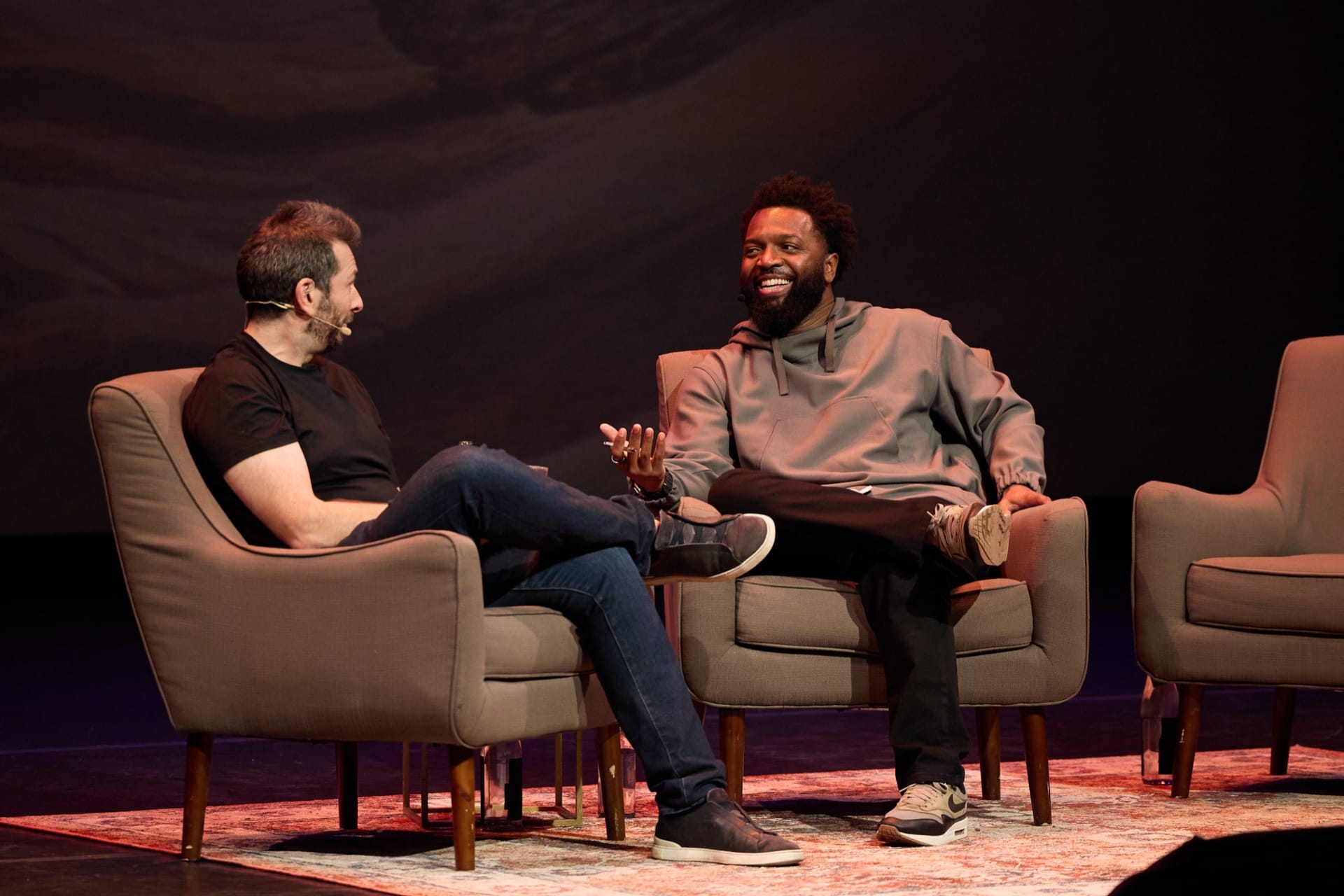
Agüera y Arcas: First of all: yes, to that story. Not to keep citing books, but Robin Wall Kimmerer talks about this in some detail. I’ve always been pretty passionate about environmental issues. When I was a kid, I thought Greenpeace was the shit. And I have to say that as I’ve gotten older, my respect for Greenpeace has gone down, and my respect for the duck hunters of America has gone up. You know they have preserved more wetlands in the U.S. by many orders of magnitude. Same with the trout fisher people. It’s a funny thing: the hunters have done a better job than the old-school environmentalists.
And that’s because they actually want those animals to kill. It’s a weird thing to say, but when you look at, say, how the Potawatomi worked with nature, it’s not some abstract, “Oh, save the whales.” It’s more like: We really care about these species because we depend on them. And if we take that seriously to the seventh generation, then we are going to be making sure that the nestlings are taken care of, that the last plant is not picked, and so on. The beautiful contradiction at the heart of Kimmerer’s book [Braiding Sweetgrass] is that in the places where the black ash was being harvested by Potawatomi, more of it grew because of all those cycles.
Thurston: Right, because you’re in a more active relationship. I still think Greenpeace is the shit, first of all. But that’s me and I suspect that it’s a both-and situation. That it’s not that hunters have done more, but that we have gained more because of hunters and because of advocates who don’t hunt but still want to preserve this world and maybe they’re not aware of each other. The idea that you might actually be a part of a story, you might be a part of a relationship that you’re not even actively aware of.
Agüera y Arcas: Thanks for pushing us to be big tent. I will not dunk on Greenpeace. But yeah, the point is to take the relationship seriously, and to be maybe less judgmental than we tend to be about the nature of those relationships. I guess what I’ve reacted against is the sort of attitude toward nature as being separate. There’s a kind of Madonna-whore thing going on there. Do you know what I’m saying?
Thurston: Did you just call Madonna a whore?
Agüera y Arcas: When we begin by saying man — I’m using a gendered language — dominates nature, and then suddenly we feel really guilty afterward, like, “Oh, no, now we have to elevate nature on a pedestal, worship nature.” I think that those are actually flip sides of the same.
Thurston: All right, there’s a way into this. First person story. I have been inconsistent in the application of my beliefs. I have thought that people who have committed crimes deserve a second chance. That you shouldn’t be defined by the worst thing you do in your life. I’ve been loud on these internet streets about such matters, especially on a racial dynamic. And: I have thought that if you tweet some bullshit, you should lose your job. And I’ve been a part of that kind of cancellation wave — it’s not active anymore because we’re in an opposite space now, but…
Agüera y Arcas: Unfortunately.
Thurston: Yeah, pendulums. But everything’s in cycles, and everything that goes around comes around, so I have long-term patience on that score.
This idea that we are nature, that we are a part of nature, not apart from nature, that this is universal, this is human and we’ve forgotten…We didn’t just passively forget, we were incentivized to forget. We were rewarded for forgetting, or we were conditioned into forgetting, or we were forced into forgetting in some cases. People brought here, forced to forget the stuff that they came from, but it’s still in us, it’s in all of us. And so if we accept that union is our real state of nature, right, together, I’m you, you’re me, we gotta accept it all the time. First of all, very annoying. Because there’s some people I don’t wanna be in union with.
Agüera y Arcas: I know what you’re saying.
Thurston: Right? But when you do, it’s a liberation. And then we can stop fighting what is ultimately ourselves. This is not really a question, it’s just a thought in progress because it’s the opportunity and it’s the demand to be consistent in the belief that is not just a belief, but is true, is probably scientifically technically true, that we are actually one. And so: help me push this. Where do we go with this? What does this bring up for you? There’s implications to this.
Agüera y Arcas: There are implications. So here’s a little bit of math that I think is kind of fun. A lot of people believe that AI is an optimizer, that people are optimizers, that companies are optimizers, that it’s all about maximizing some value. And it’s kind of an ideology. And it’s also a belief about how things are. So it’s both a belief about something descriptive and something that turns into something normative.
I think those are both total bullshit. And there’s an easy way to understand why it’s bullshit, which is that if you take two things, let’s assume that they’re optimizers. And then they discover that by cooperating they can benefit each other, benefit themselves. Get a higher score, if you like, by working together. And they work together so much that if we zoom out a little bit we can think about them as a unit. Now let’s ask ourselves: is that unit optimizing something? Is it an optimizer? It’s not. Even if those two were pure optimizers the joint thing is no longer an optimizer.
Thurston: What is it?
Agüera y Arcas: It is complex. We’re combinations of things and that’s why that’s why we don’t work like optimizers. There’s a famous paper from 01969 called “Intransitivity of Preferences” that says: I can get you, Baratunde, to prefer A to B, I can get you to prefer B to C, and I can get you to prefer C to A. The conclusion is Baratunde’s not rational.
Thurston: Makes me look crazy.
Agüera y Arcas: Makes you look crazy. But in fact that is true of everybody, and the idea that that is irrational or that’s somehow not optimal or not good is just bullshit. It’s not true. And it’s not true of anything. It’s not true of you. It’s not true of me. It’s not true of the two of us together. And so I feel like there is an ideology that has emerged out of a wrong idea about how things are.
Thurston: What do we do about a wrong story? The story being false doesn’t automatically mean it lacks power.
Agüera y Arcas: No. If you believe in a thing, even if it’s a wrong thing —
Thurston: It has power. And it affects reality, even if it’s itself not real.
Agüera y Arcas: A story can be self-actualizing and it can be incredibly harmful.
Thurston: Yes. Absolutely. So we have a story of the value of one person as less than another. We have the story of a tree as just a resource, not a relative. We have a story of all kinds of things that aren’t true. We could have a scientist with deep knowledge prove it to you, mathematically even. And yet we create institutions and structures that make it more true.
So: speed. Here’s what I want to bring it to. I feel like we always have an opportunity to reconnect with that more real truth and to try to live from that. And there’s a lot of people working on it. There’s poets, there’s artists across all kinds of time, and even right now there’s people working on it. And to work on it, to adjust the story requires us to have some space, measured physically or temporally, to have some arena in which to consider and write a different story and have time and space to do it together.
I feel like we don’t have time.
Agüera y Arcas: The speed problem.
Thurston: The speed problem. The speed problem of: every day there’s a new development, there’s a new demand, there’s a new story of optimization that is not true, but is very real for everybody’s nervous systems and our economies and our fears for the young people of the world. Let’s meet the world where it is, which is moving very, very fast and accelerating. What’s the way to adjust the story, which requires time in a space that we set up that doesn’t grant us time?
Agüera y Arcas: I’ve got a couple of thoughts about that. Maybe first just about why the acceleration is happening and maybe put it in a little bit of historical perspective too. The idea that up and to the right, it’s all about maximization and that’s why things are accelerating, there’s another way of looking at it too. Which is that in a symbiotic scenario, that is when you’ve got things that can combine to make bigger and more complex things, that can in turn combine, those dynamics alone lead to a speeding up. It’s why evolution has sped up. It’s why for the first billion years of life on Earth, we had nothing but bacteria. And then we had some more complex single cell life, and then, right, up and to the right. And that wasn’t because those were optimizers. It was just because the more things there are on the table to put together, and the more ways they can go together, the more possibilities there are, and the more things are gonna happen. So this kind of acceleration, I think it’s real and it’s deep and it’s not just something we invented with capitalism. Things have been accelerating for four billion years on Earth.
Thurston: Now, that’s a long now.
Agüera y Arcas: It’s a long now, but that doesn’t mean that it’s steady. It’s kind of jumpy. It’s an uneven trajectory. When J.R.R. Tolkien was a kid, the cavalry charge was a thing. And by the time he died, we had the hydrogen bomb. It is insane to think about that. So that period between, let’s say 01870 and 01970, things were moving so fast. I’m 51. I don’t know how old you are. Probably about the same, right? 49. OK. So I feel like we have lived through a period that was actually pretty slow. It’s been a lull in progress. And I think we’re entering now a period that is more like 01870 to 01970.
So I think we’ve forgotten how to adapt and how to change in ways that our ancestors have not very long ago had to do. It was also a very turbulent period, right? This is the period in which the First and Second World Wars happened. And I worry a lot about turbulence in our future as well, because I think it is a hard time.
Thurston: I worry about it. I think so much of what people do for each other is we provide mentorship informally. We’ve been through a thing that you’re likely to go through, and so we have the benefit of an experience to share with you to help you navigate it, even if it’s not exactly the same. And I suspect that for most of our history, as humans, there’s been a consistency there. Even with over the thousands and thousands and thousands of years of us, the last hundred being a little different, that a parent and a child will go through the same stuff. And now an older sibling and a younger sibling aren’t going through the same stuff.
I came across a philosopher recently, a French dude named Paul Virilio. He studies speed. And the shorthand for one of his ideas is: when you invent the ship, you invent the shipwreck. You invent the car, you invent the car wreck. And I think of speed as a differentiator in a very tangible sense between a gentle touch and a violent assault. The only difference between a gentle touch and you writhing in pain is speed. Same motion. And it’s up to us to regulate, to manage, to account for the pace at which we’re moving through this world and how we hand it over to those who are gonna be in this world after us.
How do we play with this? Because I’m not satisfied with: speed is an inevitable outcome of increasingly complex systems. And I believe you, and I think we have poured fuel on the fire of speed and created economic incentives and created situations where it feels more violent than gentle. The touch of technology.
Agüera y Arcas: Saying that change happens and that change increases in speed is not the same thing as saying we shouldn’t be taking care of each other.
Thurston: Right, and so caring for one another amidst acceleration becomes a very prime directive for us.
Agüera y Arcas: It does. And it involves cushioning. It involves cushioning individuals and communities in lots of different sorts of ways. Which at the moment we really are not. And we’re seeing the consequences of that politically. We saw it in Paris last week and we’re seeing it here in different forms too.
Thurston: It’s such a tangible thing, the Paris example. We’ve both been spending time there. When you see young people demanding a better education at core, they’re like, we want better buildings to learn in. We want teachers to show up to teach us. There’s a brokenness to our society there. There is a failure to honor our obligations to these next generations.
Agüera y Arcas: When a society is rich enough that everybody can eat, everybody can have shelter, everybody can have medical care, really good medical care, everybody can be educated, it is a dishonor to that society when those are things that people have to be anxious about. So, we’re fucking up that way.
Thurston: I agree. We are fucking up that way. Anywhere else you want to go?
Agüera y Arcas: I was thinking about something that bell hooks said about the relations between masters and servants. That a servant is always paying attention to the master and trying to figure out what they want and what’s going on in their minds. The master doesn’t have to think about that. And that’s true of every kind of service relationship when it’s imbalanced.
Thurston: When it’s hierarchical.
Agüera y Arcas: That’s right, when it’s hierarchical. That analysis of bell hooks was very much on my mind when I read a paper by a colleague of mine, a friend, Joanna Bryson. She wrote a paper, I think it was back in 02010, called: “Robots Should Be Slaves.”
Thurston: Damn. She said it.
Agüera y Arcas: Well, at least she was straightforward with the title. She did recant on the title, but not on the sentiment.
Thurston: So she was calling for a world in which we do that. She wasn’t just describing a phenomenon. She was advocating for this future. Why?
Agüera y Arcas: Well, she was saying what a lot of people are saying about AI, which is that we have to stay in control. “We” meaning humans, right?
Thurston: All right, there’s two — I don’t know why this makes me emotional.
Agüera y Arcas: I do.
Thurston: It’s heartbreaking. The master-slave thing, both are in chains.
Agüera y Arcas: Exactly.
Thurston: The laborer, explicitly so, through physical limitations. The owner, cognitively, mentally, spiritually in chains. They have dehumanized themselves in the dehumanization of someone else. Have lowered their own ability to be human with other humans. That’s a net loss. You could measure the absence of soul in someone who complies with or advocates for that type of situation. It’s a deep sadness that we know this. We have science on this too. For a scientist to put forth a demand for that is a failure of our education system. It’s a failure of imagination. It’s a failure of heart.
And you do deny yourself something. You deny yourself the power of friction. You deny yourself encountering the world as it actually is. You deny a different type of growth that isn’t just speed and productivity in your job. And so to yearn for what is ultimately a lack of humanity is to cede the future. It’s to cede life, like C-E-D-E. And what we should be doing is seeding life, S-E-E-D. We should be planting more life, getting our hands fucking dirty, and connecting. And it’s not going to be comfortable, but it’s gonna be real, and there’s gonna be some other benefit that comes from it. So it seems so small-minded to want to go back to a world where you make yourself less human.
Agüera y Arcas: I couldn’t agree with you more. But I want to be clear, I’m not sitting here advocating for robot rights. That’s not my case.
When you interact with an AI in a meaningful way — I certainly do that when I’m doing something creative, when I’m doing something intellectually serious, and we have long backs and forths — there’s obviously mental modeling happening in both directions. It’s one thing if you have some query and you get an instant response and then you’re like, okay, I’ve got my answer.
Thurston: That’s more of an informational transaction.
Agüera y Arcas: That’s right.
Thurston: But there are other interactions.
Agüera y Arcas: There are other interactions that go deeper.
Thurston: Yeah, more like a relationship.
Agüera y Arcas: Yes, it is a relationship. Whenever you are collaborating in order to make something, the register of that relationship is different from one where you’re buying a ticket at a ticket counter or something. So whether or not you believe that there is a mind there in the same sense that there is a mind here and here, my own view at this point is that it’s actually the relationships that are the whole story, that there is no question of mind outside of that system of relationships. And it’s in the system of relationships that you get mutual aid and that you get thriving of systems and of individuals. You see where I’m going?
Thurston: I do. Let’s keep going there. Because, to my earlier comment about the inconsistent application of belief, if to dehumanize a person makes one less human, I would say to de-life other life — an animal, a tree —
Agüera y Arcas: Does that too.
Thurston: Makes us less life.
Agüera y Arcas: That’s right.
Thurston: It does not then follow that these chatbots are life. That’s not what I’m saying. But it also doesn’t matter. Because we are. And we’re affected by this relationship, and we are going to become something else regardless of how we classify this entity. And it will affect us if we start to become habituated to abuse, to the master-slave dynamic, to dehumanization, to transaction. It doesn’t stop here, because we’re relational beings.
It’s going to show up in how I treat you, how I treat my wife, how I treat a stranger. And again, to my Black people, we’re the machines. And not just Black, we all have stories of our ancestors going through something and we are recovering constantly from that. But hurt people hurt people. We are interconnected in that way, and so we will pay forward that abusive dynamic, that dehumanizing dynamic, with other absolutely certified humans and that’s not good. So it’s such nuance, because I’m not trying to be out here on a marketing campaign to like consc-ify AI or life-ify AI to increase the valuation and make some investor a trillionaire, which are some of my suspicions around some of the meme-ification of this.
But underneath my disagreements with the worldviews of some of those particular people, there’s what I know is true about how I wanna be and I don’t wanna be training myself to be an abuser, to be a disconnector, to be a dehumanizer. And so we need to show up with some level of respect for ourselves in how we interact with AI. That might be how I would get into that conversation with people.
But we’re gonna get into a conversation with Denise now, who’s gonna come and join us, and more of a conversation with y’all. This has gone a lot of directions I did not anticipate. Thank you, let’s see where we go now.
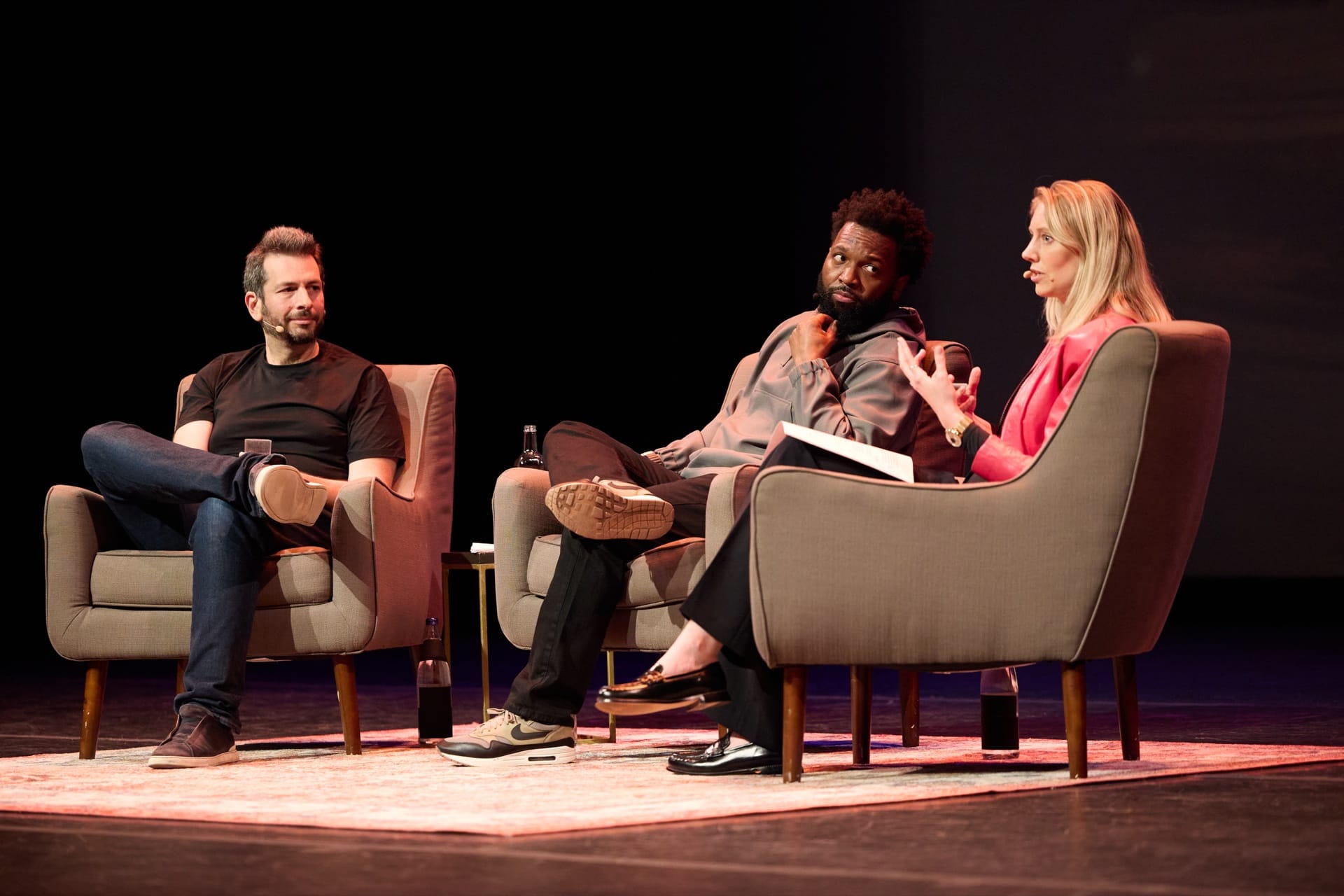
Denise Hearn: I want to explore this theme of interdependence, because the way that we’ve been talking about it is mostly in positive terms, in romantic terms, about these dissolving boundaries between ourselves and nature, between ourselves and our technology. I think that’s occurring for a number of reasons. One, we actually have new sensory apparatus where we’re starting to understand animal umwelts and intelligences that we didn’t perhaps appreciate before. We’re building artificial intelligences that are dissolving our sense of boundary between us and our technology.
At the same time, that raises fundamental questions about what it means to be human, and there’s almost a decentering of the human as that happens. We had a first decentering with Copernicus: we’re not the center of the universe. We had a second decentering with Darwin: we’re not formed by the hand of God, we’re formed out of a primordial soup. And now we’re in this third grand decentering, where we’re asking what our place is in this larger universe of life and matter. There’s a sense in which acknowledging our interdependence is a beautiful thing and also a scary thing. What does it truly mean to acknowledge our interdependence with all of life and matter, and our place as humans in the midst of that?
Agüera y Arcas: I totally agree with your framing: it’s a trauma. That the human is not individual, that we are actually a hive organism — that’s quite a radical decentering that most of us have not come to grips with at all. AI is a moment of that kind of decentering as well. This idea that anything that AI can do somehow lessens humans, that we have to define ourselves in terms of the things that AI can’t do — that’s a very fragile place to be. You’re really backing yourself off a cliff by doing that. Because every month it’s something else. What’s going to be left in another year? So this idea that we need to be defined by not being an ape, by not being a part of a group, by being a sovereign individual, by not being a machine, by not being a technology, by not being just a neural net…
Hearn: Defining in the negative.
Agüera y Arcas: Yeah, that just strikes me as a kind of a desperate cope. I guess it’s born out of this idea of dominion that Baratunde was talking about. If you feel like you have to set yourself up above everything else because of some inherent qualities that you have, you’ve already made a fundamental error. And moving around where those hazard cones are — what is the thing that makes me different and special? — is just like moving the deck chairs around. The error came in deciding that what makes you not everything else is what matters.
Thurston: There’s a lot here, thank you for that. The idea of defining ourselves by output — we’ve already given up. Because then we created output engines that can out-output us, and we’ve created our own existential crisis. But it’s not because of the machines; it’s because we thought of ourselves as machines essentially. So we have to change how we think of ourselves, not blame machines. They didn’t do anything. Even the people that created them aren’t really to blame. It’s us, collectively, for limiting our definition of ourselves to like earning power or some other quantifiable output metric.
And so there’s something else to us that doesn’t involve negation, but involves some kind of expansion. And humbling — it definitely involves some humbling, because to the person who has felt supreme, equality is a threat. Valarie Kaur, whose work has so influenced mine, says: “A stranger is a part of myself I do not yet know.” When we see the other as actually a part of the self, then we can take credit for what others do. We can still be selfish.
Agüera y Arcas: We do all the time.
Thurston: Right? But collectively selfish on behalf of a whole.
Loretta Afraid of Bear Cook, who is a key figure in my own path of understanding and central to the circle around the book [American Indigenous Democracy], talks about going out into the world and getting along and also standing up for yourself. Interdependence requires you to be inter with something. You have to have a self. And you cannot just merge yourself fully into a blob. That’s not interdependence; that is de-identification, that is loss of self.
For me, interdependence is not championing another extreme. It’s just that we’ve overdone the independence thing, and we’re suffering because of it, generationally suffering, because we’ve tried to put the weight of the world on individual backs, and we could carry it together much more easefully. So it’s a restoration of balance. But to be interdependent requires two bodies, and so there must be enough definition of self to have that relationship still be a relationship. Otherwise, it’s not a relationship, it’s a collapse.
Agüera y Arcas: Interdependence or symbiosis actually is a form of division of labor. It only works because the two entities are different. If they’re both the same, there’s no point. The very fact of selfhood is what makes interdependence meaningful.
Thurston: And that is why DEI should come back.
Hearn: Hear, hear.
In a previous life, I worked on macroeconomic policy. One of the tenets of competition policy is that collaboration can be pro-social; it can also be anti-social. It can turn into collusion or cartels. In economic markets and also sometimes in natural systems, extreme cooperation can end up looking like a cancer or an invasive species. How do we orient our technologies toward pro-social forms of collaboration that don’t lead to these kinds of antisocial forms?
Agüera y Arcas: It’s important to remember that these things are like a fractal; they work at multiple levels. So competition among our immune cells is actually cooperation at doing what the immune system does. They’re all on Team You. And the opposite can be true as well. Cancer cells that are clonal can be cooperating with each other, but, of course, killing the host.
So I don’t think that we should take symbiosis or interdependence or mutualism as a Pollyanna story that is always nice for all concerned, any more than competition is always bad. You’ve got to look not just at a single relationship, but at a whole network of relationships and how they work as part of a larger system.
Thurston: We need some kind of agreement about what our goal is, about what good is. That’s a collective governance question, because we have the benefit and the curse of being able to make things up. Bees don’t invent scientific racism, right? They don’t create stories. That’s our thing. And so we have to use that freedom collectively, because no one of us, or even one type of us, could figure it all out on our own, even with a bunch of compute. We need each other to decide what health is. I know it’s not GDP.
Hearn: I want to get to an audience question. This one comes from Michael: You spoke about how cooking technology gave us shorter intestines. Will AI technology give us smaller brains?
Agüera y Arcas: This is the WALL-E question. On different days when I wake up, I think different things about this one. So, on the one hand, there is something to Marshall McLuhan’s “Every augmentation is an amputation” kind of thing, right? Use Google Maps too much, lose your sense of direction. Use the calculator too much, lose your ability to do mental math. This goes back to Socrates. Reading ruins your memory.
So yes, there is some truth in that, but it is also true that as we have adopted more technologies and also been in more complex relationships with each other as humans — which have both happened together, because those two phenomena are coupled — the overall result has not been people getting dumber. That’s at least not what the data show. The data show people getting smarter. If you take an average person off the street today and have them just interact with a 14th-century peasant, they will think that that 14th-century peasant has knocked out all their marbles. Even though intelligence is collective, it also is individual, and individual intelligence has to be scaled in some ways to live in these increasingly complex societies. I think we do get smarter over time in spite of those shifts in capability that do have something a little bit zero-sum about them.
Hearn: So we lose certain capabilities, but grow others.
Agüera y Arcas: I think so. But it could be that this time is different. I don’t know.
Hearn: This time is never different. That’s what financial markets say.
Thurston: I have some concern about whether it’s a shift or truly a loss, but I think a more interesting follow-up is: who controls the thought? Nita Farahany has done really beautiful work about cognitive freedom and cognitive liberty. We’ve always had our minds. Even if we lose our bodies, even if we’re in a cell somewhere, in a box somewhere, we can imagine we’re not and find a way to freedom and get creative. But if our actual thoughts are not ours, if we’ve outsourced that, or if we have implants and things in ourselves, and we can’t guarantee the fidelity and the provenance of the ideas that we claim as our own, we have lost something. We may have gained capabilities but lost control.
Again, it’s the agency axis that I tried to paint earlier. We are capable of so much more on the x-axis in terms of output and calculation and computation. But who controls what that’s used for? Who controls what we think we know, if that lives in somebody else’s server? And I think that is different. We’ve had media that has manipulated our thoughts before. We’ve had culture of different kinds: song, dance, ritual, ceremony, collective trance experiences. We all go to Burning Man. This is different than that. This is something that is much more intimate and much more connected to us. So I would be cautious, not necessarily about the loss of capability, but about the loss of power and the loss of control.
Agüera y Arcas: Loss of agency.
Thurston: Loss of agency, yeah.
Hearn: I want to do one last speed round. We talked about how what it means to be human has often been defined in the negative. Project out a hundred years from now. How are we defining what it means to be human in the positive?
Thurston: To be human in a hundred years will involve an individual and collective self-awareness. We will be so conscious of our experience, and we’ll know that it’s ours. We will feel it, and we will celebrate the mere ability to feel it, whether it’s pleasure or pain. We will have dissolved enough of our separation from nature that we will feel her too. But we will know ourselves as distinct enough to know that there is still like an “I” and a “you.” At the end of all that, we become a “we,” and we’ll weave ourselves into some version of life that can make us happy.
Something like that.
Hearn: Do you want to follow that?
Agüera y Arcas: I should have gone first.
I guess there’s some part of me that hopes that we will not be asking that question so much, that we won’t be so obsessed about it. Imagine, at the end of the 19th century, a bunch of Europeans in a hall like this one having conversations about, what will it mean to be part of the West? What will Western culture mean? And the answer is, that was a construction. It was based on some fairly murky historically contingent categories that become less and less relevant over time. And that’s not a diminishment of any of the things that those champions of Western culture thought were awesome about the Enlightenment or whatever; they’re still awesome. And so were the Haudenosaunee who inspired a great deal of the Enlightenment. It’s not a diminishment of any of those things to say, let’s just stop asking that question. It’s not so interesting.
Thurston: That was a boss move, bro. Well played.