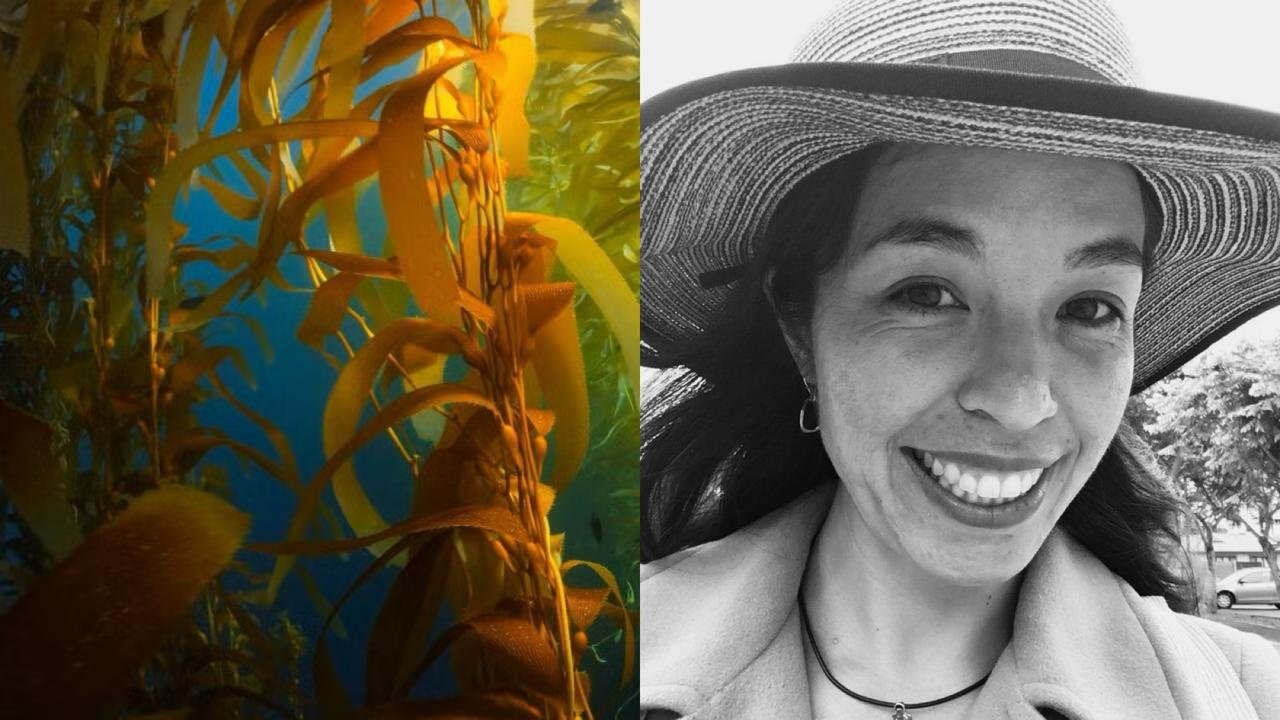
Melody Jue
Ocean Memory
Recorded live on Mar 18, 02026
at Cowell Theater in Fort Mason Center
The ocean is not empty. It is a vast storage facility of memory agents. Ocean bodies use the chemical signatures of seawater for memory and intelligence in ways we can barely imagine. In her Talk, Melody Jue said our struggle to understand ocean memory comes from our terrestrial bias. This bias shapes what we try to protect and the technologies we develop. We must, she said, “deterritorialize the sensorium.”
For example, the vertical depths of the Pacific carry thermal signatures of ancient ice ages. Arctic glaciers are laced with matrices of microbes retaining genes from before the Great Oxidation Event. Whale songs are also memory agents, passed down through generations, preserving the cultural histories of the planet's largest creatures. Corals hold memory, too. Those exposed earlier to changing ocean pH are more resilient to acidification. Meanwhile, human cultural memory is in danger of disappearing alongside these ecosystems. Jue pointed to Indigenous and traditional environmental knowledge at risk, like the Ama divers’ fishing tradition, as abalone populations drop.
To better translate the ocean sensorium, Jue worked with interdisciplinary artists, musicians, divers, and researchers to develop soundscapes that help us “smell” with our ears, remapping chemosensation through synesthesia. Don’t miss the moment in the Talk where she plays two original music pieces that use the density and flow of sound to mimic chemical gradients of seawater.
“The ocean teaches us humility,” Jue concluded. “It makes us confront our preconceptions about the planet and sensation.”
watch
primer
Jue will be hosted by Margaret Cohen of Stanford University.
What does the ocean remember? Can the ocean’s memories teach us to better steward our planet? In this talk, Melody Jue approaches this question as a literature and media scholar, drawing on eight years of collaboration with the Ocean Memory Project. This interdisciplinary group of scientists, artists, and humanists explores how the concept of memory reshapes the questions we ask about the ocean.
Jue examines how ocean memory might be understood not only as history, but as a capacity for anticipating and responding to future conditions. She considers how understanding chemosensation underwater can disrupt our anthropocentric approaches to time, smell, and marine life as we know it. Jue will explain what underwater memory might offer for imagining and preparing for the long now both on land and in the ocean.
Why This Talk Matters Now
As we face accelerating ocean warming and biodiversity loss, the ways we perceive and value the ocean shapes the planetary futures we imagine, and the actions we take to defend it. This talk reframes memory as an invaluable sensory capacity that can inform our long-term thinking and resilience in times of changing climate.
The Long View
By calling our attention to non-visual forms of perception, Jue challenges human-centered timelines that often dominate the discourse on environmental crises. Her work opens new ways of imagining responsibility and continuity across civilizations-long timelines.
Learn More
- READ Jue’s Ideas essay on soft corals and the challenge of remembering something that disappears without a trace.
- READ Jue’s book Coralations, exploring marine coral as a climate archive.
- LEARN about The Ocean Memory Project, exploring how environmental changes are recorded in deep sea “memories”.
- WATCH Mark Lynas’s related 02012 Long Now talk on planetary boundaries, ocean acidification, and the threat to coral reefs.
transcript
Rebecca Lendl
The ocean covers nearly three quarters of our planet. And yet we still know less about its depths than we do about the surface of Mars. The ocean is ancient, it is alive, and — as today’s speaker suggests — it remembers.
Welcome to The Long Now Podcast. I’m your host Rebecca Lendl, Executive Director here at The Long Now Foundation.
In today’s Long Now Talk, media scholar and scuba diver Melody Jue invites us to explore an unusual question: does the ocean have memory? Not metaphorically — materially. In the thermal signature of the ice age still lingering in the deep Pacific. In microbes who have held onto genes for a vanished atmosphere, just in case. In the chemosensory world of larval abalone recognizing a smell never encountered before.
What makes Melody’s approach so distinctive is where she’s looking from. This isn’t a traditional climate talk or an ocean science lecture. It’s something more like media theory meets marine biology — an exploration of how different forms of media, from corals to kelp, from great works of fiction to underwater scent, unlock new stories about what the sea can sense, store, and remember.
As Melody puts it: concepts are different underwater. And that reorientation is the quiet revelation here. Once you start thinking through seawater — familiar ideas start to shift. The archive looks different. Memory looks different. Even forgetting looks different, when ocean acidification is functionally impairing the ability of fish to smell.
It’s a talk that invites intellectual humility — a willingness to set aside our terrestrial assumptions and wonder what the ocean might teach us about time and what it means to carry the past forward into the future.
You’ll find a ton of great resources in our show notes. After the talk, you’ll hear a Q&A with our Long Now host Dr. Margaret Cohen, a professor at Stanford whose current work focuses on the growing field of ocean humanities.
Now, before we dive in, a quick note — Here at The Long Now Foundation, we are a counterweight — deepening our capacity to move wisely in these times of uncertainty. If you feel so inspired, we hope you’ll join us. Head over to longnow.org/donate to become a member and get connected to a whole world of long-term thinking.
With that, we’re excited to share with you — Ocean Memory with Melody Jue
Melody Jue
Good evening. Thank you for all being here tonight. Nearly 10 years ago, I found myself on a ferry humming along the smooth waters off Anacortes, heading towards Friday Harbor Marine Laboratories, a major center of marine biological research, situated at one of the four corners of the country. As the large ferry glided through the peaceful verdure of the San Juan Islands, I wondered what I would find. I was a new assistant professor of English who had just happened to say hello to scientist Alyson Santoro at a gathering for new faculty and then been invited to Friday Harbor for a week long gathering of scientists, artists, and as it turns out, one humanist.
This gathering had emerged from a deceptively simple question raised by the artist, Daniel Cone, "Does the ocean have memory?" For scientists and ocean memory PI, Jody Deming, the question of memory has the potential to reframe her decades of research in marine microbiology. As she writes in a 2025 article in the science and arts journal, Leonardo, she writes, "Sea ice is porous. Architecturally, it's composed of a complex scaffolding that is indeed frozen solid water ice and an interior network of interconnected channels and veins filled with briny liquid that does not freeze despite subzero temperatures. This liquid filled space, extreme for its subzero temperature and high salt concentration is the inhabitable portion of sea ice. There resides sea ice microbes. With the emergence of ocean memory, I," and this is still Jody speaking, "Began to think of the Arctic Ocean sea ice cover as a vast storage facility of microscopic memory agents concentrated within the interior brine network, eventually melting far from home and releasing memory agents into new territory." Deming had given a version of this research as a flash talk at Friday Harbor and my attention was piqued.
As a scholar of literature and environmental media studies, her ideas reminded me of the 1976 documentary, Voyage to the Edge of the World in which Jacques Cousteau's son, Philip Pierre, poetically narrates the experience of scuba diving under the reflective palace of an iceberg, imagining how, "Every storm, every winter and summer was engraved in its heart." I also thought about the way that ice was portrayed as a storage medium in documentaries like Chasing Ice, which famously followed the attempt to install winter proof cameras to record time-lapse footage of a glacier melting into extinction. I now think about Jen Rose Smith's recent book, Ice Geographies, which notes how conceptions of ice's storage media for climate history show a colonialist bias. They tend to calibrate ice cores to moments in a western timeline rather than events meaningful to indigenous geographies from which they were extracted.
Deming's reflections on ocean memory also drift towards reconceptions of emptiness as a vital space full of microbes living within ice matrices. And the microbes introduce another aspect of memory, the ability to anticipate and recall, particularly given their ability to respond more rapidly to a stimulus after initial exposure. To remember after all is not simply to leave the past in the past, but to carry some sense of the past forward into the future. In this way, memory has a non-linear temporality. As I listened to the arts and science talks at Friday Harbor Laboratories, sitting in a room underneath a paper machete sculpture of a sperm whale covered with the pages of Moby Dick, I began to wonder about the difference between history and memory.
Historian Kerwin Lee Klein charts the rise of scholarly interest in memory to the 1970s, whereas one historian wrote, "We speak so much of memory because there's so little of it left." Klein writes that memory and history are not opposites, a cliche in the field of memory studies, but simply perform different linguistic functions. "We sometimes use memory as a synonym for history to soften our prose or to humanize it and to make it more accessible. Memory simply sounds less distant and perhaps for that reason, it often serves to draw general readers into a sense of relevance of history for their own lives.” Extrapolating from Klein, if memory implies a subject as in whose memory, then the formation of ocean memory may also carry a hint of personification when we ask, does the ocean have memory or even does the ocean forget?
Film scholar Bhaskar Sarkar notes that memory's emphasis on subjectivity became a way of countering hegemonic narratives in the 20th century. In his research on the cinematic representations of partition in 1947, Sarkar writes, "Memory came to be construed as the domain of resistance to remember was also to listen to oral testimonies, to recover forgotten traditions and worldviews, to bear witness to the experiences of the oppressed. The eruption of memory splintered history as the definitive universalized teleological account of human experience into many competing and provisional histories. In effect, the field of history was transformed. The emergent paradigm was contingent, malleable, multiple and more inclusive, a kinder, gentler history, if you will." So historical narratives, if understood as a curated sequence of past events do not always relate what a situation felt like on an individual level and can therefore be complimented or contested by accounts of first person witnessing.
The pluralization of history into histories is about a rebalancing of the power to shape accounts of the past. If we are to ask, "Does the ocean have memory?" We must also ask the historical question, why ocean memory and why now? We can imagine overlapping taxonomies of ocean memory that have to do with archives, collective memory, anticipatory memory, and traumatic memory. Archival memory could include anything seen as a climate record, such as mud cores from seafloor sediment discussed well in books by Stefan Helmreich and Lisa Han, or coral growth rings, which I mentioned in my most recent book. Archival memory could also include seawater itself as in the thermal signature of the little ice age still present in deep Pacific waters. In this fascinating example, Gebbie and Huybers show how temperature trends at the ocean surface gradually sink, forming a thermal record in the vertical depth of the ocean. Drawing on paleo oceanographic data and understandings of ocean circulation, they demonstrate how the little ice age that occurred 700 years ago still shows its thermal signature in the deep waters of the Pacific Ocean.
What makes this example interesting to me is that deep water cooling isn't just a proxy record or a sign. It's actually an ongoing effect in the present. Those waters are still cold and this coldness lives on in the deep Pacific to this day and perhaps is haunted by the specter of anthropogenic ocean warming that you can start to see in the upper part of the graph as these warming trends will enter the deep ocean in the future. Yet this also brings up the question of scale. Do we look for memory in the whole ocean or in the organisms living in it? Here, I'm reminded of how Captain Nemo in 20,000 Leagues Under the Sea reports that he loves the sea and he writes, "It is nothing but love and emotion. It is living infinite," but at the same time, there are many passages where he discusses how he hates sperm whales. This raises the ontological question of whether ocean organisms are seen as being of the ocean or simply in the ocean, so prepositions matter, and whether the ocean includes or excludes the many life forms that comprise it.
Ocean memory can also be collective, shared, or distributed beyond the individual. Since the 1920s, French sociologist Maurice Halbwachs theorized cultural memory as collective memory, given how memories are sustained by different communities and can shape collective behavior. This definition of memory is helpful for understanding instances that go beyond the individual person having a memory as a kind of possession, but instead account for distributed and shared effects. In the ocean, we could think of collective memory as including something like the memory of whale songs that are repeated and shared over the years, or perhaps even the way that microbes laterally share genes or participate in quorum sensing. One example of microbial memory that frequently came up during the ocean memory gatherings was this, how many microbes have retained a gene that would have been useful before the great oxygenation event that occurred about 2.4 billion years ago when cyanobacteria began photosynthesizing and producing oxygen at such a rate that it largely replaced the previous atmosphere.
The fact that some ocean microbes have held onto this gene for the previous atmosphere feels almost like the attitude of a prepper, the kind of person ready for disaster because to the microbes, it's for some reason worth the metabolic cost of hanging onto this one gene just in case the atmosphere changes again. I hope not. Okay. Once living forms are in the picture, however, the temporality of ocean memory changes from simply being a sense of the past to a relationship between past, present, and active anticipation of possible futures. We see this in oceanic accounts of ecological memory. Using the example of the ability of corals to adapt to heat stress, one article defines ecological memory as "The ability of the past to influence the present trajectory of ecosystems." Other research on environmental memory of corals has shown that corals which have experienced a widely varying pH tend to recover better from exposure to more acidified waters than corals who have not experienced this prior stressor.
Immune systems can also be thought of as memory systems. In one study, exposing a small abalone to a pathogen was shown to enhance immunity, improving its future response to repeat exposures of the same pathogen. In all these examples, anticipation is a key component of memory systems. I'm intrigued by how the concept of ocean memory has the capacity to frame research questions differently than the more capacious term environmental memory, because it asks us to consider a phenomena in ways that are milieu specific to the ocean. Milieu specificity is a mode of analysis I advanced in my book, Wild Blue Media: Thinking Through Seawater, one that examines how concepts are different underwater. My study focuses on concepts in media studies and how they tend to exhibit a terrestrial bias. So for example, if you think of a chapter on the museum, how is a museum experienced differently on land than underwater?
Lots of facets start to come up, including the question of stasis versus change over time through the sort of generative capacity of seawater, which loves a surface to grow on things. This open-ended question of how milieu matters to the conceptual formation in media theory is something that can be applicable in a variety of situations, including in questions about memory. For example, humanity's scholarship on environmental memory has tended to center terrestrial environments and recollections of people living in spaces that have been damaged. The ocean often gets left out characterized as a force of erasure rather than as a site of memory or history. Literary scholar Lawrence Buell's focus on biogeographical memory relies on "The evocation of landscape as a chronotope," whereas literary scholar Margaret Cohen, who's here today, turns our attention to oceanic chronotopes that focus on mobile hydrographies from deep waters to the storm tossed whitewaters to deltaic spaces.
Other scholars have countered perceptions of the ocean as a blank space by showing evidence for the ocean as a space of the social or space of history, as in Martinique and writer Derek Walcott's famous poem, The Sea Is History, and in what Paul Gilroy calls the Black Atlantic accounting for the traumatic history of the Middle Passage. The traumatic history of the Middle Passage has also been an important focus for scholars in the Ocean Memory Project, including the sub project Descent and Transformation led by artists Kathy Foley Meir and Max Marcellus, for which I contributed a poem. In this short film, two Bermudean free divers visit the locations of the underwater wreckage of a slave ship. On the one hand, their subaquatic descent evokes the drownings of many captive Africans that died during the Middle Passage, a haunting repetition of the same downward route. Yet as the free divers gaze on the underwater landscape, they see an insistence of aquatic life from fish to purple sea fans that has since transformed the wreck.
The wreck becomes a memorial to the collective trauma of the middle passage. In my own research, I'm finding that the questions I have around ocean memory keep drifting towards chemo sensation, the sense of smell or taste underwater. This line of questioning emerged directly out of the experience of co-organizing a hybrid ocean memory conference with scientist Jacob Kram and artist and historian Anya Yermakova in 2021 to 22, right during one of the resurgences of COVID-19, which then meant that the conference had to be online and iteration of ocean memory that focused on sense and sensing. Just as the COVID side effect of Anosmia or loss of smell was being discussed in the news, we began to wonder how to involve participants in thinking about the two dominant modes of sensing for marine creatures underwater, sound and smell.
So what we did is we ended up hiring a perfumer, Yoshan, who developed a smell walk recorded as a 14-minute podcast, similar to the model of the Soundwalk, which was developed by Murray Schaefer in the 1970s. Participants who tried the smell walk noticed a number of things. Sometimes the outdoor location they had access to was too cold to really smell anything. Others noticed the metallic quality of sea spray or dwelt with the newness of paying attention to a sense that had been mostly in the background. In literary fiction, memory and smell share a strong connection. Consider Marcel Prust's famous scene in Remembrance of Things Passed during which the taste of a Madeleine triggers a cascade of remembrances or Patrick Suskind's novel perfume, which dramatizes a murderer's eidetic memory for smell, or the detective who can taste the past in the graphic novel series, Chew.
Scholars have noticed that attention to the sense of smell or taste often coincides with the genre of detective fiction. So as in the saying, the nose knows, olfaction connects people with a sense of memory and reality. Yet to smells also to be vulnerable to the outside, as Sean Shu reminds us in his influential study, The Smell of Risk, connecting olfaction to issues of environmental injustice. And my student, Ting Hau Jo, has recently taken up this question of environmental risk in his media ethnography of the island of Gulangyu in China, a primary site for the e-waste industry that has become known for its noxious fumes, even as these same fumes have desensitized local residents to the intensity of those smells. This is a prime case of what ocean humanity scholar Stacy Alimo calls transcorporality or the poorest condition of embodiment that opens us to post-human and feminist questions of ethics.
Instances of chemo sensory memory are harder to find in oceanic fiction, perhaps because humans breathe and smell through the air. I began to wonder how we could ever know what it's like to imagine smelling underwater, a kind of limit case requiring language that remaps the reader's sensorium, perhaps through the techniques of synesthesia. One incredible example of ocean literature that starts to take our imagine in this direction is Bermudan writer, Mandy Suzanne Wong's short story, duology, Awabi or Abalone. Awabi centers the relationship between endangered cultural memory and imperiled ocean health for communities of Japanese ama divers in the near future and the abalone that they traditionally harvest.
Other East Asian women divers such as the Korean Henyo have also been the subject of recent novels, plays and documentaries, including Islands of the Sea Women, The Mermaid from Jeju, two short documentaries by Patagonia and the 2024 documentary, Last of the Sea Women. What makes Awabi unique among these depictions of women divers is an attention to how ocean chemistry impacts both abalone and human worlds. The prologue of Awabi imagines the ocean as a fragrant medium. It is written as if from the perspective of a planktonic abalone drifting alone before eventually settling on a rock.
As Wong poetically writes, "Her skin is alive to the myriad tastes of the water all around her and to distant smells." This passage invites the reader to imagine the phenomenological experience of platonic abalone life full of movement and chemosensory details. Wang conveys this experience through the techniques of synesthesia evoking the crossing of both touch and smell. Being alive to the myriad taste of water into distant smells in this passage suggests a prickle of sensibility that a human reader can only imagine.
For the juvenile abalone, where sensation meets memory is in the recognition of a smell, specifically the unique scent of Crustose coralline algae, a sign of rocks on the sea floor. Gendering the abalone is she and the story parallel to the all female alma divers, Wong offers a detailed description of the algae scent. "She swims what seems a terrible distance in search of two safe smells, smells that she remembers even though they've never touched her skin before. Somehow she remembers the appetizing scent of Crustose coralline algae. Her skin remembers a smell of strangers who aren't strangers. Something in that smell is 80 million years old and the first to smell of it may have lived where she is now, in the ocean near Japan, where they call her kind, Awabi.”
Wong's prologue uses the pronoun, our, yet never discloses who the narrator is, but we know that their interests are more than economic centering matters of memory. In particular, the narrator connects chemo sensation with genetic memory, the recognition that something in that smell is 80 million years old. The abalone's genetic memory is a form of non-conscious storage of an intersubjective safe smell. In a Awabi free indirect discourse helps the reader to subjectively experience what it might be like to float as a larval abalone and to smell via touch, but with an element of distance.
Here, memory is an interspecies relation between abalone and algae calibrated to a healthy ocean. Importantly, the planktonic abalone is a creature in transformation. It drifts only for a short time before settling on a correctly scented rock. As the abalone settles on its newfound surface, Wong imagines that, "Relief and gratitude to the stone beneath her foot overwhelm her in this unhurry current where kelp holds fast, grows tall, and waves the probing light away. The opposite of turbulent, this pink stained stone is the first thing in the world to offer her stability, sustenance, peace. She decides to never let go. She breaks her sails, she swallows the wings of her childhood.” However, the stories in Awabi are not just about the phenomenological world of the abalone, they also concern the plight of the Ama divers themselves.
And this is allegorically figured through the imagery of ocean acidification. The very ocean acidification that makes it hard for abalone to build shells or build a calcium home becomes a source of descriptive language that characterizes the unraveling of familial relations for the ama divers in the story. In a clear evocation of ocean acidification, Wong frames the microcosm of Ayuka and Heroki's relationship as a social bond under chemical duress. Ayuka is like the abalone whose home has become acidified, a home that used to be anchored by Heroki, but to which she finally feels unable to return. The interrelated problems of climate change, pollution, overfishing, and ocean acidification are connected then to the collapse of cultural memory for Ama divers who can no longer pass on their traditions, and of course, to the abalone and their chemosensory memory. Through the stories in Awabi, I think of how ocean memory is not just one thing or even a taxonomy or sub forms of memory, but can instead involve overlapping or simultaneous forms of memory at the same time that refuse solid boundaries between human communities and marine organisms.
But writing about Awabi wasn't my only foray into questions of imagining what it's like to smell underwater. Following our experience organizing the Ocean Memory Conference on sense and sensing, I worked with Anya Yermakova and Jacob Kram to write a small grant to develop a short story and sound installation called, Invisible Kelp Forest from Smell to Sound. The idea came from our suspicion that sound might be an ideal medium for translating senses of smell. Sound and smell can both convey intensity, distance, dispersion, texture, and perhaps elements of memory that may be specific to particular organisms. The books that inspired this project include Sophia Barwich's smellosophy, which challenges the ocular centrism of philosophy, Ed Yong's, An Immense World on the sensory worlds of animals, and Ursula Le Guin's incredible six-page short story, the author of Acacia Seeds, which is anthologized here.
In our version, we offer a variation on Le Guin's by imagining a fictional group of scientists who translate not writing, but the sensation of underwater olfaction rather than imagine forms of animal writing. In drawing inspiration from Le Guin, our short story does cheat a bit. We call it fiction, but it camouflages itself as a journal article. As a compliment to the short story that I'm about to read from, sound artist and composer, Eli Stein, developed sonic impressions of each chemosensory experience of the kelp forest more as creative translations than as sonifications, which I felt were too data driven.
We invite the listener to smell the kelp forest with their ears, tuning into the sensations of several marine organisms. I'll now read excerpts from two portions of the story, each of which imagines the chemosensory worlds of spiny brittle stars and ocean microbes, and then followed by playing Eli Stein's sonic compositions. So as you listen, I invite you to try to smell with your ears. I realize this may feel like an impossible task, but the intention is to deterritorialize the sensorium and ask you to imagine other ways of perceiving or perhaps even perceiving underwater. And modes of underwater sensation as this story speculates are the precondition for the formation of underwater memory.
And so I'm now going to read the section, the Dance of Olfaction Spiny Brittle Stars. One of the most profound biases that we bring to the study of olfaction is the assumption that it has to involve a nose, an organ for smelling. This is not always the case in the ocean when important chemical cues might be wafting in seawater. Spiny brittle stars do not smell with a nose, but with their whole bodies. Relatives of sea stars, they take the name ophiothrix spiculata, ophiomening snake for their long bristly arms that can voluntarily break and regrow. Spiny brittle stars are extremely mobile and can move quickly when distressed. One arm leads forward while the other two pairs heave its body forward through rapid jerks. This was not the behavior that we witnessed for acquiring food, which involved far more fluid movements. The conceptual leap that needs to be made is that the chemo sensation in the ocean has to be thought of spatially in three dimensions, attentive to degrees of stillness or turbulence and the positionality of the observer.
We first observed spiny brittle stars at the campus aquarium with Christophe Pierre. A large rectangular tank contained piles and piles of them, some resting on each other, others half buried in sand. It was the lowest tank of a stack of three with water flowing between them. We conducted a brief experiment by pouring the delectable fragrant juice of chopped up squid into the upper chamber. The juice was slightly purplish and flowed readily into the stream of clear seawater. We then squatted and peered over the tank to watch the gradual diffusion tensed, but still as we awaited a reaction. It was not as we expected. As the juice reached the tank, the spiny brittle stars did not try to chase down the smell to an origin point. Instead, they raised their long speculated arms expecting to grasp their usual food, fish flakes, and bring the small fragments towards their hungry mouths.
The squid juice was not so much a dinner bell as a cue to begin doing a small dance in place. Imagine the act of smelling as a kind of shiver that runs fully down your arms and legs, a rolling prickle preparing your whole body to become available for action. On a chemical level, the squid juice activates the receptors on your skin, your muscles, your fascia. It is a full body response. Observers might call your movements a dance, but what emerges isn't choreographed. You aren't thinking of intricate patterns that would be beautiful to watch or of an ordered sequence of movements. Your dance is an improvised response to this smell sensing and you swirl your appendages to concentrate the sensation more fully. The creation of motion or turbulence is a strategy to draw the smell and maybe tasty particles closer to your grasping tube feet. You move not to chase down prey or locomote, but to waft tasty particles closer to you, undulating your arms in place.
In this dance, you do not worry about where the smell is coming from like a detective. Your logic-ing is source agnostic. Much like contact improvisation dance, whose nickname armpit dance feels appropriate here, you unfurl your arms in constant contact with the water. The axis of olfaction is not a center or a nose, but your five appendages rotating through space. Smell is imminence. And now in this short clip, try to smell the world of the spiny brittle star with your ears.
So the next section is called, Tumbling the Arrow of Time on Ocean Microbes. How do smells disperse in different parts of the kelp forest and to whom does this matter? Predispose as we are to sight, our teams snorkel to several different kelp forest locations with a syringe of green fluorescent dye. This technique was less precise than the one used by Alice Aldridge, who engineered a spear light gun instrument for deploying dye at a distance to track down sinking particles. We quickly realized there was wisdom in such a setup given our own difficulty in not accidentally drifting into the cloud of fluorescent dye at close range. Thankfully, our wetsuits were not stained, but the ocean reminded us of a beautiful epistemic lesson that observers are always entangled with their own situations of observing. The fluorescent dye exhibited dramatic differences in dispersal depending on where we released it.
It disappeared immediately if released in the surf zone, its signature bright yellow green cloud erased by the next oncoming wave. But in water surrounded by a thick, giant kelp, it lingered the most, emerging from the syringe as a bright silken fabric billowing into many folds as if swirled by an invisible dancer. It formed a soft hyperbolic geometry of thinning sheets before stretching out into mucus-like strings in a vaguely glowing cloud. The behavior of this drift brought home the realization that giant kelp forests create pockets of slower water where, unlike the surf zone, chemical gradients might become temporarily sensible instead of immediately churned. If this is true, if slower water helps establish more persistent chemical gradients, then it seems we should always consider seawater movement as a force affecting the sensation of seawater chemistry via smell. Flows, currents, turbulence, all of these circulate through the soup of the ocean, laden as it is with swirling life forms, minerals, particles, and more.
Such conditions matter to oceanic bacteria, which use chemical gradients to navigate. Yet here, let us pause to note that navigate for bacteria is quite different than it is for us humans. When we navigate, we might use a map or an abstract representation of space. Not so for the oceanic microbe, which completely lacks a map and instead engages in chemotaxing. Like the spiny brittle star, ocean microbes smell with their whole bodies, but for different physical reasons having to do with their microscopic scale. Ocean microbes are spherical, rod or spiral or crescent shaped beans surrounded by two or more flagella. In order to move, the flagella linked together in a corkscrew shape and spin in the same direction, motoring the organism forward. The microbe detects chemical concentrations as a way of determining whether or not to continue moving forward. If the microbe senses that it's moving towards a lower concentration of an appealing chemical, it is more likely to stop, tumble, and randomly move in a new direction.
In this way, ocean microbes distinguish between gradients rather than objects, a world of cloudy thicknesses and wispy thinnesses. Imagine sensing and describing the world only in terms of concentrations or gradients. You could move towards the concentration, which is forward, or away from the concentration, which would be not forward. For example, the ammonium wake of a fluffy particle in the ocean. Upon sensing this trail, you pick a direction and begin to move. If the concentration becomes too faint, you might stop, tumble, and then begin swimming in a new direction. It is not disorientation, but a form of calculation and embodied mathematics, the precondition for making a directional choice. Joseph Kram compares ocean microbes to dice, attempting metaphor at the level of form and function, since microbes are both physically round and probabilistic in how they determine a direction in which to move. Their agency is in the act of tumbling, not in choosing the direction taken.
Forward is movement towards a density that you like and not forward is the pause that you take to calculate a new angle to turn. Forward is confidence and not forward is contemplation. In the turbulent and watery world of ocean microbes, perhaps it is normal never to be oriented, sensing the contours of chemical gradients in a mapless game of olfactory Marco Polo. Now, try to smell the world of the ocean microbe with your ears.
So again, I'd like to thank Eli Stein for those compositions. The Long Now recently posted a story about the production of "An aromatic gin featuring juniper berries harvested among the 5,000-year old bristle cone pines to be served at the interval." Distiller Lance Winters was quoted as saying, "It's going to smell the same way it did by and large as when we distilled it. So we're able to capture an olfactory slice of time." This is a fascinating example of using ancient ingredients to, in a sense, send forward an olfactory message in a bottle to the future, a sort of liquid archive waiting to be accessed. Literary scholar Sean Shu uses the term fragrant time to rethink the nature of duration, archive, and semiotics of place.
For Shu, fragrant time could be many things. It can be evoked by an incense clock, by a perfumer intentionally using familiar cultural scents, or as a counterpoint to seller colonial landscapes. In discussing fragrance as spatializing time, Shu reminds us that smellscapes are not experienced in universal terms, smells signify differently for different people and trigger or not different memories and histories, which could be joyful, traumatic, or mundane. He writes, "Smellscape functions as an atmospheric medium for the uneven distribution of memory, which can exacerbate the effects of dislocation for indigenous and diasporic subjects in particular." But as my talk this evening has suggested, we can channel some of Shu's questions about the atmosphere to the ocean. What happens when we shift the uneven medium of the atmosphere to the question for certain smells to the ocean and to multi-species subjects? Is the ocean itself a time capsule for different smells or a home and/or a home for varied smellers and remembers who are differentially attuned to the significance of olfactory signals?
Wondering how smell and the ability to smell will endure for the future ocean leads me to the flip side of ocean memory, which is the question of forgetting. And here we can connect ocean memory and forgetting through specific chemical changes such as ocean acidification. The ocean not only absorbs excess atmospheric heat, but of course also excess atmospheric carbon, which is gradually making its pH more acidic, an obvious threat to any creature with a shell, but it's also a chemosensory issue. One recent article in Smithsonian Magazine jokingly notes that ocean acidification is frying fish's sense of smell, maybe kind of a bad pun here, but it's also a harrowing observation. And as Chasmaporthetes notes, "The smell of sea bass was reduced by up to half in seawater that was acidified with the level of CO2 predicted for the end of the century." The Smithsonian article concludes, "The solution to the problem like it is for a myriad of problems facing the world is to tackle carbon emissions head on, whether we can smell them or not."
And what I find interesting about this formulation is the articles shift back to the pronoun we who might not be able to smell carbon emissions. And this could include both humans who cannot smell underwater as well as the bass whose sense of smell was inhibited by acidified waters in the first place. If we're concerned about the future possibility of ocean memory, which comes in so many species specific forms calibrated to many different places in the ocean and many different long-term relations with multiple human cultures, then we should absolutely commit to limiting carbon emissions. And I think about this particularly in a dubious moment of war with oil fields on fire and the production of unbreathable atmospheres in the air. In addition to the task of protecting potential areas of ocean memory, as in mission blues creation or establishment of hope spots based here in San Francisco, ocean memory is also a concept I find philosophically generative for thinking about multi-species worlds, distributed modes of cognition, the temporality of anticipation, self-reflexivity, and intellectual humility.
Like Ed Yong writes in an immense world, "I agree that imagining non-human sensory worlds is key to avoiding the causation of unintentional harm in the ocean." This feels like a difficult ask at a time when it already seems difficult for forces in the world to take seriously the suffering of other humans, but the type of long-term thinking I imagine would interrogate the anthropocentrism of the archive, what archive will exist for non-humans in the ocean and for whom a primary mode of sensation is smell. What are the stakes of seeing the ocean as itself a living archive of olfactory memory, one that is irrevocably tied to the wellbeing of all terrestrial life? Perhaps the ocean might also intervene in memory studies, highlighting possible areas of terrestrial bias and opening out into other interdependencies. To fully account for possible futures of desensitization, we need strategies for imagining sensory worlds beyond the human, strategies that might draw on the techniques of synesthesia in narrative and in media forms and require open, trusting, supportive collaborations across the humanities, arts and sciences. Thank you. Thank you.
Margaret Cohen
Well, thank you, Melody. That was just really an amazing talk that's reverberating in my head and in my senses. I feel desensitization. I feel being reversed as I kind of process the sounds, the images, the concepts. So maybe I'll just start with, anchor myself in some very basic questions and then we can see where the conversation goes. I wondered if you could talk a little bit more about what you've called, milieu specific analysis and its importance and give us some examples of how thinking through seawater or being immersed in water just in a basic way deterritorializes us, deterritorializes our concepts.
Melody Jue
Yeah, thank you. First of all, it's a joy to be in dialogue with you, especially about interdisciplinary topics with the humanities and the ocean sciences. And I can say a little bit about milieu specific analysis. This all came from reading a very strange text in graduate school called, Vampiro Toothus Infernalis or the Vampire Squid, which I fell in love with for its weirdness. And it was a text written by Brazilian media theorist and Czech media theorist, Vilém Flusser, who had immigrated to Brazil and had to learn a new language from scratch, but was also thinking about all kinds of things, all kinds of things in media from photography to networks and mass media. But he ended up writing this strange fable about the vampire squid. And then he went into all these different philosophical explorations about what would its concepts be in the abyss and how would these be different from ours?
And it really began my thinking about how are concepts different underwater. And so what factors of the environment of the deep sea, such as pressure, temperature, these things that often are difficult to relay in a documentary? You can see the visual qualities of the deep ocean when you watch different famous blue planet documentaries, but pressure is a really hard one to get to. So I began to think about how different environments might be a precondition for the formation of different concepts that would orient the reader differently in space. And I thought about this a lot from sitting at my desk a lot and thinking about normative orientations. And so milieu specific analysis is simply a mode of paying attention to the environment in philosophy and in media theory and literary scholarship, especially when reading different scenes. And I've been delighted to see that it's been picked up in a number of different ways by both students of mine and other scholars.
So one that I'm really impressed by is Susan Reed, who's trained as a lawyer, but also did a PhD in the humanities and wrote this dissertation thinking about the ocean and law together. And so she channeled milieu's specific analysis think about what's the terrestrial bias of the law and how does this have a role to play in conceptions of the deep sea that maybe look a little more terrestrial as a pretext for extracting them in deep sea mining. So she was looking at some of this language. And so I think she put her finger on a really important pressure point to inquire how is power operating in the law and how are the sort of literary qualities of legal language using sort of terrestrial figurations rather than oceanic ones, sort of on purpose. And I have a student, Nadia Ahmed, who's writing this fabulous dissertation on temporary waters and her engagement with the ephemeral rather than the long, but then thinking about the ephemeral is cyclical is really interesting and also has implications in environmental policy.
So she looks at environmental policy as an archive for milieu specific thought. This time, asking whether that environmental policy is actually reflecting the ecology and materiality of temporary waters or whether it's not doing that. And so a good example is a recent Supreme Court case that sort of scaled back provisions of the Clean Water Act to say that we're only going to protect waters that are connected to each other, which then Xs out a whole category of temporary waters that come and go with the seasons, especially in places like California. So I think those are two examples where I've been really excited to see milieu's specific analysis unfold.
Margaret Cohen
Yeah. I mean, what you say about the flattening out of just what the reality of the ocean environment is in how it's rendered in legal language, I just think is very powerful and that you could get rid of the differences of pressure by ... That just really strikes me as important. And also just the way in which water comes and goes. I mean, we had the video at the beginning of this, the Long Short where we were asked to think about that movement. And just, I mean, I feel I want to connect it to your specific analysis because just being in touch with that kind of coming and going is something.
Melody Jue
Like the title movements of the waters that come about.
Margaret Cohen
Yeah. Yeah.
Melody Jue
And I know we both admire Elizabeth DeLowry's work on title ectics as well in the humanities that thinks through the movement of tides as a poetics in the Caribbean and beyond.
Margaret Cohen
Yeah. Yeah. Okay. So you used the word orientation. So I have to just tell everybody about one of your works that's really amazing that everyone should go read, which is a field guide for underwater orientation. Could you just share a little bit about that with us?
Melody Jue
Yeah. So this was a piece that I wrote after my book was out and that I realized should have been in the book itself, which often happens. And what I wanted to do was write sort of a how-to for humanities scholars who wanted to pursue scuba diving as a technique and to lay out exactly like what you could write in a grant so that you can do this and make a case for why it's important to your work. And I think the obvious point that I start with in the piece is well access to first person observations of a site, which is key for many of us in our fieldwork. But then what came out of that is not just the access question and having to rely on, not having to rely on other people's media, whether they're video or photographs or hydrophone recordings or other, but also the opportunity to interpret in that environment.
So scuba diving enables interpretation within underwater circumstances. So I really began to dwell with the importance of this and again, tried to lay out a case for how humanists and artists could think about the possibilities of underwater field work. And then it goes into a case study of something that I heard on one of my dives local to Golida in California that one diver called a bookshelf reef. And for a literary scholar, this was way too tempting not to write about. So I was like, "What is this bookshelf reef?" So went to go see the bookshelf reef and it turns out its sort of a moment where there's some geologic uplift and there were a couple different rocky shelves where the middle layers had eroded out. So you really got some bookshelves in there and you could hide beneath it so that the sort of surge of the waves coming in wouldn't affect you so much.
And then my dive partner at the time was noticing like, "Hey, there's clusters of critters, like lobsters over here and some urchins over here." And then started joking that there was a dewy decimal system for the bookshelves, but for sea creatures. And so then from there I began to think about like, what about the figure of the shelf and like how has the bookshelf come to embody a very particular orientation of gravity? Because of course the bookshelf has to be upright or it's going to fall over. We all have struggle with anchoring these. And then in the ocean, what about other kinds of shelves? So the continental shelf is at an angle and the oceanic conditions really get you to think about gravity differently, gravity versus buoyancy or what is a normative orientation underwater when you can drift to the side as a diver and maybe your orientation to the bookshelf flips a little bit. And so this piece became an occasion to think about what are our normative orientations and how might these shift once the environment changes to a buoyant medium like seawater.
Margaret Cohen
And I just have to have a shout-out to how like your courage to go into the environment, right? I mean, we are so discouraged from that as literary scholars, right? It's like sit at the desk, be in the library, but to actually put on the wetsuit and go out into the environment. And that's very different from ocean sciences. I mean, I remember like we've met at Stanford's Marine Station down near the Monterey Bay Aquarium. And when I first went down there, there was a sign no wetsuits in the library because-
Melody Jue
I love that.
Margaret Cohen
... People would come out of diving and they'd find things and they wanted to go into the library and identify what the specimen was. And that was such a difference from the way in which we'd been, or at least I certainly was trained to interface with my objective study.
Melody Jue
I love that as a sign. That could be a great article title. The Wetsuits in the Library.
Margaret Cohen
Well, let me use this to segue to something that we shared that you've mentioned, which is about how folks in the humanities interface with the ocean sciences. And you have a deep and long experience with this. And I wondered if you could talk a little bit about like what's essential to this type of interdisciplinary work and what kind of demeanors have you fostered and what has really led you down that path?
Melody Jue
Yeah. So my work with the Ocean Memory Project took the form of these kind of week long workshops that were really immersive. So it began with a series of short talks or sort of 10 minute flash talks where we all got some sense of what each other was working on, followed by different opportunities to just go for a walk, eat a meal together, and then come back and reconvene for sort of longer intellectual conversation. And it turns out that all the intricacies, things we missed during the pandemic of being social and placed together were really crucial for the foundation of trust and allowed us to then later disagree or argue with each other about what something might mean and then come back together fairly genially afterwards with some respect for what each other was working on. And so I found those intervals to be really important.
And then I know in your work and in collaborations, another factor that was important is regular contact. So maybe shorter contact, but repeating this regularly over time. And so I think both models can work really well for trying to foster this cross-disciplinary dialogue that really has to come from good intentions. You want to be there and everyone wants to be there.
Margaret Cohen
Yeah. Well, I have some cards from people in the audience. So this is like an amazing question. I'm sorry if I don't read the name right. It's from Robin Woliner. Do oceans dream?
Melody Jue
That's so interesting because in psychoanalysis, the ocean is often taken as a figure for dreams, like the unconscious are these like waters that you submerge into. So I've seen it work that way, but do oceans dream? It's an interesting question, and I don't know, but I think of it as a little bit akin to the anticipatory memory question, because anticipation is about speculation or the projection of a future. I think I didn't mention this in my talk, but I taught a short two unit class with Alison Santoro, who's a microbiologist at UCSB on ocean memory. And as we're designing the syllabus, we thought about archival memory and collective memory, anticipatory memory, and traumatic memory as modes of organizing the different weeks in the quarter. And initially, anticipatory memory was the hardest one for me to wrap my head around. And then I realized that this shouldn't have been so difficult because it was actually all about speculation.
And I teach science fiction as well, and so I should have known better than anticipation was going to go there. But what's interesting about dreaming is that it can be not just predictive, but about processing. It can be about all kinds of things. It can be a remix. It can involve trauma. It can involve repression. It can involve all kinds of things. And so I think the big question with does the ocean dream is what kind of dreamer is the ocean because it wouldn't have to be modeled on a human dreamer and have that kind of context and familiarity. Does the ocean dream is a much more speculative question that would interrogate an entirely different model of not just cognition, but of dreaming. And I would love to see a fiction come out of that question. One writer that comes close is Stanislaw Lem in his famous novels, which has been made into a couple films called Solaris, which imagines a sentient ocean planet.
And the funny thing about this novel is that the scientists who are trying to study the ocean planet keep getting thwarted again and again and again. And they kind of know it's conscious and sentient, but they just can't wrap their heads around what it's really doing. And by the end of the novel, it turns out the ocean's observing them, and I won't say how, so there's not quite a spoiler here, but the ocean is observing them. And I think it's an interesting case for the question of like, what are we assuming and bringing to an inquiry into the ocean and whether it dreams or is conscious or not from a fictional point of view. So someone please write that.
Margaret Cohen
Thank you. So this is James K who writes, "I'm intrigued by the notion that the ocean's waters may hold a scent or even a map of our planet's geological history through the chemical diffusion of its underlying rocks." Any thoughts?
Melody Jue
Yeah. I'm not sure if it's a map. I think when we're trying to write the microbe section of the short story, what came out was the sense that things are changing all the time. So is a map a fixation of sort of nodes in place or is it constantly on the move? You'd have to have a different notion of map to really be adequate to the change I think in the ocean. And one interesting side note is in Smelosophy, Sophie Barwich's book, she writes about cognition through olfaction and says that unlike the visual system, there is no stable map for smell, at least in humans cognitively. So that could be an interesting direction to follow up on even for the sort of map-lessness of how we remember smell.
Margaret Cohen
Do you think the rocks are part of the ocean?
Melody Jue
This is a great question. So I'm going to sort of share some details I've learned picked up from the scientists, which is that the ocean doesn't stop at the seafloor. The ocean saturates deeply into the seafloor crust. So where the water stops is also an open question because the water might seep down really far, but then cycle up through different processes. And so there's that question of sort of where the water part of the ocean ends and begins. There's the dissolving question of like how rocks and sediment also dissolve into the ocean. And then rocks can also be leftover forms of sea creatures like corals that are precipitating calcium and other minerals out of the seawater and then like forming these nice skeletons that then constitute their structures. So I think I'd have to say yes, that the rocks are part of the ocean, but what one does with that boundary philosophically, intellectually, narratively can be open to many things.
Margaret Cohen
Yeah. It seems like it could go into the memory area as well, like when you think of sedimented memories.
Melody Jue
And actually with the sediment question, one of my favorite writers, Rachel Carson, talks about the long snowfall of the ocean and this lovely chapter in the sea around us where she's trying to narrate how the seafloor got to be where it was before a theory of plate tectonics. So she's writing this in 1950, or well, it was published in 1950, and she just has this lyrical description of marine snow gradually falling from the water column, and then sedimenting in different layers on the sea floor, and this being a kind of archive of all of earth's history that could somehow be found there. But again, this is before plate tectonics and knowledge of subduction was a thing. So that bracketing that aside, it gives her then kind of the gravity or gravitas to say like, "This is Oliver's history right here."
Margaret Cohen
Oh, wow. Mind-blowing notion. So ocean health is indeed impaired. This is a question from someone who didn't give a name. If an ocean has memory, what does it mean when that memory is corrupted? Can an ocean have dementia?
Melody Jue
Yeah, this question came up too, right? And so what's interesting here to me is using human analogs to then look for, or the human as a reference point to look for analogs in the ocean. So does the ocean have dementia? Is this something an oil spill causes? It's an open question that we, I think had only begun to play with, but this is what memory opens differently than history because with history do you get dementia? No, but with memory, like this question starts to come up and then you look for the analog. So it's an interesting one to see.
Margaret Cohen
Yeah.
Melody Jue
Yeah.
Margaret Cohen
Well, I wondered if in closing you could give us some demeanors to take away that might open us as both those of us who practice the ocean and those who are learning about it or just have come to dip a toe in the waters. And just like, how do we be mindful, be aware, like how can we desensitize ourself to be more in touch with the complexity of this element, the ocean that we've been discussing today?
Melody Jue
I think first person contact is great and curiosity, but also artwork. So visiting and encountering different kinds of oceanic artwork, whether it's at a gallery or through some kind of online publication or through a talk or through reading a novel or through a poem that starts to open something you hadn't thought about in the same way before. So I hope to have shared a couple of examples of that in this talk that deterritorialize your sensation or sensorium or sense of what's normal. And I think one of the best gifts the ocean can give us is a sense of humility to really think twice about the preconceptions we're bringing to how things are and then question how things could be for the beans that live in the ocean and permanently call it home throughout their lives.
Margaret Cohen
Thank you very much. Okay. I was going to ask you, give us more examples of your favorite books, but we have so many.
Melody Jue
Okay. I'll give you another one. The Hungary Tide by Amitav Ghosh's hands down one of my favorite ocean books for a number of reasons. It has this gorgeous narration of the Sundarbans's delta between India and Bangladesh and tracks the narratives of a historian, a translator and a cetacean biologist. So someone who studies whales and dolphins. And these narratives become braided together in this gorgeous way, but there are moments in the novel that are punctuated by so much close attention to different kinds of marine organisms, so Irrawaddy dolphins, crabs, and then also tige rs that live in the area are also really important. So it's a great example of this multi-species novel that has a key attention to the ocean, to storms, to precurity, and to the sort of ecological tangledness of everything, but I use it to think about saturation as well in a different piece. So saturation and entanglement is two different kind of sets of figures or ways of describing a situation that in this novel really come together beautifully. So I recommend it to everyone.
Margaret Cohen
Thank you. I'm noting. So please join me in thanking Professor Jue for an inspiring evening.
Rebecca Lendl
If you enjoyed this Long Now Talk, we invite you to head over to longnow.org to learn more, and of course to become a member and get connected to a whole world of long-term thinking. Huge thanks to our generous speaker, Melody Jue, along with our guest host Margaret Cohen. And, as always, thanks to you, our dear listeners, and our thousands of Long Now members and supporters around the globe.
And appreciation to our podcast and video producers: Justin Oliphant and Shannon Breen and to our entire team at Long Now who bring Long Now Talks and programs to life. Today’s music comes from Jason Wool, and Brian Eno’s “January 07003: Bell Studies for the Clock of the Long Now”.
Stay tuned and onward!
bio
Melody Jue is Professor of English at the University of California, Santa Barbara. Her research and writings center the ocean humanities, science fiction, media studies, science & technology studies, and the environmental humanities.
Jue is the author of Wild Blue Media: Thinking Through Seawater, which won the Speculative Fictions and Cultures of Science Book Prize, and the co-editor of Saturation: An Elemental Politics with Rafico Ruiz. Her latest books include Coralations and the edited collection Informatics of Domination with Zach Blas and Jennifer Rhee.
Her new work, Holding Sway: Seaweeds and the Politics of Form, examines the media of seaweeds across transpacific contexts. She regularly collaborates with ocean scientists and artists, from fieldwork to collaborative writings and other projects. Many of her writings are informed by scuba diving fieldwork and coastal observations.
Join our newsletter for the latest in long-term thinking
Subscribe