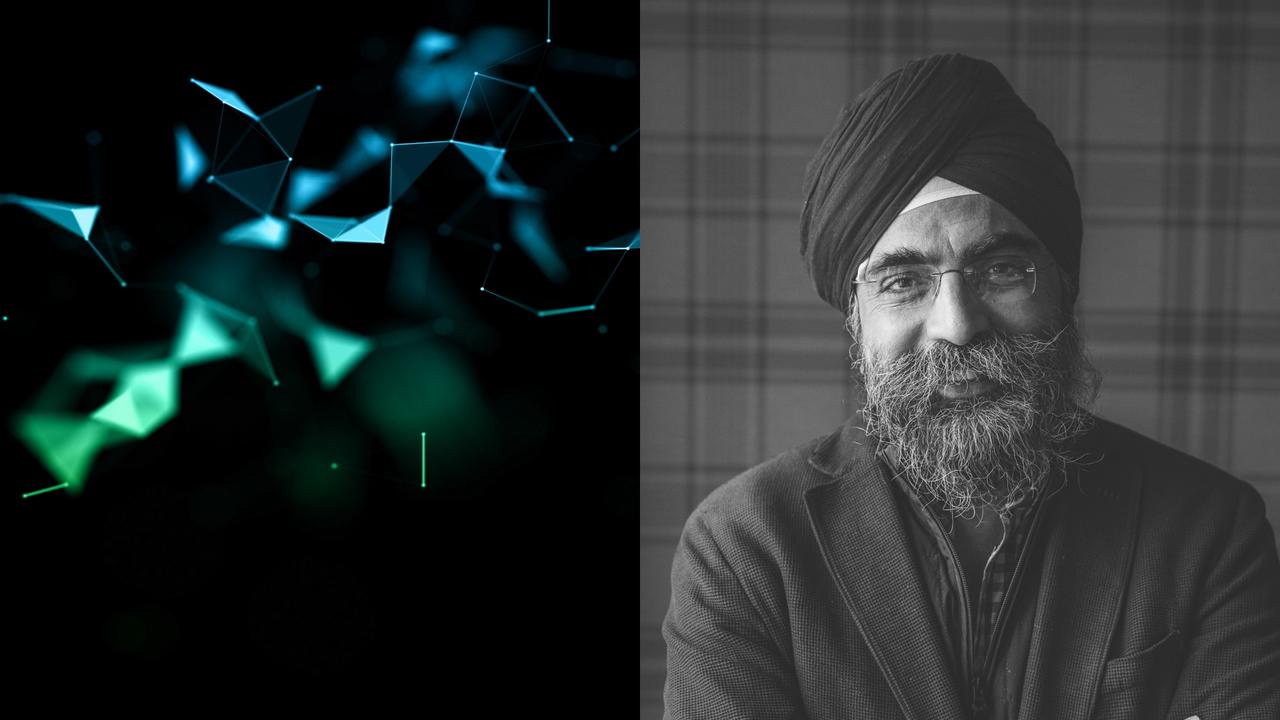
Indy Johar
Civilizational Optioneering
Recorded live on Jan 27, 02026
at Cowell Theater in Fort Mason Center
Indy Johar pointed to the first photographs of the whole Earth taken from space. “This was the moment the planet became self-aware."
This planetary consciousness came with new responsibility, he argued. The task before us is not simply to survive, but to reimagine civilization as a planetary project.
As climate and ecological instability creates extreme whiplash effects, we will find it increasingly difficult to predict, prepare, or govern at a global scale. And as artificial intelligence reshapes labor and value, Johar urged us all to reevaluate what it means to be human. So what does that require in a time of such intense, cascading volatility?
Indy’s answer is civilizational optionality: the breathing room that keeps futures open when shocks compound and our fates are systematically coupled.
As humans, we can't know everything — it's a cognitive impossibility. “But there is a beautiful liberation in accepting our partial knowing,” he said. Reframing this limitation as possibility opens us up to more curiosity and “ways of being that are about tenderness, tentativeness, and care.”
Johar imagines a future that leverages human–machine systems that expand our civilizational capacity for complex discourse and problem solving. Intelligence, in this view, is a conversational field: a meta-capacity for coordination, dialogue, and collective sense-making across sectors, species, and systems.
Climate cascades will not be local; our planetary fates are entangled. Meeting this reality demands an approach to civilization that is capable of responding to volatility and holding uncertainty.
As Johar said with a smile: “It is time to have a fucking worldview.”
watch
primer
In this talk, Indy Johar proposes that civilization’s longevity depends less on stability or efficiency, and more on optionality.
Entropy drives systems toward homogenization and exhaustion, but life acts as a counterforce, generating new pathways for becoming. Johar argues that our current economic system collapses value into singular metrics like price, which renders our systems brittle and less capable of adaptation and optionality.
To survive the long now, we must transition to an "optioneering" architecture. Our institutions and economic grammar must be redesigned to increase the surface area of future freedom, not foreclose on it. We do this by shifting away from "closed projects" with finite ends, to "open gardens" where success is measured by the system's ability to evolve and surprise us. By valuing adaptation over control, we can build a civilization capable of coherence in motion.
The Q&A for this talk will be hosted by Denise Hearn, Long Now's Director of Strategic Initiatives.
Why This Talk Matters Now
At a moment of climate breakdown and economic fragility, we find our institutions are optimized for short-term efficiency instead of long-term viability. Johar’s work offers a systems-level framework for escaping this trap. By exploring new legal and economic pathways, Johar imagines a world outside of the extractive, rivalrous logic of capitalism. His talk addresses the urgent task of rebuilding civilization-scale systems that can evolve, rather than collapse, over the long now.
The Long View
As an architect of planetary governance, Johar’s work asks a core Long Now question: how can we design institutions that preserve possibilities across generations? Through experiments in contracts, land governance, and collective “ledgers,” Johar interrogates how civilization can make generational responsibility more enforceable and relevant in our present moment.
About Indy Johar
Indy Johar is co-founder of Dark Matter Labs and of the RIBA award winning architecture and urban practice Architecture00. He is also a founding director of Open Systems Lab, seeded WikiHouse (open source housing) and Open Desk (open source furniture company). Indy is a non-executive international Director of the BloxHub, the Nordic Hub for sustainable urbanization. He is on the advisory board for the Future Observatory and is part of the committee for the London Festival of Architecture. He is also a fellow of the London Interdisciplinary School.
Indy was 2016-17 Graham Willis Visiting Professorship at Sheffield University. He was Studio Master at the Architectural Association - 2019-2020, UNDP Innovation Facility Advisory Board Member 2016-20 and RIBA Trustee 2017-20. He has taught & lectured at various institutions from the University of Bath, TU-Berlin; University College London, Princeton, Harvard, MIT and New School. He is currently a professor at RMIT University.
Learn More
LISTEN to Johar in conversation with forthcoming Long Now speaker and Council member Bayo Akomolafe.
EXPLORE the mission of Dark Matter Labs
READ about self-sovereign land in the paper Planetary Civics Inquiry: A New Framework for Planetary Futures
transcript
Rebecca Lendl
Welcome to The Long Now Podcast. I’m your host Rebecca Lendl, Executive Director here at The Long Now Foundation.
Back in 01966, Long Now cofounder Stewart Brand posed the question: “Why Haven’t We Seen a Photograph of the Whole Earth Yet?”
When that now iconic image of the whole Earth finally arrived, it gave us a new way to see ourselves: together on a single, living planet. But it also gave us a new kind of planetary self-awareness.
In today’s talk, architect/philosopher Indy Johar marvels at just how unique and precious this planetary self-awareness is — across our entire universe. Indy suggests — that it inspires our central task, not the continuity of our civilization, but rather the protection of this very rare planetary self-awareness.
So what does that require in a time of such intense volatility? Indy’s answer is civilizational optionality: the breathing room that keeps futures open when shocks compound and our fates are systemically entangled.
Preserving optionality means stabilizing foundational systems like soil, water, and energy — and building institutions that can learn fast enough to coordinate at scale.
It also asks something of us personally: a posture of partial knowing — of uncertainty as an invitation to curiosity and even tenderness as a way of being with each other and with machines.
As we like to say at Long Now, long-term thinking isn't about having the answers. It's about asking better questions.
If you find yourself with more questions after this episode, you’ll find a ton of great resources in our show notes. After the talk, you’ll get to hear a Q&A hosted by Long Now’s Director of Strategic Initiatives Denise Hearn.
Now, before we dive in, a quick note — Here at The Long Now Foundation, we are a counterweight — deepening our capacity to move wisely in these times of uncertainty. If you feel so inspired, we hope you’ll join us. Head over to longnow.org/donate to become a member and get connected to a whole world of long-term thinking.
With that, we’re excited to share with you — Civilizational Optioneering with Indy Johar
Indy Johar
Good evening. It's an absolute honor to be here. So I want to start with a thank you.
So one of the reasons I'm delighted and honored to be here is that I think this is an important moment to talk about what is a Long Now view. In a world which is increasingly becoming foreshortened and our futures become increasingly opaque, and unforeseen, and unimaginable, I think how we talk about a Long Now becomes actually increasingly critical. I would like to put forth to you that I think we're living in a moment of systemic degenerative volatility. Now this volatility is rooted in multiple factors, and I'm going to name some drivers. One of them inevitably right now is that we're heading in many ways towards climate breakdown. Which is the breakdown of predictable weather patterns to which we've been used to. And that landscape is between 2.8 to 3.1 degrees is likely the projected scenario of the world that we're living in.
What does 3 degrees global average mean? It means 5 degrees on land. It means 8 degrees warmer in your urban environments. When you put those numbers into factor that between 1.7 to 1.9 degrees, we will almost certainly lose one of the major food baskets of the world. There are five major food baskets. Remember I'm using temperature as just a proxy. It's actually climate volatility in every sense.
The one thing I'm going to put into your minds is that we often talk about these end states. People talk about 3 degrees, people talk about minus 20, plus 40, but actually the more damaging issue is the volatility that happens between now and the end point. So it's not the new stabilization positions, it's the volatility that happens.
Why is that volatility important? Because that volatility has whiplash effects in terms of actually, whether it's price, inequality, all sorts of effects, that is the period that is actually far more destabilizing. The end goal we might be able to deal with or may not be able to deal with, but the volatility period happens first.
Second, ecological breakdown. The UK government just released in the last two weeks one of the most interesting reports out there looking at the catastrophic effects with ecological breakdown its relationship to social contract.
I think what we need to keep an eye on is the relationship of those ecological effects to social contract loss. And as you lose that, you start to lose pretty much most of our assets and theories of value in society in multiple ways.
Third, we're also living in a moment of an idea of a new form of general purpose technology which can create a hegemony of power for the next 50 years. Which is creating a form of race of resources, and compute, and futures that is also creating a sense of existential competition to the point that we've never had before because of the fear it generates of a runaway power structure and a hegemony that if it's not here, it's somewhere else. And this means in real people's lives, not just the kind of conceptual problems, but the practical problems of food prices, energy prices, highly nutritious foods in the UK have gone up 82% in the last two years. So we're seeing a systematic inequality start to drive into the environment. So as we look forward into this, what you start to see is an environment that's becoming systemically fragile, volatile, fracturing into its geopolitical competition, and also weaponizable.
We're living in a moment when these risks are actually cascading into becoming existential because they're falling into cascades. One of the major cascades, if you remember 2008, there were fires around Moscow, which meant that Russia stopped the export of fertilizers. As a result, what you saw with food prices around the world go through the roof, and those food prices meant there were riots in 60 cities. And the Arab Spring was almost certainly capitalized by those situations. So you get a relationship between fires, fertilizer, all the way through the social contract.
And when you start to look at those cascades in more and more significant terms, you start to open yourself up to these pathways where we cannot stabilize the social contract. What looked like divisible environments start to become planetarily coupled. And in that moment, we reach for what I would call New Zealand strategies. And there were moments when people with significant wealth thought that you could hide in New Zealand, but it very quickly becomes very apparent that it's very difficult. New Zealand didn't have access to antibiotics, didn't have access to microchip production, didn't have access to PPP. So what you found in COVID was that actually to live outside the planetary context becomes increasingly difficult.
Denise in pre-conversations was pointing out the difficulty of even making a toaster. Forget a microchip, a toaster. So we live in this kind of delusional conversation about forced decoupling and our capacity to decouple from the planet. And whether I talk about the toaster or even a rainforest, you can't decouple a rainforest from the planet because the rainforest is fundamentally charging and transforming the atmospheric rivers that are operating across the planet. And that opens up a question about what is our strategy of operating in a planetary context.
But as we start to see this volatility. We're also seeing people becoming increasingly fragile, increasingly vulnerable in ways, and the future is becoming foreshortened. The capacity to perceive into the future is becoming increasingly difficult, and that is not just a function of intellectual capacity or anything like that. If I'm hungry today, climate change and breakdown does not matter tomorrow or in 30 years time, because I'm hungry today. So if you want to fracture a society's capacity to be able to perceive the future in a shared social contract, what you have to do is create differential risks. My risk today is hunger, well, I don't give a shit about climate breakdown because I'm going to be dead in seven days if I don't have food.
If I have only a monthly paycheck, what's your average savings? I think in the US it's less than a month and a half, I think. So that means that we have systematically, economically, foreshortened society's capacity to perceive the future. And that's making our capacity to imagine a long future systemically fragile. And we cannot create consensus or legitimacy around those frameworks. So in partial ways, we feel privileged, but the privilege is a function of this breakdown. And this opens up, for me, one of the most important questions, what are we trying to preserve? Here, I'm going to be a little bit difficult, but only as a friend.
Often the question of preservation is a very reductive conversation about what we're trying to preserve, which is the minimal viable continuity of civilization, right? Long-termism, the thesis of long-termism, you could argue if you were difficult, is about preserving the minimal viability of continuity of civilization. That is not preserving 8.5 billion people. There is an instant discount in that concept, which I think has not only horrific imaginary possibilities to it, but also legitimizes a pathway to think that way. I want to offer you a different idea, and it builds on a different way of looking at the continuity of civilization. James Lovelock's last book on Novacene I think is a beautiful book. The first third of it is extraordinary. And the way he narrates our moment, I think, sets us up for a different idea of continuity.
He would argue that the earth stored vast amounts of solar energy in hydrocarbons, and it released that energy in the formation of an 8.5 billion civilization. A civilization that was able to effectively not only talk about human, machine, and ecological civilization, and that was the release of energy. But the beautiful thing about that 8.5 billion civilization, this picture is from the 1968 Apollo. That was the moment where the planet became self-aware. The planet was able to perceive itself.
The planet had stored enough solar energy, released that to create an 8.5 billion civilization. Remember the toaster? We'd created that much capacity for the planet to take a picture of itself. That is what had been born. And so, I would argue the thing that we have to preserve is something far more precious than our idea of the civilization. But actually this idea of a planet that is becoming self-aware, to which we are party of that intelligence. And this is not a theory of ecology versus machine systems versus human systems. It's saying that is a system. Machines are as natural as humans as our ecological systems. They are part of the planet becoming self-aware. So this is the object form I'm going to put forward to you. That is the thing to preserve.
And it could be argued that might be very, very, very rare in this galaxy, let alone the universe, a planet that has become self-aware. And preserving and expanding that optionality is our objective form, not the continuity of civilization, but this other thesis. And in order to do this, the challenge becomes how do we preserve and expand this optionality? It's worth recognizing what our challenge is. We built an economic model and a social economic model that generated vast amounts of optionality, energy was used. And in this moment, it's creating externalities, and those externalities are feedbacking on itself. So these externalities are now forcing a recoupling of the planet, as well as layering an information structure on the planet, as well as a monetary system on the planet. All these things and our self-awareness, abilities to sense itself, all these compute capabilities are layering over the planet. Benjamin Bratton does a beautiful job of explaining this stuff.
What we have to do, and I think this is where the kind of things become really interesting we have to somehow preserve the optionality, the deep code optionality. We've got to regenerate those environments and we've got to transform them. Let me give you an example.
Pretty much as a result of climate breakdown, every ecological landscape will need to move 100 miles north or 100 miles south. And unfortunately, evolution won't do it for us because the speed of those transformations outstrips evolutionary capacity to make those transformations. So we're already in an environment that there is no theory of conserving our ecological systems. We are now in a relationship that we are going to have to regenerate them. Same is true for the Antarctic, same is true for the Arctic.
And I think here, when you start to look at the fundamentals, you start to see actually the preservation of optionality is going to require us to reimagine our nutrition supply. You all probably have read Professor Jem Bendell's book on soil. We are now losing, we've lost that arable land around the planet. We're about 40 cycles of agriculture away to losing significant soil damage. We are in a systemically problematized environment with regards to our nutrition landscapes. Shelter, energy stability, shared decision making capacity to name such a thing. I'll focus a little bit on shared decision making capacity. If a society cannot actually perceive, sense, sense-make, and make decisions together, it cannot preserve or manage the risk to which it's facing. So our capacity to make decisions together is a fundamental asset.
Democracy is not an overhead on the free market. It's the fundamental means to manage common fates. And I don't mean industrial democracy. I don't mean representative democracy. I mean the idea of actually agentic liberty and to be able to care and cooperate with regards to our common fates. So the tools and mechanisms have to be reimagined. What I'm talking about is soil, energy, water, nutrition, biointegrity, cognitive security. We're talking about foundations. If a society cannot perceive itself, manage itself, actually it isn't cognitively secure in itself. So what are the deep codes of those frameworks? And as I said, conservation is no longer enough. It is no longer sufficient for us to be able to say, we bounded a piece of land and it will sort itself out because of the ecological environments and environmental damage that we've already done and the climate breakdown that's already baked in, right?
We will almost certainly at best overshoot some of the limits and pull back over time. And that opens us up to how do we regenerate these common infrastructures around the world fast enough to become both resilient, anti-fragile into that future under shock. And what this opens up is the demand for a new class of technologies. I don't mean mechanistic technologies, I mean social technical frameworks and capacities in society. And one of the biggest problems that it flows up is how do you drive many to many collaboration and coordination? So the coordination technologies of being able to organize multiple agents into complexity, I think is one of the biggest fundamental challenges that we face. And that challenge is also opened up paradoxically by a capacity that we've also been building.
So if the defining coordination technology was competition as a means of coordination, I think one of the things that we have to unleash is how do we swarm innovation? How do we support multiple agents working towards shared goals of say cooling a city in a way that allows for capital and value to be organized in different formats? You could argue that machine learning capabilities are going to open up a new way for us to organize, placing learning as the means of coordination.
In a complex environment, learning opens up and expands the surface area of our ability to operate in complexity. And this is not just a paradigm of technology, it's a paradigm of the future of organizing, I would argue. 21st century organizing is going to be rooted in learning. Future of the CEO is not chief executive officer, it's chief learning officer. Being able to pattern the capacity of learning at speed of an organism is going to be its number one framework of utility. And in that framework, I think what we have to open up and build is a new class of civilization options.
And I want to illustrate what that could look like, and it's kind of a rhyme with the past. This is a bridge system that's being grown out of roots in India, and it's been built out of the root infrastructure, living roots out of tree infrastructure, biological infrastructure, human intervened and grown. Imagine this worldview for a Terra Preta worldview. Many of you will know the Amazon itself was effectively a multi-species open garden landscape. Its fertility is a function. Its hyper-biodiversity is a function of it being a gardened environment. Now imagine what happens when we talk about building agriforestry futures with precision, micromachine, autonomous machines acting as key parts of cultivating a multi-species future.
So this is not about divisibility of an ecological human and a machine future. It's about how do these futures come together and what options do they open up? How do we actually densify? The multi-species future is critical for actually improving and preserving soil strengths and soil capabilities. The multi-species capability actually provides multiple business models, value models, and contributions biodiversity, as well as the technological infrastructure that's required in a diminishing transforming labor environment where the labor provision is not certainly going to be provided by human capacities over time in an aging demographic in many parts of the world. So what is the option that it opens up?
And what I'd like to say is that this is an entirely novel landscape of possibility, and it opens up spaces of value, not just in the preservation of soil, not just in the diversification of nutrition and equal biodiversity, but also in new technologies and the capacity of those new technologies. So one of the conversations that we've been part of is saying our theory of how we think about machines is often rooted in control and certainty systems, how we conceptually perceive them. Whereas if you were to look back at someone like Decartes and read Decartes properly, I think one of the most beautiful things he says is, "I doubt, therefore I think, therefore I am." And why I prefer the doubt is that you are all incredibly bright people, at the same time, none of us can know everything. It's informationally impossible, computationally impossible.
So the only truth that you can genuinely hold is your partial knowing. It's a foundational truth. You only know partially of the world. And in that is a beautiful liberation because you must operate with a sense of doubt because your partiality of knowing is a truth. And in that doubt is an invitation of curiosity of somebody else's partial knowing. And in that doubt is a way of being, which is rooted in tentativeness, tendernessness, and care as a way of being in a complex, relatable world. Why that's important is not just for the re-imagination of what it means to be human, it's also important for a re-imagination of what we think machines are, what machines could be in a complex entangled world.
So if we use that framework to think about the world, we open up not just kind of options which are about resilience, but actually resilience, anti-fragility and pathways, which of new civilization capabilities, rooted in doubt, rooted in tentativeness, tendernessness, and care as epistemic behaviors of being in complexity. The problem space is that the problem space of operating in rich situational complexity. And actually, I would argue the technological infrastructure that we're building is allowing us to operate in learning into that situational complexity, which was a unique moment. We lived through the idea of certainty, linearity, having to simplify the world around us. Actually, we can operate in that complexity. That is an extraordinary moment. And this then opens up, I think, a series of interesting questions about optionality for whom.
One of the most profound conversations I had over the last year was somebody of significant wealth basically saying, "Over the next 30 years, given the context that we're in, I expect to lose 90% of my wealth." This was a very hyper-rational, non-morally rooted gentleman. It was a very self-interested perspective, but it recognized something really important. His wealth was fundamentally entangled to the planet. So that recognition of seeing his wealth coupled to the planet started to change his theory of how actually he had to operate in recognition of that entanglement. So expanding and preserving the optionality of the planet doesn't become a moral choice. It becomes an enlightened self-interest choice of recognizing the terminal pathways we're on.
And so at this moment in time, there isn't a divisibility problem between some and the many. Actually, we start to recognize our shared fate and we recognize the cascading failures. We recognize that actually the destruction of the social contract isn't just a piece of paper being blown apart. It's effectively about the number of sociopaths and psychopaths we create that we traumatize into the world with access to asymmetric, weaponizable technologies which we've largely democratized with bioweapons and other landscapes. We are non-divisibly linked. Our fates have become systematically coupled.
The quicker we realize that with either the mats or the enlightenment perspective, it doesn't really matter now. Those two things are so co-joining. And the cost of large scale harm, has collapsed into virtually zero. And that is forcing a coupling. And the cascades don't stay local anymore in any format, because CO2 is effectively a planetary coupling device. Our fates here become entangled with everyone else's fates.
The United Kingdom fundamentally is indivisibly entangled to the fate of the Antarctic. If we lose the Antarctic ice shelves, we talk about 65 meter rise in water levels. There is no meaningful UK. So I'm not asking for moral universal ideas of justice. I'm asking for just being smart. I'm not looking for any morality here. I think morality is a function of divisibility, separation from the planet. I'm just asking you to be self-aware and enlighten self-interest to recognize our systemic entanglements and operate in a radically new way to avoid this.
And I think optionality for everyone is because optionality breakdown is going to affect us all. We won't have a New Zealand pathway. Loads of evidence to say why that New Zealand pathway has not worked, will not work in this futures. And in this context, I think wealth and strength, as it's now often being talked about, is concentrated claim on the capacity of future making, and that's fine only in recognition of those entanglements because they're non-divisibly available. And this creates a different form of relationship of how we operate in the world. And this requires us to start to think about these foundational economies and reimagining every one of those foundational economies that I spoke about under those cascade conditions.
And again, repeating, there is no fortress pathway in a mutually assured destructive future. So our capacity to expand the option space, and it's not just the preservation of the current option space to expand the option space, otherwise we end up with a zero-sum game future, which actually will be mutually destructive, becomes really critical. So I would say, in that context, optionality is the choice of available futures to us, where we have the capacity to operate and react to uncertainty and risks in a way that we cannot perceive. And expanding that becomes a critical need.
So the question then becomes, where do we act? Right now, we're looking to lose likely most glaciers, certainly in the Alps and many parts of the Himalayas. The Himalayas is responsible for the hydrological cycle of about 3.5 billion people, with at least three nuclear powers. Remember, you don't have to wait for the end goal of losing glaciers. You have to wait for the volatility effects to be significant enough to actually violence to become the dominant way of resolving those conflicts. Atmospheric governance, more and more, it's very clearly recognizable, certainly from the UK models. If we lose the AMOC current, our capacity, most of the UK will become unfarmable because of actually the hydrological cycle will weaken so significantly. We are at the beginning of a new theory of how we govern into these environments.
How you deal with cities like Madrid, which are looking at 47 degrees temperature in middle of summer. And when we talk about these temperatures, I just want to humanize all these conversations. And some of this stuff has already happened. In fact, it happened to a friend of mine, Yost Biandaman, his close friend passed away. He hadn't slept. It was too hot at night. He got into a car in the morning and fell asleep in the car in Madrid. Or whether it's domestic abuse that increases as a result of these temperature cascades. Or whether it's actually transformers that break down, which means the continuity is whiplash effect in supply chains. Or whether it's the maintenance costs of roads and everything else. Or whether it's the IQ drops that happen as a result of the heat effects.
At the same time, what we recognize is many of these environments won't be the first movers. The hard constraint is it's very difficult to do this sort of work in the Himalayas. You may need to do it in the Alps where the need can be understood and the politics, political thickness exists to be able to build the new institutional infrastructures and the talent density to be able to do what's required. So where geographies, where risk is legible, politics can hold and talent can orchestrate, these are the locations where these futures can be built and they will need to be built at speed.
And this opens up the how question. Cooling Madrid is not a single product problem. Cooling Madrid is a multi-point intervention problem. Portfolio of interventions are required and to be innovated to deal with the cooling effect. A lot of our theory of innovation has been rooted in the theory of the startup. The challenge that we face is we're going to have to cool cities which is going to cost billions. And it's going to require multiple interventions at different landscapes, different products, different ways of measuring, different ways of actually cooling those, different ways of automating those environments, whole plethora of activities, not just for that, for glacier stabilization. It's not a single product problem.
And the bottleneck is typically organizational. So to cool Madrid isn't just about cooling Madrid, it's about actually pooling risks across multiple actors, 1,000 actors, 10,000 actors. How do you pool that risk? That allows for multiple interventions to be allocated situationally and spatially to be able to manage that risk in a spatial sense. How do you finance that? There's a wrapper problem which is fundamental to be able to organize the technologies, the physical technologies of being able to manage this reality. Here I'm going to put forward a word, ex-stitutions, not closed bounded institutions, not startups, new ways of organizing that allow us to be able to manage these large scale multi-actor problem spaces without boundaries. These are rooted in new types of capabilities, like how do you pool liabilities across mass multi-agent actors? How do you construct deep attractors for the future, recognizing and comprehending the risk, especially when the risk sometimes makes you unviable.
So one of the biggest challenges that we face, and I'm sure Denise and I will talk about this, fundamentally when you start to price some of the effects of this stuff, most of our economic enterprises don't make it through. They're non-viable. How do you construct the politics? How do you engineer the politics for these realities? How do you build an outcome accelerator, which is rooted in hitting a 7.5 degree goal of cooling a city, recognizing the innovations are yes, startup, yes, policy, yes, civic participation, yes, new forms of infrastructure, yes, new forms of supply chain innovation, which have to be coordinated to orchestrate for that goal. This requires a team of entrepreneurs working together in a different way. So one of my provocations for us here is that maybe the kind of institution of change which was in 2001 onwards, the startup, maybe this institution of driving change in the 21st century will have to be a new means of organizing rooted in a different theory.
How do you capitalize this? It's a capitalization problem of two billion to cool a city. And how do we build these forms? Everything I'm saying here isn't hypothetical analysis. Most of what I'm saying are actually pathways that we are in the process of either building with our partners and in our relationships. How do you cool Madrid in many ways is a real problem, not just for Madrid, for many cities. How do you stabilize the Alps and regenerate the water hydrological systems is a real problem for the 21st century. I think one thing I've not mentioned well enough in this conversation has been, I think one of the fundamental questions I'm holding is what's the value of being human?
And I think if we cannot transform our theory of value of being human, the value of being human is diminishing, diminishing rapidly. Return on labor has been actually stagnant, if not declining, relative to return of assets. In that reality, what we're seeing is not just a devaluation of being human, but the inability to be able to finance the education and health infrastructures relative to that diminishing value of being human. So as we transform our machine logics, which California is the center of, we need to pay equal and maybe even greater attention of what is the future value of being human and how do we build a new theory of human machine logics rooted not in certainty and opinion, but in conversation, in doubt, in curiosity. What is a new logic of organizing in that reality?
How do you finance bioregions? And not just bioregions in terms of actually one project. I mean, large scale landscapes in terms of actually soil preservation, water rejuvenation, multi-species nutrition landscapes, biomaterial landscapes, all the way through to microautonomous machines and farming infrastructure, to new provenance mechanisms, which actually are not extractive, but actually systemically generative. How do we build the capacity for societies to be able to decide together? Representative democracy, whilst great, only works with the idea of a relatively simple world or a linear world. Our ability to be able to organize in complexity is failing because we are still trying to live in a 19th century theory of decisions in a surface landscape that doesn't work.
And you've built the technology to be able to already house it. I think some of the kind of large scale learning models are opening up a new human machine landscape to be able to organize new ways of conversation, new conversational theory, which isn't rooted in valorization of opinion, but the capacities for societies to have complex discourses. What does it mean to create fertile societies? And I don't mean biological fertility, I mean societies to be able to hold fertility at a systematic level. So as I close this talk and I come close to it, what I want to say is for me, these are not theoretical conversations. These are the landscapes where I think fundamental decisions and questions will be made about how we see the 21st century. I remember many years ago, there was often these conversations about what does global governance look like? And the thing that gave me greatest sort of imagination of the future was looking back at the river Danube.
The river Danube in Europe was where international waters was born. At the conflict between 12 different nations, they gave birth to the idea of international waters. I think in the landscapes that we're talking about, in these futures that we're talking about, is our theory of governing, organizing, and capitalizing the 21st century in radical new pathways, but it's going to be found in these sites of discovery. And it's going to require us to be able to open up and imagine and work out a whole bunch of problems that we don't know how to solve. How do you understand these cascade risk? How do you put mats behind these cascade risk? How do you understand a completely different part of the equation which is often not bought into the table?
This is London numbers, the total value at risk in London just on residential property is 3.8 million homes, 668,000 is the average price of a home in pounds. That means the current total value at risk is 2.52 trillion. So when we talk about these cascading figures, we're working off the economics of that background. Not the marginal gains of growth, not the marginal gains of job discovery and losses, we're working on that scale of numbers. How do we? I've given you some examples of the critical locations where we're going to have to introduce these firebreaks. Where are these firebreaks? How do we capitalize them? How do we finance them?
How do we build machine-assisted learning infrastructures? I think the deepest revolution is going to almost certainly be in our shift of our theory of organizing in two different frameworks. Our organizing theory is rooted largely in control and instruction, recognizing humans as poor machines, two, actually learning, becoming the foundational framework and unbounded organizing being the second framework. So moving from bounded theory of corporation to non-bounded theory of organizing rooted in learning. That's the parametric move that I think we'll have to make to be able to deal with a coupling entangled world. It's not a dream, it's just the means of organizing.
How do we thicken them Markov's blankets in terms of actually giving us enough time and capacity to be able to support the pretense of that decoupling or that space and time? How do we do that? We're going to have to do that. Thicken those environments. What are the new forms of capital? Yes, what's the role of fiat money, but then also what's the role of stablecoins? What's the role of next economics around this stuff? These are all going to be opened up in many of these landscapes. And I think also stuff like the valorization of opinion or the valorization of conversation and conversation holds much greater bandwidth to be able to discuss and converse about the complexities of the world than any form of opinion. This is why I find, for example, I was often accused that, "Indy, your language is too complicated. It's great for Westminster or whatever, but it doesn't work in the real ground."
And actually, my lived reality was completely different. If you actually speak with people on the ground, I remember one 89-year-old gentleman walked up to me and said, "Hey, Indy, I didn't get every word you said, but you put words into what I was feeling." And the objective is the conversation, not the opinion. The bandwidth of what's made available as a result of that is much larger. The surface area of coordination and organization is much larger and machine-assisted capabilities are opening up a landscape of possibility, which I think will be systemically revolutionary around these things. How do we build that shared perception of risk? I go back originally to my point, if I'm hungry today, I don't have a shared perception of risk with you, and that means we have a fragmented capacity to be able to organize.
How do we pull these liabilities? How do we build an outcome accelerator? And the reason I'm saying all these questions is these are questions that we are dealing with and we don't yet have answers, right? This is my invitation to all of you. These are vast problem spaces that we are going to have to resolve and solve in different ways. And this talk for me is an invitation. And behind these questions, I guarantee you there are other questions. Forget about outcome accelerators, organizing them, term sheets, value distribution between multiple layered value points, whole bunch of questions after questions, but we are going to have to solve them. And I think this is a surface area that's going to yield vast amounts of benefits to be able to organize around that.
How do you build a deep attractors for these sorts of futures? We played with the term, what is a prophecy lab? Think about the term, the prophecy lab. Can we engineer deep attractors as we've done previously to be able to create deep attractors for a different future? What would it mean to engineer those environments? What are those conversations? What's the legitimacy around these conversations? And this is where I sort of say, we don't have pre-coded answers for this, but we certainly think these questions are valid and need to be explored and need to be capitalized. And that's some of what we're doing. We are living in a fork, a fork between mutually assured destruction and mutually assured thriving. It's not much of a choice. You know what? It's a Jurassic Park, lovely quote, "Life wants to live." Well, fucking let's live.
I think there's a genuine question about everyone everywhere Long Now, not a Long Now for the few, but a genuine Long Now for the expansion of the planet, which has become self-aware. I think that is a fucking interesting invitation for all of us. And that is the work that I think we are all holding together in many ways. With that, I'm going to thank you.
Denise Hearn
Thank you so much, Indy. Also, of all the things that we talked about, the toaster stuck. And I actually wanted to pick up on the toaster because it came up in the context of thinking about fundamental entanglements at the nation state level. And we're in a world in which politics is becoming rivalrous again, where nations are trying to re-erect borders and talk about national sovereignty. And what we were discussing was this idea that nations are essentially flows of all kinds and that it doesn't actually make sense to bound ourselves in the way that we've been bound and that we're subject to all kinds of planetary dynamics that are not governable at the nation state level.
And so I'm wondering if you can expand on that. And the toaster was essentially this idea that no one country can actually make a toaster on its own. Even though it has seven component parts, you need to source that material from a complex supply chain, the manufacturing, even something as simple as a toaster, no one nation state can do on its own. So can you talk to us about the geopolitics of this moment and how to actually assert a planetary perspective in the context of nations trying to reassert this very bounded notion of relationality?
Indy Johar
I think there's... I'll talk from a UK perspective because I'm a little bit more familiar. The UK, I would best describe the UK as a knot in global flows. It's a knot of flows. And to govern the UK, it would be a mistake to think you could govern the boundary of the UK. And if you recognize it as an interdependent knot, and like I said, UK is existentially linked to the Antarctic, UK is existentially linked to the Amazon. Any delusion that UK would survive without those ecological contributions is like just a delusion. So if we start to see ourselves in entanglement and in relationship, I think our theory of governance doesn't go from what I'd call planetary collective, but situational and relational. And the object form of the UK becomes actually in relationship to Kenyan soils, in relationship to the longevity and the mutual development of those environments, rather than an extractive relationship because it destabilizes those contexts and itself in that time.
So I think there's a third position that we often fall into the kind of... The two conversations I've witnessed even here is this idea of the universal good, like we pretend everyone's great and we sort of all act for the common good. There's been an active critique of that reality. And then the other thing is the Westphalian state, which is the bounded theory. I think there's an intermediary position, which is enlighten self-interest through a systems lens, recognizing mutual development as a pathway to stabilize your own realities as well. I think that works. I think it's available to us. I think the science supports that stuff. I think it creates a different landscape.
Denise Hearn
One of the things that struck me in your talk and that I found very compelling, was this notion of optionality. And one of the questions I had was, in thinking about the rise of our human civilization over the last even 50 to 70 years, where we have now created as you said, an 8.5 billion person civilization. That has come at the expense of the optionality of the biosphere. And we've radically reduced biodiversity. And so I'm curious to hear from you, how do we negotiate the types of optionalities? How do we negotiate between the optionalities we are creating for more humans on the one side and decreasing optionality for the biosphere on the other? And then also now with agentic capacity, how do we negotiate between the optionalities we're trying to create?
Indy Johar
I think that's perhaps the most complex question available. And it's true, right? But I also would say that I often sit in a room and somebody will say, "Well, okay, this negotiation." But the hard reality is that it's about a billion people in the world that are actually living multiple times the planet. It's about 7.5 billion, which are perfectly within planetary boundaries. And then I think when you look back at, this is why I used the example of Terra Preta and the Amazon, you start to realize that our industrial logics and our weans of organizing fundamentally are systemically deeply unproductive over time. They're efficient in terms of capital, but they're not systemically productive. So I think we are opening up a pathway where Terra Preta futures, where multi-species, open gardening, far more diversity, far more nutrition available to us in history. And with new technologies, we're able to do that at a type of scale that we could never do before and a contribution of labor which has transformed.
So I think the optionality expansion isn't just about negotiation between the lifestyles we want to lead. That's why I'm saying I think we're going to have to go back to the root level of these foundational goods and reimagine how we construct that space. So I have a kind of deep hope that there's something extraordinary available when we start to move outside the industrial logics of simplification and seeing like a state, James Scott's book of Seeing Like a State and monolithic systems as a means of making sense of the world. When we can embrace that complexity and situational variance, which I think is now technologically and bureaucratically available to us. Whether it's kind of Summer of Protocols work that's been going on, Venkatesh Rao, or like a whole bunch of other work that's been going on that's opening up these landscapes, smart contracts, open up a contingent landscape, a parametric landscape of organizing.
We are creating a whole new bureaucratic regime, which I think is able to absorb that surface area complexity and actually build much more situational variety, which we will never be able to hold historically. Even the theory of material governance, I think our mechanisms. So for example, if you have a timber house, in reality, what you have is an obligation to steward that timber for 500 years. You own the liability of the carbon stored in that house for 500 years. We haven't had the institutional frameworks outside theories of ownership and ownership includes the right of abuse and burning to be able to actually think about material stewardship chains or means of organizing that. So I think there's capabilities that are available for us to be able to organize these different forms of economy in radical new ways. And I think that sophistication, I think we'll unleash the type of optionality we've not perceived before and at different layers as well.
Denise Hearn
Could I ask you, so you shared something with us last night about all of us being bad capitalists. Can you provoke us here tonight with the same thought?
Indy Johar
There's a part of me just sits here and says, if you look at the risk profile and you look at where value sits, there is a fundamental arbitrage right now available between what we're pricing and where value and risk lies. And I'm not asking for any form of enlightenment. I'm just saying follow the numbers and the science. There is an extraordinary moment available like once in multiple generations available to be able to arbitrage where value lies and what we're pricing and they are totally out of whack. And the science is giving us the numbers. We just aren't able to absorb them because we're locked into paradigms that are actually old fashioned and unable to price them. And so, part of me is just sitting there going, "This is no longer a moral debate." I don't sit here... If I was sitting here five years ago, 2016 or whatever, it'd be like, "Hey, it would be great. Let's be better people."
I'm not asking for any inner development work. I don't think you need it anymore. The numbers of losses that we're talking about make it very evident there is a different theory of value available and what could be organized. So in a sense, I think I'm just asking us to be shit hot capitalists right now, to be able to shit hot understand that risk framework and to be able to organize against that framework in a really, really smart way. And I think that's entirely for enlightened self-interest. I'm not even also asking for any form of altruism or do goodness in a kind of... I'm just saying be smart inter-generationally, be smart as to the theory of risk and value, allocate and move.
Denise Hearn
I think the conversation we were having at breakfast today too was essentially that there are real and legitimate institutional barriers for capital owners, for asset owners, and asset allocators to recouple themselves to the economic logic that you're providing. But if you were, and I know I'm sure there are folks in the room tonight who are capital allocators, maybe you work for a family office or in venture or in some other framework, what would you advise them to do and how would they know that they're on the right path to the type of value capture that you're describing?
Indy Johar
So first thing, I think if you're institutional capital, I fully recognize institutional capital is right now bounded and structured into an all worldview at multiple layers. So this is where, I think, family offices have a unique strength because actually they can start to take a different risk profile with regards to the worldview. Second, I think I would actually have a worldview. Genuinely, I'd stop, be like, even if you're an institutional capital holder, build a fucking worldview. Because I don't think I've seen capital holders really systemically look at the risk profile and say, "How are we allocating capital and what's the impact?" And it's some of the best funds, right? Really good guys have not even done that, let alone they're not so good guys. So I think those two differentials.
Third, actually, I think the pathway of risk, like I was saying, I'm less and less, forget about when London gets to minus 20, plus 40, worry about the volatility effects. And I think there's a different risk model and I think there's work required into those risk models. Focus on the volatility and what you should be pricing against is I think the biggest worry is how fast we cascade into total value at risk and expose that total value at risk in ways that we've never talked about before. And I think those risks are all available. So I think there's work to be done around this stuff. And I also think continuity value will be really critical. So continuity of water, continuity of energy, continuity of nutrition supply, these will have high levels premium for actually stabilizing those assets.
The economics, we've been doing a lot of work around security economics, security and stability economics, there is a different economic logic that starts to become manifest in some of those realities as well. So again, none of my stuff is right now in any form of like be nice, be kind. I just think it's be smart.
Denise Hearn
I think on that point about risk, risk management is different than risk mitigation, right? And I think most of our institutions have a risk management perspective for their own portfolios or their own set of things that they're orienting around, and that's different than figuring out how to proactively invest in resilience or invest in mitigation from some of these cascading risks that you've described. And is there a way in which you can see the possibility of changing that dynamic from a kind of make sure I'm managing my own risk, i.e., my own pension fund or whatever, the liabilities that I currently have to actively and proactively allocating capital in a way that would contribute to the mitigation of the risk?
Indy Johar
I think the problem is there is no way to keep portfolio in financializing that risk with the scale that it's replicating outside. So if you just take an inward strategy, I think it's a diminishing returns and it's a demise strategy, frankly. The value is going to be about how you operate with a risk on perspective and managing external risk and being able to find leverage points into that. So I think this is a, in a way that you guys are the heart of venture capital, venture capital is fundamentally a risk-on model.
I think this is that moment for you to be proactively engaged into those risk frameworks, looking at the arbitrage between value and price in fundamentally different ways, looking at the derivative technologies that are going to be born in this reality, looking at stability as a delta function and all that reality. I think stability is going to be far more valuable than people are currently pricing as volatility increases. So I think all of these things are now available. And I think it requires us... And I'll go back to the point that was said earlier, I think it requires us to be better capitalists.
Denise Hearn
Okay. A couple of audience questions here. So this is from Joseph. What are the examples where optionality provides a first order positive influence on innovation, economics, or governance?
Indy Johar
I would say, there's a vast movement of brilliant people working around bioregionalism. I think if you look at the stability and the risk threats with regards to nutrition supply, soil loss, biointegrity losses that we're starting to see, water, other forms of... I would argue that actually restoring and rebuilding our agriforestry landscapes, our water infrastructure, our soil densities, that itself is one of the most fundamental... And I think it's... I've just talked about the effects. I'm just talking about the offtake. But actually on top of that is a whole new class of technologies and capabilities that I think are going to be really critical in being able to organize this world.
That to me is one dimension of just an explosion of not just what I would call longitudinal asset, which is the soil, or whether it's the biomaterials and the nutrition economy, or the soil and the water effects, or the fire risk management, or the derivative technologies, or the provenance and standards technologies. That whole stack of value is available. And I think that to me is one of those things where you are not only providing resilience, not only providing continuity, you're providing building anti-fragility, but also derivative technologies. That's a full stack available.
Denise Hearn
So something I'm reflecting on as I'm listening to you and to the talk is that perhaps there's a bit of a paradox in what I've heard you share, which is on the one hand that we have these new technologies, we have a new type of planetary sapiens where we have the ability or we have the capacity perhaps to move towards better management of these incredibly complex systems dynamics. On the other hand, you're encouraging us to embrace doubt and embrace a partiality of knowing. And so, I'm wondering if you can speak to that. And one of the questions here is, is doubt foundational to intelligence?
Indy Johar
Yes. I doubt, but I think... I mean, I personally... When I was reading Decartes and I was sort of like, I doubt therefore I think was a better paraphrase of what his first paragraph was, felt so structurally more interesting at every level. And I think one of the things that just kind of like has been haunting me is just this stack of logic, which is if I can't know everything, fundamentally the only awareness I can hold is my partiality of knowing. That is like, okay, I can't... That is informationally true. And once I inhabit that reality, then my curiosity of Denise or anyone here is not like, "Oh, I'm curious because I love to be curious." It's like, it's the only way I expand my partiality of knowing. And if that's true, and recognizing my partiality of knowing, tentativeness, tendernessness, and care are not like care of something, it's a way of being in the world.
Tendernessness is a way of being. You've all probably seen some of these self-learning machines, which are actually reorganized dynamically to be able to actually find ways of walking and learning, and they are finding their own path of organizing. So I think there's a way of being in complexity, which I think has fundamentally rooted in partial knowing, curiosity of learning, learning orientated coherence that becomes really interesting. So yeah, I would say I think it's a way of being. It doesn't discount us from expanding our possibility. It doesn't say that we can't know more. It doesn't remove the idea of action, but it roots the action in a theory of hypothesis, and inquiry, and question-orientated organizing, which I think is really interesting.
Denise Hearn
So is it that we can take that partiality of knowing that to me feels very intuitive at the personal level as one small being amongst 8.5 billion, but that we can imbue that within our organizations, which are themselves living complex, dynamic ecosystems that have feedback loops of learning. And that there's a way in which doubt can feature in our ex-stitutions, as you say, but in our institutions and ways that allow them to become continuously learning entities over time.
Indy Johar
Exactly. And the kind of object form becomes the conversation. So if I am partial knowing and your partial knowing, the really interesting thing is the conversation. And the conversation, if you valorize the conversation rather than the opinion, then the conversational dynamic is the means of actually intelligence. So intelligence is not my possession or your possession, it's the meta possession of the conversational field that's evolving. And I think that's much more interesting than this kind of anthromorphic internalization of intelligence, seeing it as a meta capability of the system. And that's where I think conversation for me is the unit product here.
Denise Hearn
We live in a world where planetary coordination might be more difficult as a result of being in a context of mostly monotheistic eschatologies that are based on end time salvation and a Messiah coming for us to save us one day. And so the question is, as breakdown increases, we might expect the power of these types of politics and worldviews to increase. And so how might we break through with this kind of planetary perspective that you are offering us to build really wide ranging constituencies around this shared optimism of the future?
Indy Johar
Wow.
Denise Hearn
That was from Ashoka, so you can thank Ashoka later for that one.
Indy Johar
Thank you. I'll buy you a drink. I'm sort of wide ranging, but that is going wide. So I think the way I suppose I look at this is that I come from a faith of Sikhism and what I think has made it interesting for me in Sikhism, God is not a thing out there. Everything is God. So it's a non-divisible reality to a worldview. And I think some of the problems, I think, like if you were to chart a theory of our relationship, there's a beautiful book by Sophie Strand called Flowering Wand, which talks about different theories of masculinity and pre-Arthurian masculinity and talks about the power of the one partnership societies and non-monotheic religious sun god societies. And how we had different relationship with land, different relationships of being with the planet. So I think, I mean, I would argue that we are on a course of a new form of evolution.
And I think this is why, for me, there's a kind of profound moment when I remember thinking about that blue marble picture and saying, "What if this was a planet perceiving itself?" And if you see it from that lens, I think it changes our relationship with ourselves, but also our relationship with our own divisibility for the planet. So I think there are new ways of perceiving the world. I think there's new ways of being in the world, being with the world, but also transforming our own theory of self. And maybe the way I'll take the question is that the most radical question right now is not what the future of AI. The most radical question, I think, on available is what's the future of being human. I think every revolution has almost always reinvented the idea of what it means to be human. And I think it is the underdeveloped thesis and I think there's something extraordinary available there.
And I think that's the question that I think San Francisco and California should be holding in parallel with the extraordinary work that is going on and difficult work actually in adjacent to the future of machine learning, what is the future of being human? And I think there's something magical available there. If you talk to neuroscientists, if you talk to some of the kind of work that's already going on, there's a completely different path. So between the blue marble picture of the planet perceiving itself and this kind of expansion of what it means to be human, I think there's something that may be able to break us free for some of the locks that we've got into history.
Denise Hearn
I wanted to end with a quote from Stewart Brand, he says, "None of us can save the world, but we can all set in motion a self-saving world." And I wonder if you might leave all of us with an encouragement as we leave here tonight. If there's one thing that we could do to bring about, to set in motion a self-saving world, to set in motion a world which increases optionality, which increases resilience, what would you like us to take away?
Indy Johar
I think the number one thing that sort of I would like us to walk away with is this idea that I think we're facing a fork, not a choice, and the choice is, do we want to live? And I think it's as profound and structural as that. And when you look at the world through this lens and mutually assured thriving is the only viable pathway, I think the options and the ways of perceiving the world radically change. And I would argue that you are sitting in a place of an extraordinary opportunity of being able to radically imagine into that world. I think some of the core capabilities that have been built here are going to be an essential and fundamental building block of that future. But I fear we're still trapped into the institutional forms of the 19th century with the capacity to organize in a radically different way.
So how do we organize for this world, I think, is the innovative step and the transformative step. And maybe this is where the provocation would really sit if California and San Francisco in 2001 was the birthplace as a startup as a means of organizing value. I think the question is, what is the form of organizing value in 2026? And I provoke and challenge you that I don't think it's a startup.
Denise Hearn
I love it. Thank you so much for being with us, Indy. This was phenomenal. We're so thrilled to have you and thank you all for being here tonight.
Indy Johar
Thank you. Thanks.
Rebecca Lendl
If you enjoyed this Long Now Talk, we invite you to head over to longnow.org to learn more, and of course to become a member and get connected to a whole world of long-term thinking.
Huge thanks to our generous speaker, Indy Johar, along with our guest host Denise Hearn.
And, as always, thanks to you, our dear listeners, and our thousands of Long Now members and supporters around the globe.
And appreciation to our podcast and video producers: Justin Oliphant and Shannon Breen and to our entire team at Long Now who bring Long Now Talks and programs to life.
Today’s music comes from Jason Wool, and Brian Eno’s “January 07003: Bell Studies for the Clock of the Long Now”.
Stay tuned and onward!
bio
Indy Johar is cofounder of Dark Matter Labs and of the RIBA award winning architecture and urban practice Architecture00. He is also a founding director of Open Systems Lab, seeded WikiHouse (open source housing) and Open Desk (open source furniture company). Indy is a non-executive international Director of the BloxHub, the Nordic Hub for sustainable urbanization. He is on the advisory board for the Future Observatory and is part of the committee for the London Festival of Architecture. He is also a fellow of the London Interdisciplinary School.
Indy was 02016-17 Graham Willis Visiting Professorship at Sheffield University. He was Studio Master at the Architectural Association - 02019-02020, UNDP Innovation Facility Advisory Board Member 02016-20 and RIBA Trustee 02017-20. He has taught and lectured at various institutions from the University of Bath, TU-Berlin; University College London, Princeton, Harvard, MIT and New School. He is currently a professor at RMIT University.
Join our newsletter for the latest in long-term thinking
Subscribe